Liquid argon supplies welding shops, steel and foundry operations, and laboratories whose argon demand has outgrown cylinder deliveries. This page maps our catalog to argon service by application: pure shield gas, mixed shielding blends, metallurgy and laboratory supply. Each item is sourced from a network of Chinese manufacturers, with the factory selected per destination country and design standard.
Why argon moves as liquid
Argon is produced by air separation and typically reaches steady consumers as a cryogenic liquid. Above a certain monthly volume, cylinder rental, handling and residual gas losses tend to cost more than a liquid store with a vaporizer.
Argon is also dense. A 499 L horizontal cryogenic cylinder holds 660 kg of liquid argon against 383 kg of liquid nitrogen, so each delivered vessel carries more gas. The crossover point from cylinders to liquid supply is examined in microbulk vs cylinders and in the equipment-by-gas overview.
Where argon arrives in liquid cylinders, each cylinder’s reserve can be watched remotely instead of on rounds. On cylinders with a compatible capacitive level probe, a CryoFor TM2 module takes the place of the stock electronic level gauge and reports the level, and the pressure once a separate pressure sensor is fitted, to CryoFor Telemetry, where a low-reserve alert arrives while there is still time to plan the refill.
Welding and fabrication: pure argon shield
TIG and MIG welding of aluminum, stainless steel and titanium runs on pure argon. Shield-gas purity affects weld quality directly; vacuum-insulated storage and tight transfer lines help preserve it from tank to torch.
- Vertical cryogenic cylinders — 50–500 L, working pressures 2–10 bar, with pressure build-up for direct gas draw. The usual format for workshops taking one or two vessels per week; see the liquid cylinders page.
- Horizontal cryogenic cylinder 500 L — the same duty where vertical height is limited.
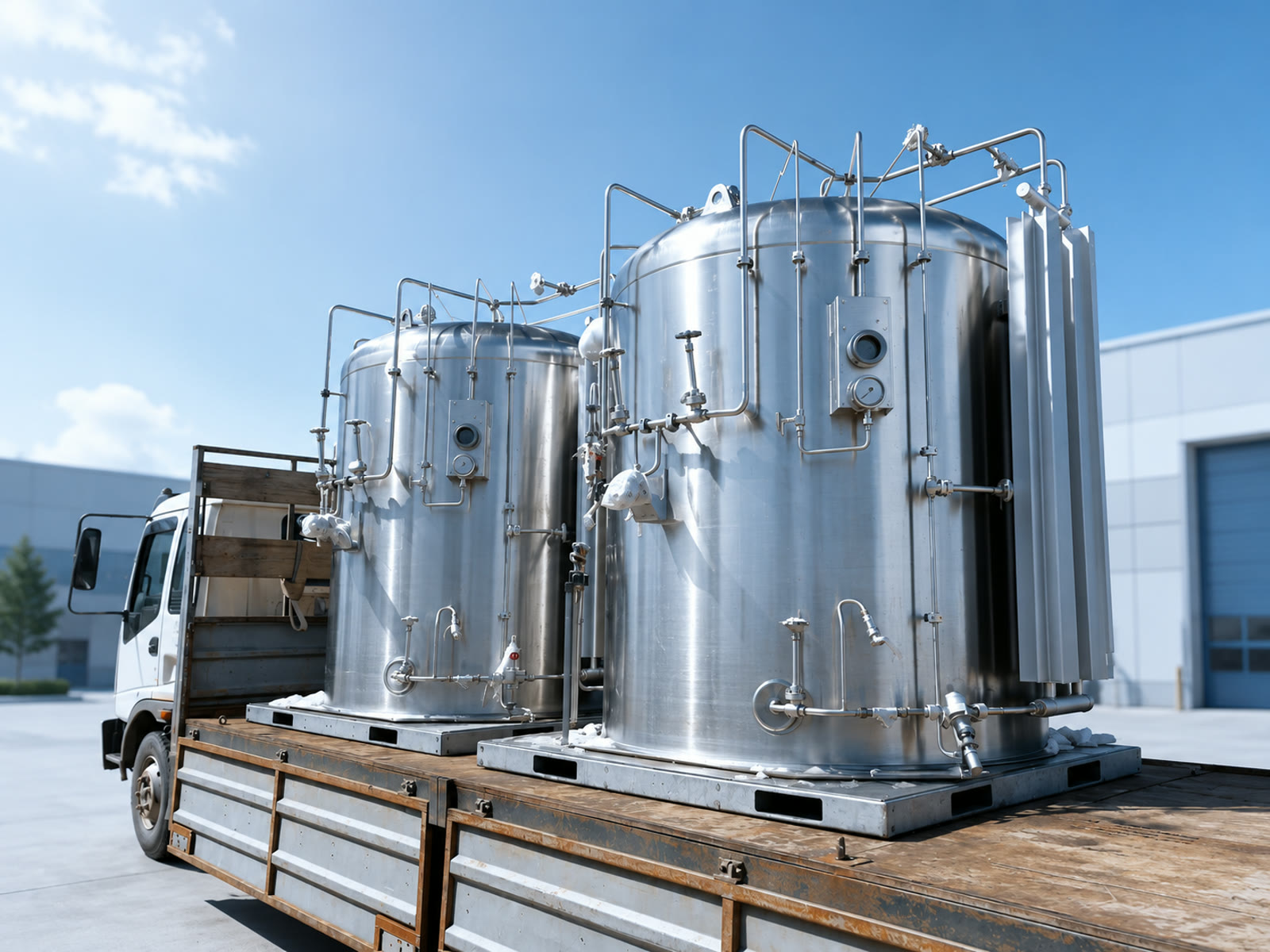
- Vertical cryogenic storage tanks — 7,990–25,000 L gross, working pressure 0.8–2.2 MPa, for fabricators consuming argon continuously. Selection logic is on the storage tanks page.
- Cryogenic vaporizers — ambient-air and heated configurations up to 500 m³/h, converting stored liquid to gas on demand. Sizing is covered in the vaporizer sizing guide.
Mixed shielding gases: Ar/CO₂, Ar/O₂, Ar/He
MAG welding of carbon steel typically runs on argon–CO₂ blends; other processes use argon–oxygen or argon–helium. Where blend consumption is steady, on-site mixing from bulk argon and bulk CO₂ replaces purchased premixed cylinders.
- Gas mixer with buffer tank — 50–300 m³/h outlet flow, mixing accuracy 0.5–1%, for Ar+CO₂, Ar+O₂, Ar+He and N₂+CO₂ service.
- Gas mixing cabinet with PLC control — 100–300 m³/h, centralising dosing, pressure regulation and operator monitoring in one cabinet.
- Gas mixture buffer tank — 600 L or 2,000 L at 0.8 MPa working pressure, smoothing line pressure downstream of the mixer.
The CO₂ side of a blend line — storage, vaporisation and gas heating — is mapped on the liquid CO₂ equipment page.
Metallurgy and heat treatment
Argon is fully inert, so it blankets molten metal and fills furnace atmospheres where nitrogen would react with the melt or the workpiece. Typical duties include steel degassing, aluminum treatment and protective atmospheres in heat treatment.
These duties draw high and often intermittent flows. A bulk vertical tank with an ambient vaporizer sized with reserve is the usual configuration; a gas heater (variants at 100–300 m³/h, working pressure 2–25 MPa) stabilizes outlet temperature under sustained draw. The vaporizers page covers configuration choices, and this comparison weighs ambient against heated types.
Laboratories and specialty gas users
Instrument-grade argon for spectrometry, glove boxes and chromatography is commonly taken as compressed gas rather than liquid. High-pressure seamless cylinders (5–50 L, 150–300 bar, typically manufactured to ISO 9809-1 — standards are confirmed per destination on the standards hub) cover distribution and point-of-use supply. Laboratories with steadier argon demand can move to a small vertical cryogenic cylinder instead.
Argon cylinder filling and distribution
Gas distributors fill high-pressure argon cylinders from a liquid store rather than buying compressed gas in.
- Cryogenic cylinder filling pumps and skids — 800–1,000 L/h flow, discharge pressure 16–25 MPa, feeding cylinder filling manifolds. Selection notes are in how to choose a filling pump and on the pumps page.
- 20 ft cryogenic tank containers — 17.5–21.13 m³ gross volume, for moving liquid argon between sites or importing it; the format is described in the ISO tank container guide.
- 40 ft ISO containers — an LNG-type intermodal container also configured for liquid argon per project; transport by road, rail and sea.
A complete argon filling line — storage, pump skid, vaporizer and manifold — is treated as one package on the gas filling systems page.
Handling note: argon settles low
Argon is colorless, odorless and heavier than air. Released gas accumulates in pits, tank bottoms and poorly ventilated rooms, and it displaces oxygen without warning. Indoor storage and enclosed workspaces around argon equipment generally call for oxygen monitoring and ventilation planned at the design stage.
Standards and destination markets
Argon vessels and mixing systems are pressure equipment. Design codes such as ASME or PED may apply, selected per destination; the standards hub outlines how we match factory and code. Country notes are collected for Australia, New Zealand, Europe, the UK and the USA, and the paperwork itself in export certification.
Scoping an argon supply system
Configurations and documentation are confirmed for the specific manufacturer, model and order before production.
Send a rough duty description — argon demand in m³/h or cylinders per week, blend requirements, site constraints and destination country — and we will return a proposed configuration with the relevant factory’s documentation set.