In cryogenic equipment purchasing, one word is asked to carry seven different meanings. A buyer requests “the certificate”, and the reply may contain a design code reference, a directive, a marking, a register entry or a folder of weld maps. These are different instruments with different owners, and blurring them is where import problems usually begin. This page defines each instrument, then shows how they combine into a compliance pathway for each destination market.
What a pressure equipment certificate actually contains
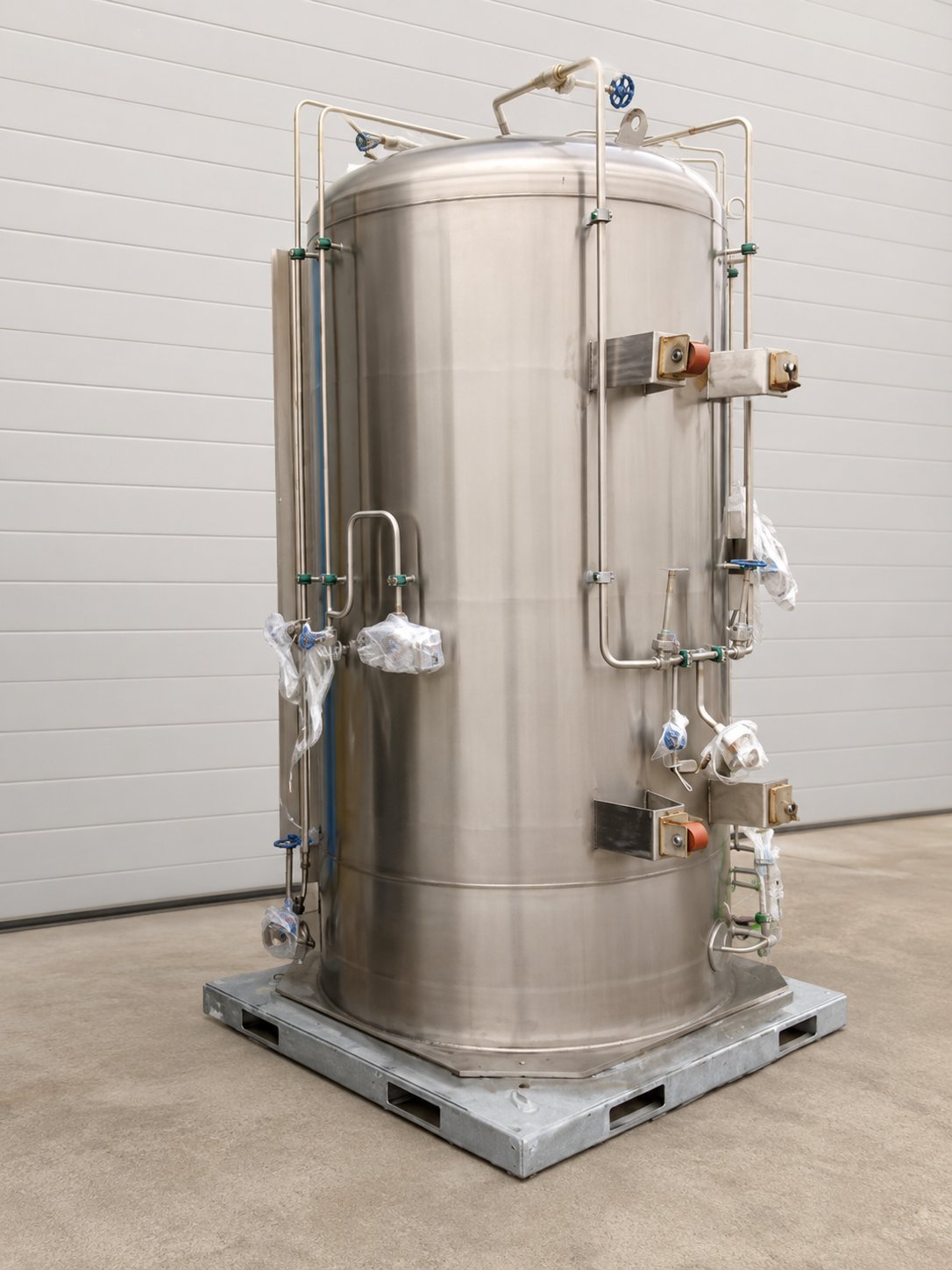
Every page in this section states plainly which of the following its subject is. The seven concepts, each illustrated on a typical vertical cryogenic storage tank, are these.
- Design standard. A technical rulebook for calculation, materials, welding and testing — EN 13445, ASME Section VIII or AS 1210. It determines the shell thickness and weld details of the tank, not its legal status in any country.
- Legal regime or directive. The law of the destination market that decides which equipment is regulated and to what degree. PED 2014/68/EU sorts a cryogenic tank into a hazard category by the fluid it holds (fluid group), its state, its pressure and its volume; it sets safety objectives and categories, not the calculation rulebook — that is the design standard’s job.
- Conformity assessment procedure. The defined process by which compliance is demonstrated — a PED module from Annex III involving a notified body, or an ASME shop certification maintained through periodic joint reviews. It is a procedure applied to a manufacturer or a product, not a document.
- Marking. The physical mark on the nameplate — CE with a notified body number, or the ASME Certification Mark with its designator. The marking is evidence that a procedure was completed, not a substitute for it.
- Equipment registration. Entry of a specific vessel or design into an official register — National Board registration in North America, or design registration with a state WHS regulator in Australia. Registration typically happens in, or for, the destination jurisdiction, and part of it may rest with the importer or owner.
- Inspection. Examination of the actual item by a qualified person or body — an Authorized Inspector witnessing fabrication under ASME, a notified body verifying a unit under a PED module, or in-service inspection years later. Inspection concerns the physical tank, not the paperwork alone.
- Technical documentation. The file behind all of the above: design calculations, material certificates, weld and NDT records, test reports, the data report or declaration of conformity. This is what actually travels with an exported tank, and it is examined in detail in our export certification guide.
Compliance pathways by market: PED, ASME and AS 1210
No market uses one instrument alone. Each combines a design standard, a procedure, a marking and, in some cases, a registration into a single pathway.
- European Union. A cryogenic tank is designed to a standard such as EN 13445, assessed under a PED module with a notified body where the category requires one, and then carries CE marking with a declaration of conformity.
- United States. A cryogenic pressure vessel is designed and built to ASME Section VIII in a shop holding the relevant ASME certificate, under Authorized Inspection, with National Board registration where the installing state requires it.
- Australia. The design follows AS 1210 within the AS/NZS 1200 framework, and depending on its hazard level may require independent design verification with design and plant registration under WHS regulation — the practical sequence is described on our Australia and New Zealand pages.
Pressure equipment standards explained: PED, CE marking, ASME, EN 13445, AS 1210
- PED 2014/68/EU — the EU legal regime for pressure equipment: hazard categories, conformity modules and the role of notified bodies.
- CE marking — what the mark on a nameplate attests, what must sit behind it, and what it does not prove.
- ASME Section VIII — the US design and construction code for pressure vessels, and the certificate-holder system built around it.
- EN 13445 — the harmonised European design standard for unfired pressure vessels, giving presumption of conformity under PED.
- AS 1210 — the Australian pressure vessel design standard, and how design verification attaches to it.
- AS/NZS 1200 — the umbrella pressure equipment standard that binds Australian and New Zealand codes into one framework.
- TPED 2010/35/EU — the EU regime for transportable pressure receptacles, and the Pi marking that goes with it.
- UKCA marking — the Great Britain conformity marking and the current CE recognition policy.
- CRN registration — Canadian provincial design registration under CSA B51.
- EAC / TR CU 032 — the EAEU pressure equipment regulation and its conformity mark.
Other regimes: UKCA, CRN and EAC marking
Other national regimes follow the same seven-concept logic with different instruments: UKCA marking in Great Britain, CRN registration in Canada, TR CU 032 with EAC marking in the EAEU, and Gulf-state schemes, which are evaluated per order. Transportable receptacles in the EU follow TPED 2010/35/EU with the Pi marking. A regime not yet listed here is a question for the enquiry stage, not an obstacle.
For explosion protection of LPG filling equipment, see Ex certification for LPG filling equipment: ATEX, IECEx and EAC.
How Cryofor matches the factory to the compliance pathway
Cryofor supplies from a network of Chinese manufacturers, not from a single factory. The destination regime is therefore an input to factory selection: where an order requires PED module assessment, a manufacturer holding current notified-body certification for that scope can be selected; where ASME construction is specified, a shop holding the relevant ASME certificate can be proposed. Certificates belong to a specific factory, production site and scope — the reasoning is set out in our supplier vetting guide. Statutory steps in the destination country, such as registration or import notification, remain with the buyer or importer; Cryofor arranges the supporting manufacturer documentation those steps depend on.
Send a rough duty description — medium, working pressure, capacity and destination country — and we return the applicable pathway with candidate factory options. Availability and applicability of any standard, certificate, marking or registration procedure are confirmed for the specific manufacturer, model and order before production.