PED 2014/68/EU is a legal regime, not a design standard. It is the European Union directive that sets the conditions under which pressure equipment may be placed on the EU market. It does not tell an engineer how to calculate a shell thickness. Design rules come from standards such as EN 13445; the directive defines the legal obligations, risk categories and assessment procedures that sit above them. Keeping that separation clear avoids most of the confusion around the word “certificate” in cryogenic purchasing.
What PED 2014/68/EU covers
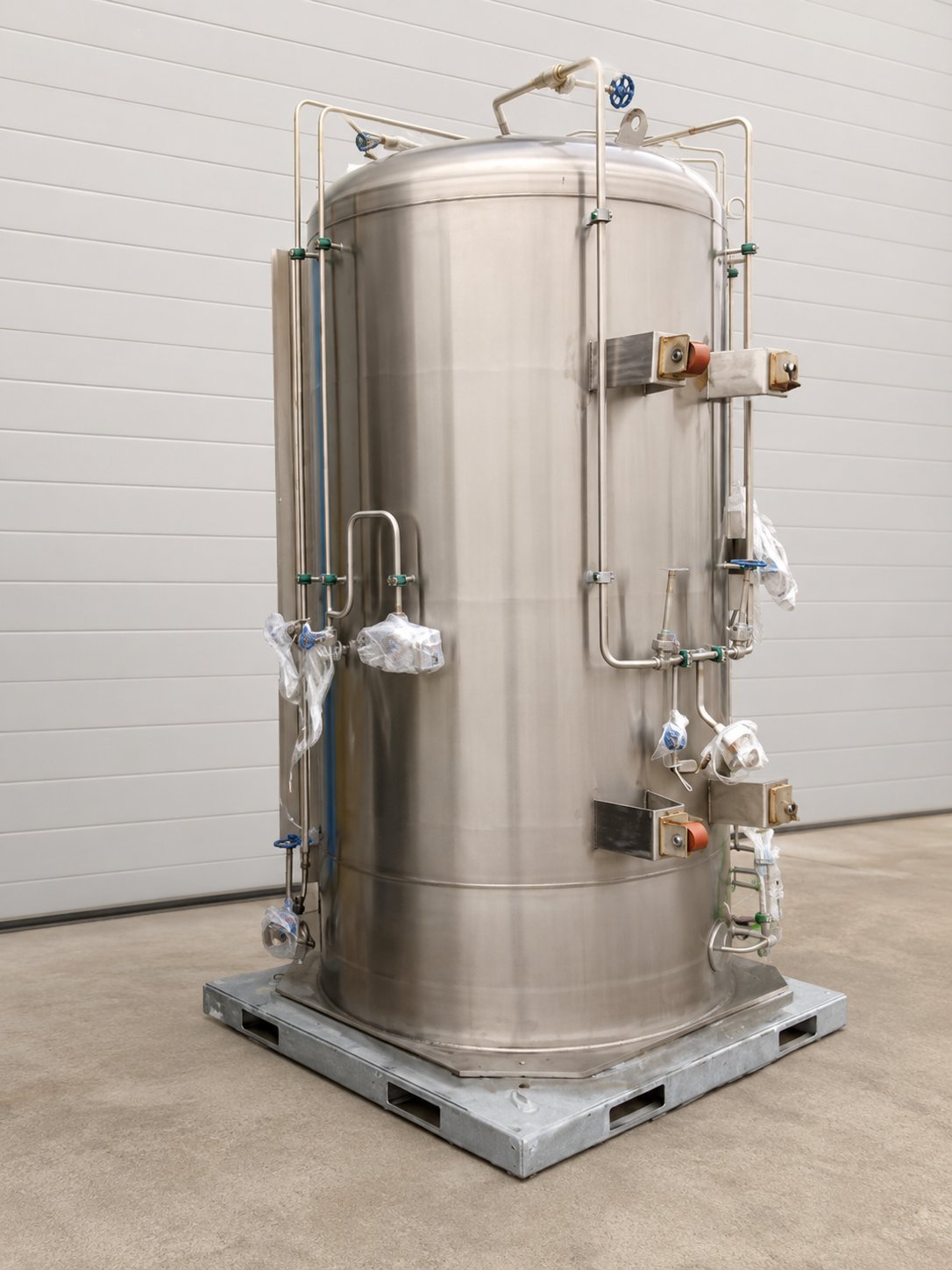
The directive applies to pressure equipment and assemblies with a maximum allowable pressure above 0.5 bar. That includes vessels, piping, safety accessories and pressure accessories. In a cryogenic scope of supply, this typically captures static storage tanks, the pressure-bearing circuits of vaporizers, station piping and relief devices. Equipment intended for transport of dangerous goods is treated separately, as described below.
PED categories I–IV: how cryogenic tanks are graded
The directive grades equipment into categories I to IV. For vessels — the case that matters for cryogenic tanks — the grading uses two inputs: the product of maximum allowable pressure and volume, PS×V, and the fluid group of the intended media. Piping is graded by nominal size DN and the product PS×DN, and safety accessories such as relief valves default to category IV unless classified with the equipment they protect. Group 1 covers fluids classified as hazardous under the EU CLP regulation — such as flammable, oxidizing or toxic media. Group 2 covers everything else.
Most cryogenic media, including liquid nitrogen, argon, helium and carbon dioxide, fall in group 2. Liquid oxygen is an oxidizing fluid and falls in group 1, which generally places the same vessel in a higher category. LNG and liquid hydrogen are flammable and are likewise group 1. The same tank geometry can therefore land in different categories depending on the intended media, so the duty is declared before assessment, not after.
Below the category I thresholds, Article 4(3) applies. Such equipment must follow the sound engineering practice of a member state, carries no CE marking under the directive, and is documented more simply. Small low-pressure items in a cryogenic package sometimes sit here.
Conformity assessment modules and the notified body
Each category maps to a set of conformity assessment modules under Annex III of the directive. Category I allows internal production control by the manufacturer alone (module A). Category II uses modules A2, D1 or E1 with limited third-party involvement. Category III combines an EU-type examination (module B) with production surveillance (D, E, F or C2), or uses full quality assurance (module H). Category IV, the highest grade, uses B+D, B+F, unit verification (module G) or H1.
For serially produced cryogenic vessels, the common patterns are module B type examination plus module D production quality assurance, or module H1 for full quality assurance with design examination. One-off or project-specific vessels can be assessed under module G, unit by unit. Module choice is confirmed per order, not assumed.
The third-party role belongs to a notified body — an EU-designated organization that examines the design, audits the quality system or verifies the unit, depending on the module. Several notified bodies operate audit programs at manufacturing sites in China, which is what makes direct PED supply from a Chinese factory possible.
Essential safety requirements and harmonized standards
Annex I of the directive lists essential safety requirements covering design, materials, manufacturing and protective devices. A manufacturer may satisfy them by any demonstrable route, but the practical route is a harmonized standard. Designing and building to EN 13445 gives a presumption of conformity with the corresponding requirements, which simplifies the notified body’s review. Compliance ends in CE marking and an EU declaration of conformity — the marking is the visible result of the directive, not a separate approval.
Transportable receptacles fall under TPED, not PED
Transportable cryogenic cylinders and dewars — closed cryogenic receptacles moved under ADR or RID transport rules — are outside PED. They fall under the Transportable Pressure Equipment Directive 2010/35/EU (TPED) and carry the Pi (π) marking rather than CE marking. Open, non-pressurized dewars sit outside both regimes — they are neither PED nor TPED equipment. This is distinct from transportable gas cylinders under TPED. A quotation that promises “CE” on a transport dewar is describing the wrong regime; the correct question is whether the receptacle is Pi-marked. See our guide to TPED 2010/35/EU.
How a Chinese factory supplies PED-category equipment
PED compliance belongs to a manufacturer and its production site, not to a trading name. A factory supplying category III or IV vessels holds current module certificates — typically an EU-type examination certificate and a quality assurance approval issued by a notified body. Each delivered item is then covered by an EU declaration of conformity, CE marking with the notified body number, and the technical documentation behind it: design calculations, material certificates, weld and NDT records, and pressure test reports.
Cryofor works with a network of manufacturers, and holdings differ between factories and models. Where an order requires PED, a manufacturer holding the relevant module certificates for that equipment type can be selected, and the documentation package is defined at the quotation stage. Statutory steps in the destination country — import declaration, installation approval, in-service inspection — remain with the buyer or importer; Cryofortune arranges the supporting manufacturer documentation. The general export paperwork behind this is described in our note on export certification for cryogenic equipment, and other regimes are compared on the standards and procedures hub.
Availability and applicability of any standard, certificate, marking or registration procedure are confirmed for the specific manufacturer, model and order before production.
If your project is destined for the EU market, send a rough duty description — media, working pressure, volume — and the applicable category and module route can be assessed against specific factories.