When you import cryogenic equipment, the hardware is only half the purchase. The other half is paperwork. A vacuum-insulated tank, a pump skid, or a vaporizer can be technically excellent and still sit in a bonded warehouse for weeks because the design code does not match your jurisdiction, or because a single certificate is missing. For engineers and procurement teams sourcing from overseas, getting the certification route for a cryogenic tank right before the inquiry stage is what separates a smooth commissioning from a costly standoff at the port.
This guide walks through what the major pressure-equipment regimes actually mean, how to compare documentation between suppliers, the mistakes that delay shipments, and a checklist you can use before you ever request a quotation.
Why ASME and CE certification decide where you can install a cryogenic tank
Cryogenic storage vessels, microbulk systems, and high-pressure monoblocks are pressure equipment. They are governed not by a single global standard but by regional regimes, and the certificate that travels with the tank determines where it can be legally installed and operated.
Three frameworks dominate international trade:
- ASME (United States and many export markets). The ASME Boiler and Pressure Vessel Code governs design, fabrication, and inspection. A vessel built to it carries the ASME stamp and a Manufacturer’s Data Report. This is the reference point in North America and is widely accepted or expected across the Middle East, parts of Asia, and Latin America.
- CE / PED (European Economic Area). In Europe, pressure equipment falls under the Pressure Equipment Directive. These are separate instruments and worth keeping apart. The directive is the legal regime: it sets safety objectives and sorts equipment into hazard categories. A harmonised design standard such as EN 13445 supplies the calculation rules. Conformity is then demonstrated through a defined assessment procedure — a module from Annex III, involving a notified body above the lowest categories. The CE marking is the mark applied once that procedure is complete, and the Declaration of Conformity is the document that declares it, backed by a technical file. One scope limit matters here: transportable equipment — cryogenic cylinders, dewars and tank containers — falls outside PED and under TPED 2010/35/EU instead, carrying the Pi marking rather than CE.
- GB (China). GB and TSG standards govern pressure vessels manufactured in China. Because much cryogenic equipment is built in China, you will often see GB-compliant fabrication as the baseline, with ASME or CE/PED added as an export configuration.
Registration is a separate step again, and it is the one most often missed. Some markets require the specific vessel, or its design, to be entered in an official register before it can be installed: a CRN in the Canadian provinces, National Board registration in North America, design and item registration with a state regulator in Australia, an EAC declaration or certificate for the EAEU. A tank can be correctly built, correctly assessed and correctly marked, and still not be installable until that entry exists.
Who does what matters just as much. Construction, conformity assessment, marking and the technical file sit with the manufacturer. Registration, import notification and in-service inspection are statutory duties on the buyer, importer or owner in the destination country — they cannot be transferred to a supplier by agreement, however helpful that supplier is. What a supplier can do is arrange the manufacturer documentation those steps depend on, and confirm before production that the intended factory can actually produce it.
The practical takeaway: ASME and CE/PED certification are not interchangeable. A vessel stamped only for one regime is not automatically admissible in another. Decide your destination market first, then specify the code, not the other way around.
How to compare documentation between suppliers
Two quotations for the same vacuum-insulated tank can look identical on price and capacity yet differ sharply on what arrives in the document folder. When you compare suppliers, evaluate the paper trail as rigorously as the steel.
Ask each supplier to confirm, in writing, which of the following they provide:
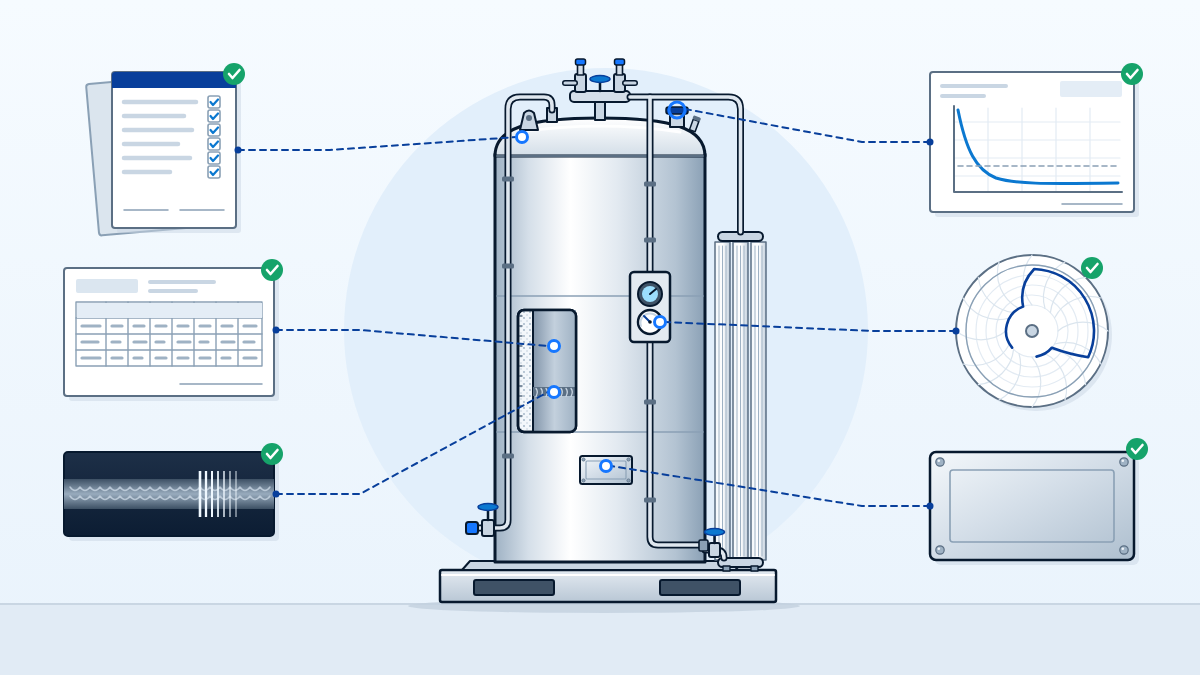
- Design code and certificate of conformity for your target market (ASME stamp and Data Report, or CE Declaration of Conformity with Notified Body number, or GB documentation).
- Material certificates (mill test certificates / EN 10204 3.1 type records) for the pressure-retaining components.
- Welding and NDT records — welder qualifications, procedure specifications, and non-destructive examination results for the welds.
- Pressure test report confirming the vessel was tested at the specified pressure.
- Vacuum and performance data for vacuum-insulated equipment, since insulation quality directly affects boil-off and holding time.
- Nameplate and traceability data matching the certificates to the serial number physically on the tank.
A capable export-focused supplier treats this as routine. Cryofortune, for example, supplies cryogenic storage, vaporization, transfer, and filling equipment configured to the operating duty, with export documentation support, so the certification set is matched to the destination rather than assembled as an afterthought. That alignment between hardware specification and paperwork is exactly what you are testing for when you compare vendors.
Common documentation mistakes that delay shipments
Most customs and commissioning delays trace back to a handful of avoidable errors. Watch for these before money changes hands.
Specifying capacity but not code. Buyers frequently lock in volume, working pressure, and gas service while leaving the design code vague. The factory then builds to its default domestic standard, and the certificate does not match the import requirement.
Assuming one certificate covers a system. A cryogenic installation is rarely a single vessel. Pumps, pump skids, vaporizers and gas heaters, cryogenic cylinders, automatic filling systems, multi-ramp assemblies, valves, regulators, and gas analyzers may each carry their own conformity requirements. Confirm coverage component by component, not just for the headline tank.
Mismatched commercial and technical documents. The model, serial number, and specification on the certificate must agree with the commercial invoice, packing list, and the physical nameplate. A discrepancy as small as a transposed serial number can trigger an inspection hold.
Ignoring gas-service implications. Documentation for a vessel intended for oxygen service is not the same as for an inert-gas vessel; cleanliness and material declarations differ. State the intended gas service explicitly so the right records are issued.
Leaving telemetry and accessories undocumented. Modern systems often include add-ons such as Wi-Fi telemetry modules that report liquid level, and pressure where a sensor is fitted, on a set schedule. These are easy to omit from the technical file even though they form part of the delivered scope.
What “export documentation support” should actually include
The phrase appears on many supplier websites, so press for specifics. Genuine export support means more than emailing a PDF after production. At minimum it should cover:
- Selecting the correct design code for your destination at the configuration stage, not after fabrication.
- Issuing the full conformity set — certificate, material and weld records, NDT and pressure-test reports — in a language your authorities accept, which for international trade usually means English.
- Providing accurate commercial documents (invoice, packing list, and any certificate of origin) that reconcile cleanly with the technical file.
- Confirming HS classification so the declared goods match what is shipped.
A supplier that handles English-language sales and structures configuration around the destination duty and code regime removes most of the friction that strands shipments at the border. This is the level of support a serious importer should expect, and the absence of it is a red flag regardless of unit price.
A pre-inquiry selection checklist
Run through this before you send your first message to a supplier. It forces the decisions that, made early, prevent the expensive surprises later.
1. Define the destination market and therefore the required code: ASME, CE/PED, GB, or a combination. 2. List every component, not just the main vessel, and note which need independent certification. 3. State the gas service for each item so material and cleanliness records are correct. 4. Specify capacity, working pressure, and performance (including boil-off or holding expectations for vacuum-insulated equipment). 5. Request a sample documentation package for a comparable unit so you can inspect format and completeness before ordering. 6. Confirm language and reconciliation — certificates and commercial documents in English, matching serial numbers and specifications. 7. Verify accessories are in scope, including telemetry, valves, regulators, and filling components. 8. Agree on responsibilities for inspection, classification, and any third-party witnessing up front.
Working through this list turns a vague request into a precise specification, and a precise specification is what allows a manufacturer to quote accurately and certify correctly the first time.
Closing
Certification is not a formality bolted on at the end; it is a design decision you make at the start. Choosing the destination market, the correct code, and a supplier who can produce a complete, reconciled documentation set is what makes the difference between equipment you can commission on schedule and equipment that becomes a customs problem. Treat the document folder as part of the deliverable, and most of the risk in importing cryogenic equipment disappears.
If you are scoping a project and want to understand how an export-focused supplier structures configuration and documentation for international delivery, learn more about Cryofortune and the cryogenic equipment it supplies worldwide.