Cryofor sources cryogenic storage, vaporization, and transfer equipment for Australian buyers from a network of Chinese manufacturers, selected per order rather than tied to one factory. Australia regulates imported pressure equipment through its own design, verification, and registration framework, so the manufacturer is proposed to suit that framework, with suitability confirmed per order. The network exists to match a factory to the compliance pathway, not to move every order through one production line.
Cryogenic storage tanks, liquid cylinders and vaporizers supplied to Australia
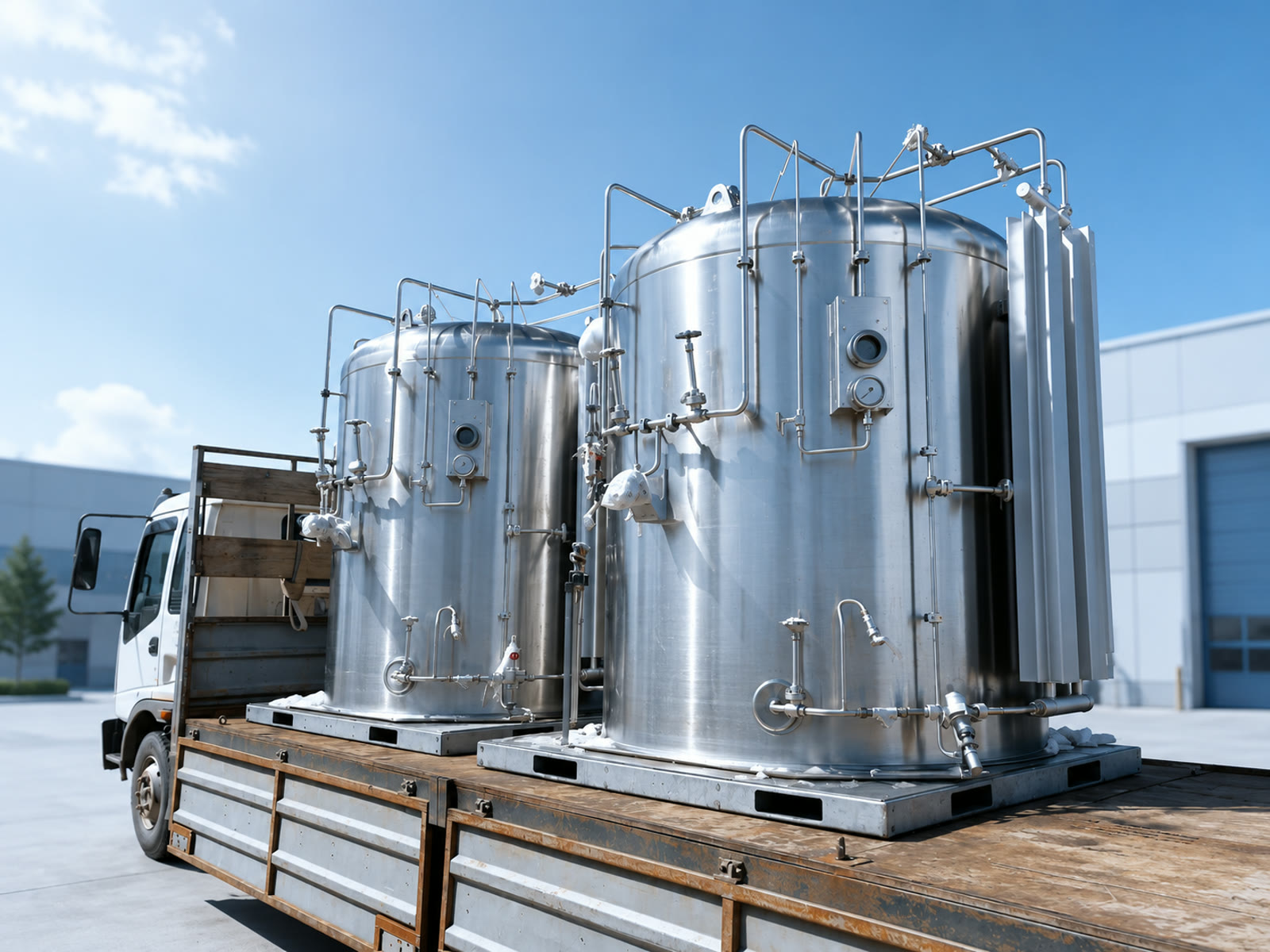
The supply scope covers vertical cryogenic storage tanks for bulk LOX, LIN, LAr and LCO2, vertical liquid cylinders and horizontal microbulk vessels, ambient air vaporizers, cryogenic filling pumps, liquid nitrogen dewars, ISO tank containers, dry ice pelletizers and storage containers, and gas mixing equipment. Each item is configured by duty — media, capacity, working pressure, and outlet flow — and matched into a supply station rather than sold as a standalone catalog box.
Typical Australian buyers include gas distributors building bulk and microbulk installations, wineries using nitrogen for sparging and blanketing, food and beverage plants freezing or carbonating with LIN and LCO2, metal fabrication and mining operations drawing oxygen and argon, laboratories and biobanks storing samples in nitrogen, and healthcare facilities planning oxygen supply. Buyers comparing packaged supply against cylinder swaps can start with the guide on when to move from cylinders to microbulk.
Australian standards and registration requirements that may apply
Australia treats a design standard, a conformity procedure, a registration, and an inspection as separate steps. Keeping them separate is the practical basis for planning an import, so the framework is summarized here in those terms.
Design standard. Static vacuum-insulated cryogenic tanks are pressure vessels. The default Australian design code is AS 1210, applied within the umbrella standard AS/NZS 1200, which also lists accepted international codes such as ASME BPVC Section VIII and relevant EN codes. A vessel does not have to be designed to AS 1210, but the design code used must be acceptable under this framework, and South Australia is noted as accepting only codes specified in AS/NZS 1200.
Hazard classification. AS 4343 assigns each item of pressure equipment a hazard level from A (highest) to E (lowest), based on design pressure, volume, and the contents. The hazard level, not the product type, determines how much of the registration regime applies.
Design verification and design registration. Equipment at hazard level A to D generally requires design verification by an independent, competent verifier, and registration of the design with a state or territory WHS regulator such as SafeWork NSW, WorkSafe Victoria, or WHSQ. A design registered in one Australian jurisdiction is generally recognized in the others. Hazard level E equipment does not generally require registration.
Item registration and marking. Vessels at hazard level A to C generally also require item-of-plant registration in the state of installation, with exceptions for gas cylinders, serially produced vessels, and LP Gas automotive vessels. Victoria is generally described as applying design registration only; the requirement is confirmed for the state of installation per project. The design registration number is expected on the vessel nameplate, so nameplate content is part of the order specification, not an afterthought.
Transportable receptacles — a different track. Transportable cryogenic cylinders and dewars generally follow the gas-cylinder regime under the AS 2030 series and the ADG transport code rather than the AS/NZS 1200 vessel track — though cylinder designs are still registrable plant designs under the WHS framework. Classifying each product correctly before ordering avoids applying the wrong compliance path.
Installation and in-service inspection. Installed tanks may also need to meet siting and storage standards — AS 1894 for non-flammable cryogenic liquids and AS 3961 for LNG — and in-service inspection practice under AS/NZS 3788. Which of these applies depends on the media, the hazard level, the state, and the installation; exact requirements are confirmed with the relevant state regulator per project.
How Cryofor selects the manufacturer for an Australian order
Cryofor works with multiple Chinese factories and selects one per inquiry rather than routing every order to the same production line. For an Australian duty, the selection criteria are practical: whether the factory designs to AS 1210 or to an ASME or EN code acceptable under AS/NZS 1200, whether its documentation supports independent design verification, whether third-party inspection during manufacture can be arranged, and whether it has prior export experience with equipment registered in Australia. Factories that do not appear able to support the required verification and registration path are screened out during selection; whether a specific factory, model, and documentation set can support that path is confirmed for the specific order before production. The vetting logic is described further in how to vet a cryogenic equipment supplier in China.
Technical documentation for Australian design verification and registration
Depending on the manufacturer selected and the order scope, the documentation package can include design calculations to the declared code, general arrangement and detail drawings, material certificates, weld procedure and NDT records, pressure test reports, and a manufacturer data report. Documentation is assembled with the Australian design verification and registration steps in mind, so the verifier and the regulator can be supplied with the inputs they typically request. Sufficiency for verification and registration is assessed by the verifier and the regulator; the scope of each package is agreed before production. An overview of typical export routes is given in cryogenic equipment export certification.
What the Australian buyer or importer may need to arrange locally
Under the WHS framework, if the overseas designer or manufacturer has not registered the design, the registration duty falls to the importer. In practice the Australian side may need to arrange design verification by an independent, competent design verifier, design registration with a WHS regulator, item registration in the state of installation where the hazard level requires it, and siting compliance for the installed system. Cryofor does not perform these local steps; it prepares the design documentation, verification inputs, and manufacturer data with the aim of minimizing repeated requests back to the factory. Budgeting for a project can start with the cryogenic storage tank price guide.
New Zealand applies a related but separate regime under the PECPR Regulations 1999, with design verification and certificates of inspection issued by recognized inspection bodies. New Zealand orders are scoped against that framework and are covered separately; as with Australia, local verification and certification steps are arranged on the New Zealand side.
Confirming certification and registration before an Australian order
Certificates, approvals, and registrations belong to a specific factory, production site, model, or project — not to a supplier network as a whole. Cryofor can propose a manufacturer whose design-code experience and documentation can support the Australian verification and registration path for a given duty; any approvals or certificates are specific to that manufacturer, model, and order. The availability and applicability of any standard, certificate, marking, or registration procedure are confirmed for the specific manufacturer, model, and order before production.
To start, send a rough duty description — gas, capacity, working pressure, flow, and the state of installation. Cryofor replies with a configuration proposal, the suggested manufacturer profile, and the documentation scope for review.
Choosing a supplier for Australia: the registration checklist
For Australia the deciding step is design registration: pressure equipment put into service is design-verified and registered under the state and territory WHS regulations (WorkSafe bodies), with AS 1210 as the reference pressure-vessel standard and AS 1894 governing the siting and handling of cryogenic liquids. Vessels designed to recognized international codes such as ASME Section VIII or EN 13458 are commonly accepted through design verification. Before ordering, confirm four things: who performs the design verification, that the design will be registered for your state, the document pack (material certificates, weld qualifications, NDE and pressure-test certificates, data book), and English-language operating documentation.
Common questions
Does an imported cryogenic tank need Australian registration?
Yes. Pressure equipment put into service in Australia goes through design verification and registration under state and territory WHS regulations before operation, regardless of where it was manufactured.
Are ASME or EN designs accepted in Australia?
Commonly yes — vessels designed to recognized codes such as ASME Section VIII or EN 13458 are accepted through the design-verification route against AS 1210 requirements. Confirm the verification path per order.
What documents should arrive with the vessel?
The design-verification statement, material certificates, welding qualifications, NDE reports, the pressure-test certificate and the data book — the set the registering authority and your verifier will ask for.