Sourcing cryogenic and industrial-gas equipment across borders is a different exercise from buying off a domestic catalogue. Lead times stretch, documentation requirements multiply, and the cost of a wrong specification is paid in customs delays, failed inspections, or a vessel that cannot legally enter service in your market. For an engineer or procurement lead evaluating a cryogenic equipment supplier in China, the decisive work happens before the first inquiry email: understanding what you actually need, what a credible manufacturer looks like, and which questions separate a genuine producer from a trading intermediary.
This guide walks through how to vet manufacturers, compare options on the factors that matter, and avoid the mistakes that most often surface after the purchase order is signed. It is written for buyers who want to make a confident technical decision, not a price gamble.
Understand the Equipment Scope Before You Inquire
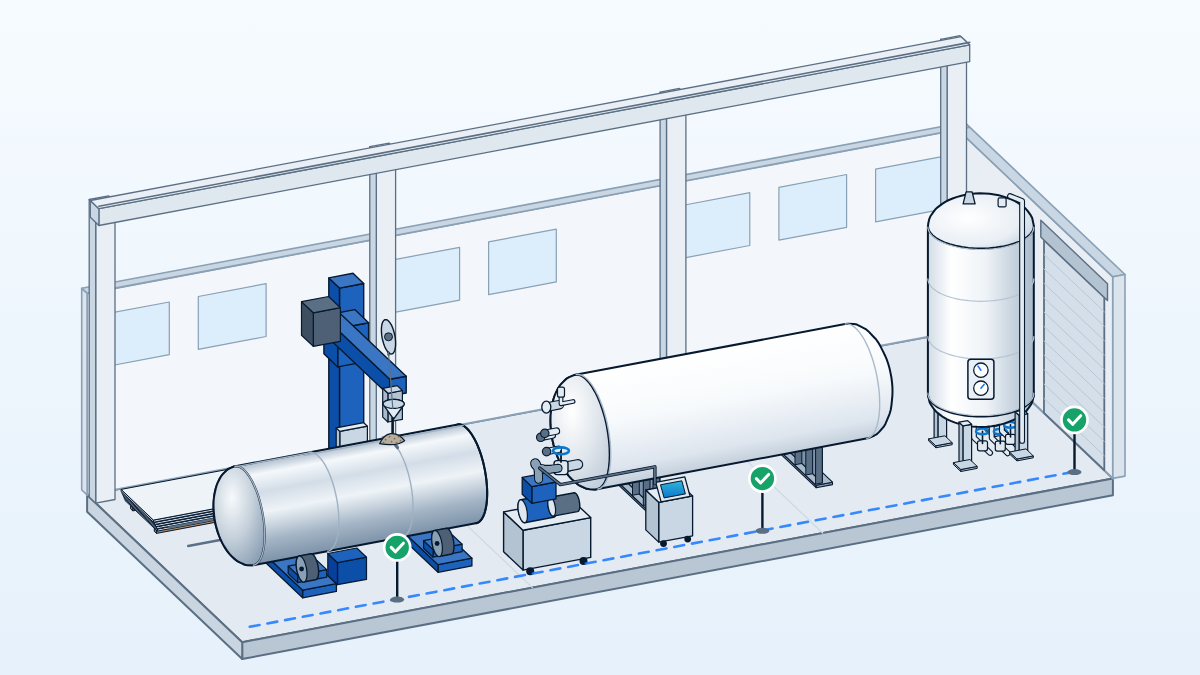
Cryogenic supply is not a single product — it is a system. A manufacturer’s catalogue tells you whether they can support your whole application or only a slice of it. A full-line cryogenic equipment supplier in China typically spans several interrelated categories:
- Storage: vacuum-insulated tanks and storage vessels, plus microbulk systems for smaller, decentralised consumption points.
- Containment and distribution: cryogenic cylinders, high-pressure cylinder monoblocks, multi-ramp assemblies, and cylinder racks.
- Transfer and conditioning: pumps and pump skids, gas heaters, and automatic filling systems.
- Control and accessories: valves, regulators, hose fittings, and gas analyzers.
- Monitoring: CryoFor TM2 Wi-Fi telemetry modules that report liquid level on a set schedule, and pressure once a sensor is fitted, for refill planning.
Before contacting anyone, map your own requirement against this scope. Are you buying a single storage vessel, or a filling station that needs pumps, heaters, and a control package to function as one unit? Suppliers who handle the full chain — from storage through vaporization, transfer, and filling — reduce the integration risk that arises when components from different vendors do not match. Knowing your scope up front also lets you tell, in the first conversation, whether the company understands the whole chain or is quoting parts of it blind.
Verify Accountability, Not Just Who Owns the Factory
The useful question in cross-border sourcing is not whether a company owns the welding shop — it is whether anyone will answer for the engineering when something goes wrong. Two models can both work. A factory selling direct gives you one production line and deep knowledge of it. A sourcing and engineering supplier gives you a choice of production lines, and has to prove it can choose correctly. Both fail the same way: when the supplier will not say where the equipment is actually made, cannot answer a technical question without relaying it, or treats documentation as an afterthought. Opacity is the risk, not the business model.
Concrete checks to run:
- Ask for the registered legal entity and how the equipment is actually produced. A trustworthy supplier states this plainly. Cryofortune Engineer & Supply Co., Ltd., for instance, is based in Foshan, Guangdong, and is transparent that it operates as an international sourcing and engineering supplier — matching each order to a manufacturer selected from a vetted network in China, rather than claiming to build every model in-house (see how Cryofor selects a manufacturer for each order).
- Request the product range in the supplier’s own words and ask where each item in it is made. A direct manufacturer should name its own production site; a sourcing supplier should name the factory behind each line and explain why that factory was chosen for your destination. Either answer is acceptable — being unable to give one is not.
- Probe engineering depth. Pose a specific technical question about your application. What matters is whether the answer comes back from design knowledge and comes back quickly — not the job title of whoever holds the drawings.
- Confirm export experience directly. An export-focused supplier should offer English-language sales and structured export documentation support — not improvise it once your order is placed.
A supplier that communicates clearly in your language and treats documentation as a standard part of the transaction is signalling that cross-border trade is core to its business, not an occasional sideline.
Match Specifications to Your Market’s Codes and Conditions
Cryogenic equipment is governed by pressure-vessel codes, and those codes differ by destination market. A vessel built to one standard may not be accepted for installation or operation in another without the correct certification and paperwork. This is where many import projects stall.
Do not accept a specification at face value. Define, in writing, the standard your jurisdiction requires for storage vessels, cylinders, and high-pressure monoblocks, then ask the supplier to confirm — in the quotation — that the equipment will be built and documented to meet it. The same discipline applies to the gas service: equipment for cryogenic liquids must be specified for the exact medium, temperature, and working pressure of your application, with materials and seals selected accordingly.
Clarify operating conditions too. Ambient temperature, altitude, electrical supply, and local installation practice all influence pump skids, gas heaters, and automatic filling systems. A supplier that asks these questions before quoting is engineering for your site; one that quotes a generic unit without them is leaving the fit to chance.
Insist on Export Documentation and Clear Communication
For an import, paperwork is part of the product. Incomplete or inconsistent documentation is one of the most common — and most avoidable — causes of customs holds, inspection failures, and delayed commissioning.
Establish before ordering exactly which documents the supplier will provide and in what language: commercial invoice and packing list, certificates and test reports tied to the relevant code, material traceability where required, and the technical manuals your operators and inspectors will need. A capable cryogenic equipment supplier in China treats this as routine. Cryofortune, for instance, frames its mission around reliable supply, clear documentation, and calm export communication — a reasonable benchmark for what to expect, because the discipline behind the paperwork usually reflects the discipline behind the engineering.
Communication quality is itself a diagnostic. Prompt, precise, English-language replies that engage with your technical detail indicate a supplier organised for export. Vague or slow responses during the quoting stage rarely improve after money has changed hands.
Common Mistakes Export Buyers Make
A few recurring errors account for most disappointing outcomes:
- Selecting on headline price alone. The lowest quote often omits documentation, the correct code, or accessories your system needs to operate — costs that reappear later, frequently larger.
- Specifying components in isolation. Ordering a tank without confirming compatible pumps, heaters, valves, and controls leads to integration gaps that surface only at commissioning.
- Treating certification as an afterthought. Confirm code compliance and documentation up front; retrofitting paperwork onto a finished vessel ranges from costly to impossible.
- Overlooking monitoring and replenishment. If your operation depends on uptime, factor in telemetry — liquid level reported on a set schedule by the CryoFor TM2 Wi-Fi module, and pressure once a sensor is fitted — at the specification stage, not after installation.
- Assuming a trader is the manufacturer. Verify the producing entity so warranty, spares, and engineering support trace back to one accountable party.
A Practical Selection Checklist
Use this short checklist when comparing suppliers:
1. Scope fit — Can the supplier deliver, and account for, the full system you need, from storage through filling and accessories? 2. Manufacturer verified — Confirmed legal entity, and either an in-house facility or a disclosed, verifiable manufacturer relationship, with clear engineering accountability. 3. Code compliance — Equipment built and documented to your destination market’s standard, stated in the quotation. 4. Gas and conditions matched — Specified for your exact medium, pressure, temperature, and site. 5. Export documentation — Complete document set confirmed in writing, in your language. 6. Communication — Responsive, technical, English-language engagement during quoting. 7. Monitoring and support — Telemetry options and a clear path for spares and after-sales questions.
Working through this list before you inquire turns a vague RFQ into a precise one — and lets you judge each supplier on engineering substance rather than sales claims.
To see how a full cryogenic and industrial-gas equipment range is structured for export buyers, you can review the Cryofortune company and product overview. Cryofortune supplies this equipment worldwide with export documentation support.