New Zealand regulates pressure equipment through one national framework, administered by WorkSafe New Zealand under the Health and Safety in Employment (Pressure Equipment, Cranes, and Passenger Ropeways) Regulations 1999 — the PECPR Regulations. For pressure equipment there is no government design register and no plant item register. Compliance is carried instead by a chain of certificates issued by recognised inspection bodies, running from design verification through to the Certificate of Inspection that permits operation. Cryofortune Engineer & Supply Co., Ltd. supplies cryogenic equipment from a vetted network of Chinese manufacturers, and can structure a New Zealand order around that certificate chain, not around the shipment alone.
PECPR 1999: one national pressure equipment regime, verified by recognised inspection bodies
Under the PECPR Regulations, a pressure vessel is broadly any unfired vessel operating above 50 kPa, which captures cryogenic storage tanks. Vaporisers and interconnecting lines are typically captured as pressure equipment too — as pressure vessels, pressure piping or pressure fittings — under the same 50 kPa threshold. The Approved Code of Practice for Pressure Equipment recognises AS/NZS 1200 with AS 1210 as the primary design route, alongside ASME Section VIII and PD 5500.
The structural difference from Australia matters for planning. Australia requires design registration and, in most states, item registration with a government regulator, as described on the Australia country page. For pressure equipment, New Zealand requires neither. Conformity is certified privately: WorkSafe recognises inspection bodies accredited to ISO/IEC 17020, and each body keeps its own register of the designs it verifies and the items it inspects. The certificates, not a registration number, are what a New Zealand buyer must be able to produce.
Cryogenic tanks, vaporisers, dewars and dry-ice equipment Cryofor can supply
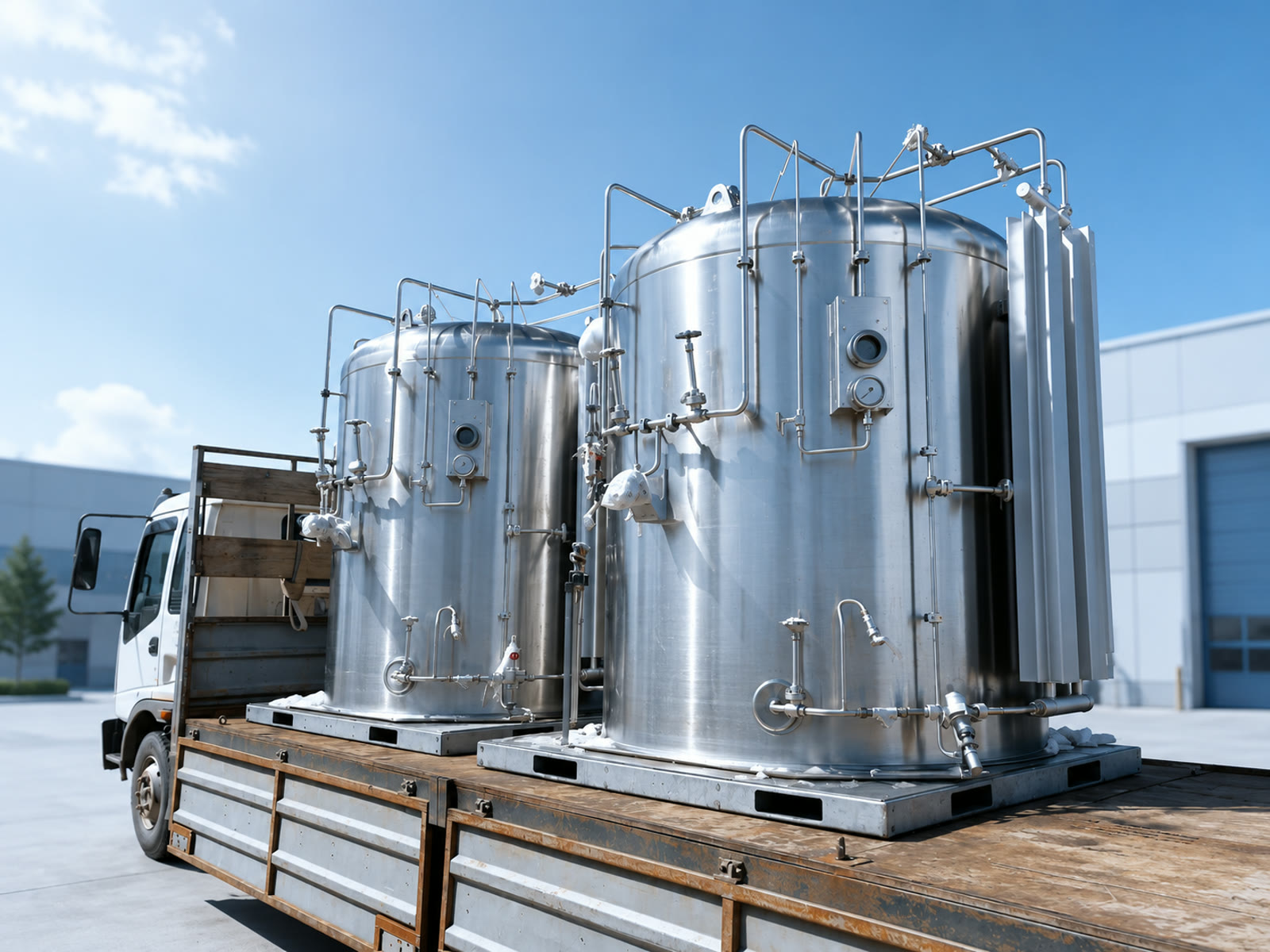
The core scope is bulk and packaged cryogenic supply. Vertical cryogenic storage tanks hold liquid oxygen, nitrogen, argon, carbon dioxide or LNG at site scale. Ambient cryogenic vaporisers convert stored liquid to gas at the duty flow rate. Liquid cylinders in 175 to 500 litre configurations cover workshops, breweries and clinics between dewar and bulk scale. 20 ft cryogenic tank containers and ISO tanks move liquid product into and around the country. Liquid nitrogen dewars run from laboratory and on-farm sizes up to self-pressurised transport vessels. Dry ice pelletisers, dry ice storage containers and CO2 heaters extend the same sourcing model to dry-ice production.
The duty profiles behind New Zealand enquiries are distinctive. Dairy artificial breeding runs on small on-farm nitrogen dewars and depot storage, refilled on a seasonal cycle. Wineries in Marlborough, Hawke’s Bay and Central Otago use CO2 and nitrogen for blanketing and sparging. Seafood and meat exporters use liquid nitrogen for flash freezing and dry ice for air-freight cold chain. Hospitals, clinics and fertility laboratories hold liquid nitrogen for cryospray and long-term sample storage. Since the 2022–23 CO2 shortage, many of these buyers weigh owned storage and buffer capacity against sole-source delivered supply. Holding time and boil-off performance therefore carry more weight in a New Zealand specification than in most markets.
Hazard levels, seismic design and the Certificate of Design Verification
The designer determines a hazard level under AS 4343, graded from A down to E. Levels A to C generally require design verification and fabrication inspection by an accredited inspection body, while levels D and E carry lighter duties. A typical bulk cryogenic tank falls where verification is required, so the verification path is settled before production, not after arrival.
The Certificate of Design Verification is a New Zealand-specific document. It states the design standard, the design pressure and temperatures, the hazard level, and the seismic coefficient and wind loading applied. New Zealand seismic loadings are where an unmodified overseas design most often falls short, so leg, anchor and support calculations may need checking against New Zealand loading requirements at this stage.
The PECPR Regulations allow WorkSafe to recognise overseas inspection bodies, and recognised bodies have operated at Chinese factories. Where a recognised body’s scope covers the order — the specific factory, design standard and vessel class — design verification and fabrication inspection can be completed at the factory before shipment, which is usually the least costly sequence; availability for the specific factory and design standard is confirmed before production. Engagement of the recognised inspection body, and acceptance of its Certificate of Design Verification, is arranged by the buyer, the importer or their New Zealand representative; Cryofor’s role is to coordinate with the manufacturer in assembling the drawings, design calculations, material specifications and weld details the verifier requires.
Factory selection built around the ISO/IEC 17020 verification path
Selection starts from the verification path, not from price. For a New Zealand duty the shortlist is limited to factories with documented experience of third-party design verification and witnessed fabrication inspection, or with an ASME code-stamped programme an inspection body can accept. Material traceability, weld procedure records and vacuum retention results are reviewed before the order is placed, following the checks set out in the supplier vetting guide. Evaporation-rate test reports are requested for tanks and dewars alike, because New Zealand delivery legs are long and holding time is part of the duty.
Manufacturer data reports and records the New Zealand controller must keep
The New Zealand controller must keep, at the workplace and for the life of the equipment: the Certificate of Design Verification with its referenced drawings, the manufacturer’s data report including nominal wall thickness and corrosion allowances, inspection and test reports, and commissioning records. Cryofor can assemble this package with the manufacturer during production, together with nameplate details showing maker, year and operating parameters. The general shape of such evidence packages is described in the export certification overview. A tank that arrives without its manufacturing records leaves a gap that is difficult to close from New Zealand afterwards, so the package is checked before the equipment ships, not after it lands.
Installation in New Zealand: hazardous substance compliance certificates and the Certificate of Inspection
Installation brings a second regime into play. Cryogenic tanks holding hazardous substances sit under the Health and Safety at Work (Hazardous Substances) Regulations 2017 as stationary container systems, which may need compliance certificates for design, fabrication and installation from authorised compliance certifiers. Sites holding liquid oxygen or LNG above the oxidising-gas (class 5.1.2) and flammable-gas (class 2.1.1) thresholds may also require a location compliance certificate, and a new hazardous substance location is notified to WorkSafe at least 30 working days before commissioning.
At commissioning, a recognised inspection body inspects the installed equipment, assigns its unique identification number and issues the Certificate of Inspection. The equipment may not legally operate without a current certificate, which is renewed at intervals drawn from AS/NZS 3788. These statutory steps, like the design verification before them, are arranged by the buyer, the importer or their local representative; Cryofor prepares the manufacturer documentation the compliance certifiers and the inspection body will ask to see.
Gas cylinders and dewars: Part 15 approval, the WorkSafe cylinder record and periodic testing
Transportable cylinders, a definition that expressly includes cryogenic containers, are regulated under Part 15 of the Hazardous Substances Regulations rather than through the Certificate of Inspection regime. Cylinders imported into New Zealand for the first time may need design verification, pre-commissioning certification and import compliance certification; cylinders carrying compliant UN marks may qualify for a lighter route that still requires import compliance certification, confirmed case by case before production. Approved designs receive a record number on WorkSafe’s gas cylinder record, and filling stations may not fill unlisted cylinders. Permanent-gas cylinders are then periodically tested at approved test stations, generally on a ten-year cycle that shortens to five-yearly for older cylinders. Road carriage of cylinders and cryogenic liquids follows the Land Transport Rule: Dangerous Goods 2005. Cryofor confirms the marking and design-standard basis for each cylinder or dewar configuration against this route before production.
Every certificate is confirmed for the specific manufacturer and model
The regime described above is a summary, not a determination for any particular vessel. The availability and applicability of any standard, certificate, marking or registration procedure are confirmed for the specific manufacturer, model and order before production. Certificates and verification records belong to a specific factory, model or project; Cryofor does not claim blanket certification across its manufacturing network.
Describe the duty rather than the product: the medium, where in New Zealand it will be installed, the industry behind the demand, and the daily or peak gas flow. From that, Cryofor returns candidate tank, vaporiser or cylinder configurations, together with the verification route a recognised inspection body is likely to accept and the documentation scope for the New Zealand end.
Choosing a supplier for New Zealand: the PECPR checklist
In New Zealand pressure equipment operates under the PECPR Regulations (Pressure Equipment, Cranes and Passenger Ropeways) within the WorkSafe framework: the design is verified and the equipment certified by a recognized inspection body before service. Designs to recognized standards — ASME Section VIII, EN 13458, AS 1210 — are accepted through that verification. Before ordering, confirm the design standard, who the recognized inspection body will be, and the delivery document pack: material certificates, weld qualifications, NDE and pressure-test certificates, and the data book.
Common questions
What rules govern cryogenic tanks in New Zealand?
The PECPR Regulations under the WorkSafe framework: design verification and certification by a recognized inspection body before the equipment goes into service.
Are overseas design codes accepted in New Zealand?
Yes — designs to recognized standards such as ASME Section VIII, EN 13458 or AS 1210 are accepted through the design-verification and certification route.
What documents should the supplier provide?
The design documentation for verification, material certificates, welding qualifications, NDE reports, the pressure-test certificate and the data book, plus English operating instructions.