
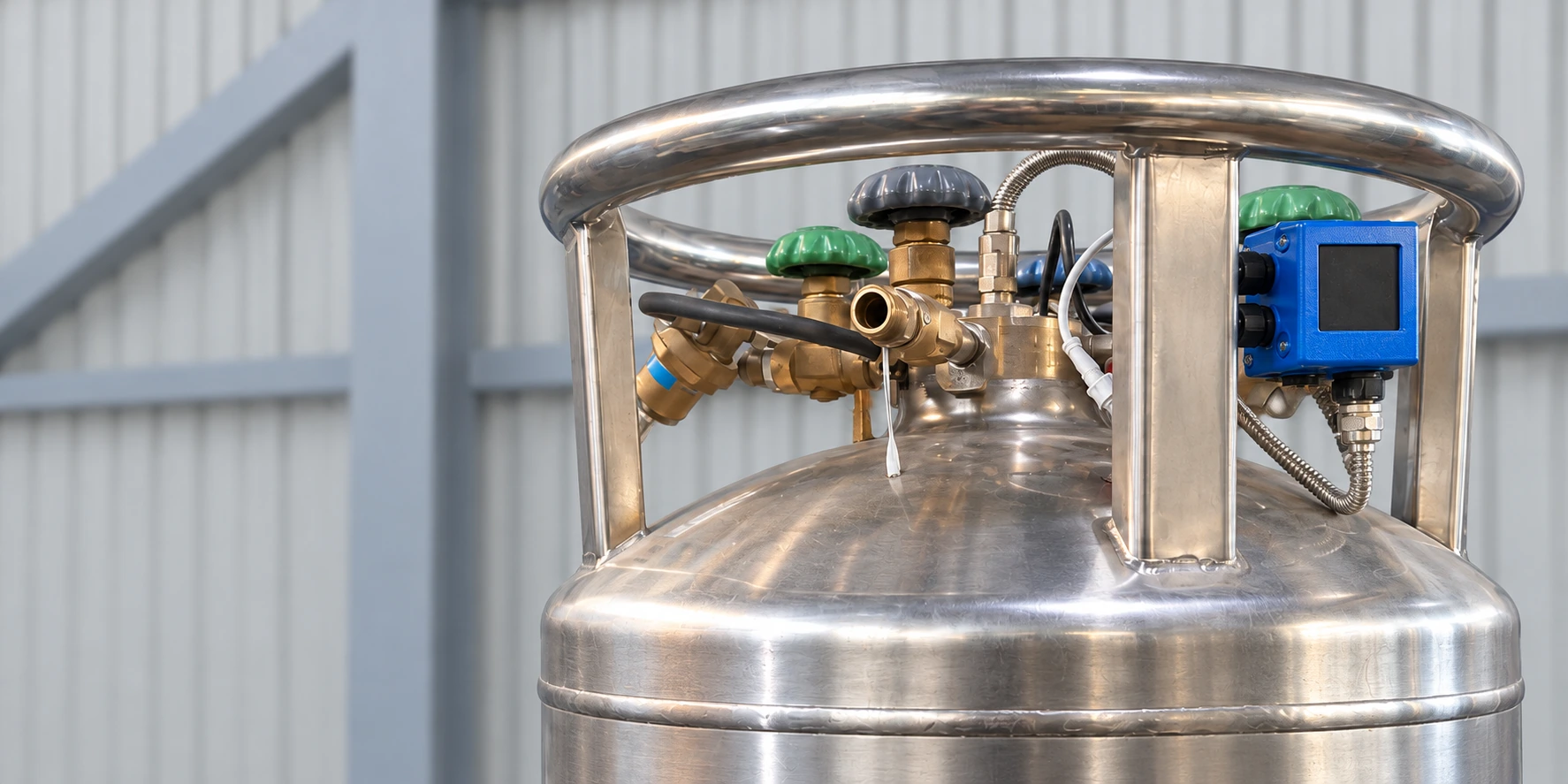
Illustrative scenario, not a customer case: vessel #26, an argon liquid cylinder, is found at 5% on a morning round. Once a CryoFor TM2 module is fitted, a low-reserve alert at 8% arrives weeks later, in time to plan the refill.
Request a demo or jump to common questions.
The problem: the level is known only after someone looks
At many sites, a liquid cylinder’s reserve is known only after someone walks the yard and notes the gauge in a logbook, or when a customer calls to say the gas is running out. The costs are familiar: a line waiting for gas, a rush delivery that breaks the day’s route, and reserve cylinders venting gas while nobody is watching.
Cylinders and rounds are a working setup, and at modest volumes often the right one; monitoring starts to pay as consumption, swaps and sites grow. Whether the supply format itself still fits is covered in microbulk vs cylinders.
How it works
CryoFor Telemetry is a remote monitoring platform that Cryofortune supplies as a digital layer on liquid cylinders (DPL-type dewars) and gas systems sourced from multiple manufacturers. The platform is run together with a technology partner.
- Vessel and TM2. TM2 takes the place of the stock electronic level gauge and reads the vessel’s own capacitive level probe. Pressure readings need a separate pressure sensor.
- Wi-Fi. On a set schedule, typically every 15–30 minutes, TM2 reports through the site’s 2.4 GHz Wi-Fi router. A buffering hub for sites with unreliable internet is optional, per project.
- CryoFor Telemetry cloud. Keeps the history and raises alerts.
- Your screen. A web console on a desktop or phone browser, plus a Telegram bot and Mini App.
Short connection drops lose no readings: up to 12 unconfirmed packets stay queued and are re-sent when the link returns.
The CryoFor TM2 module
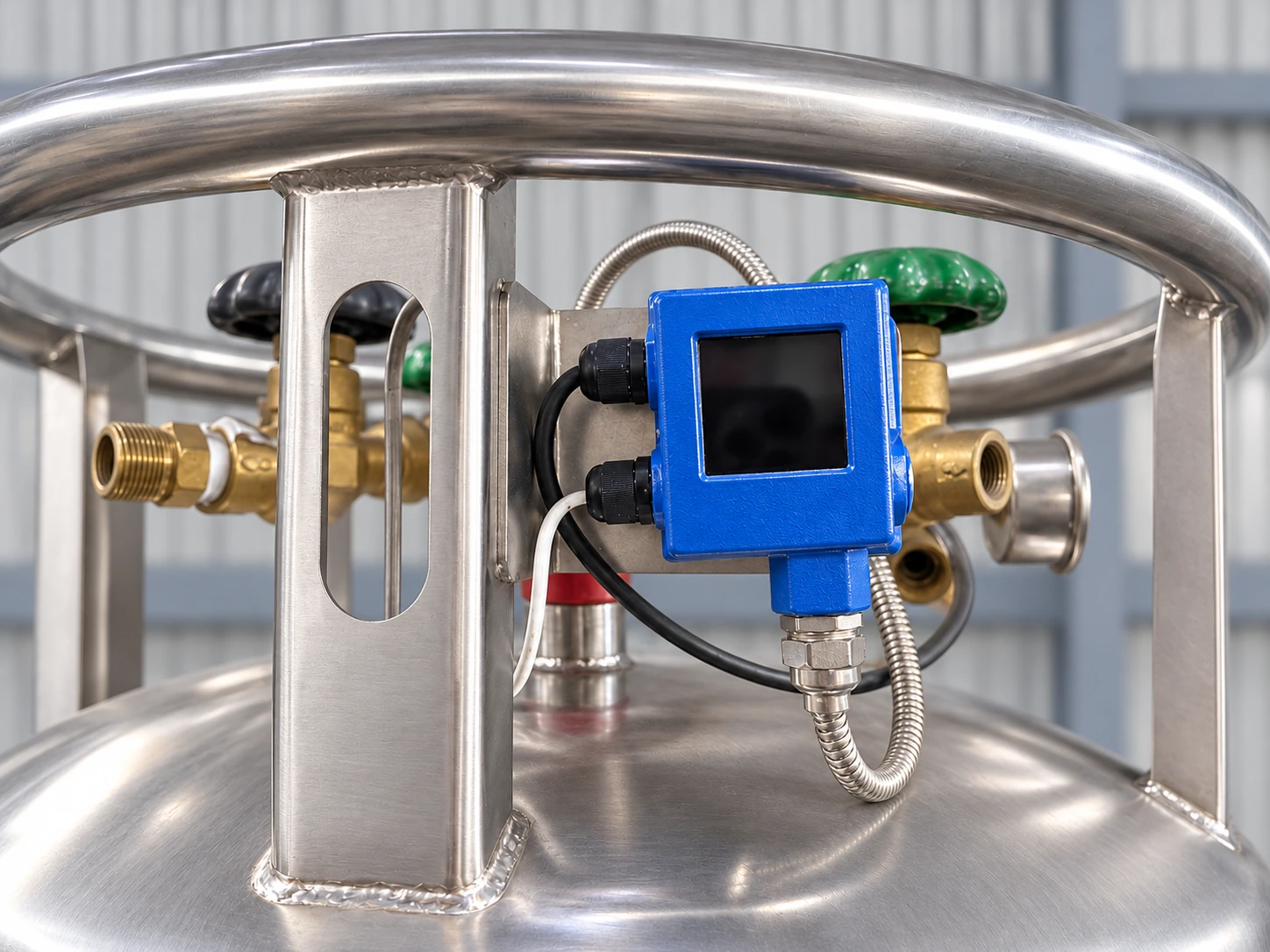
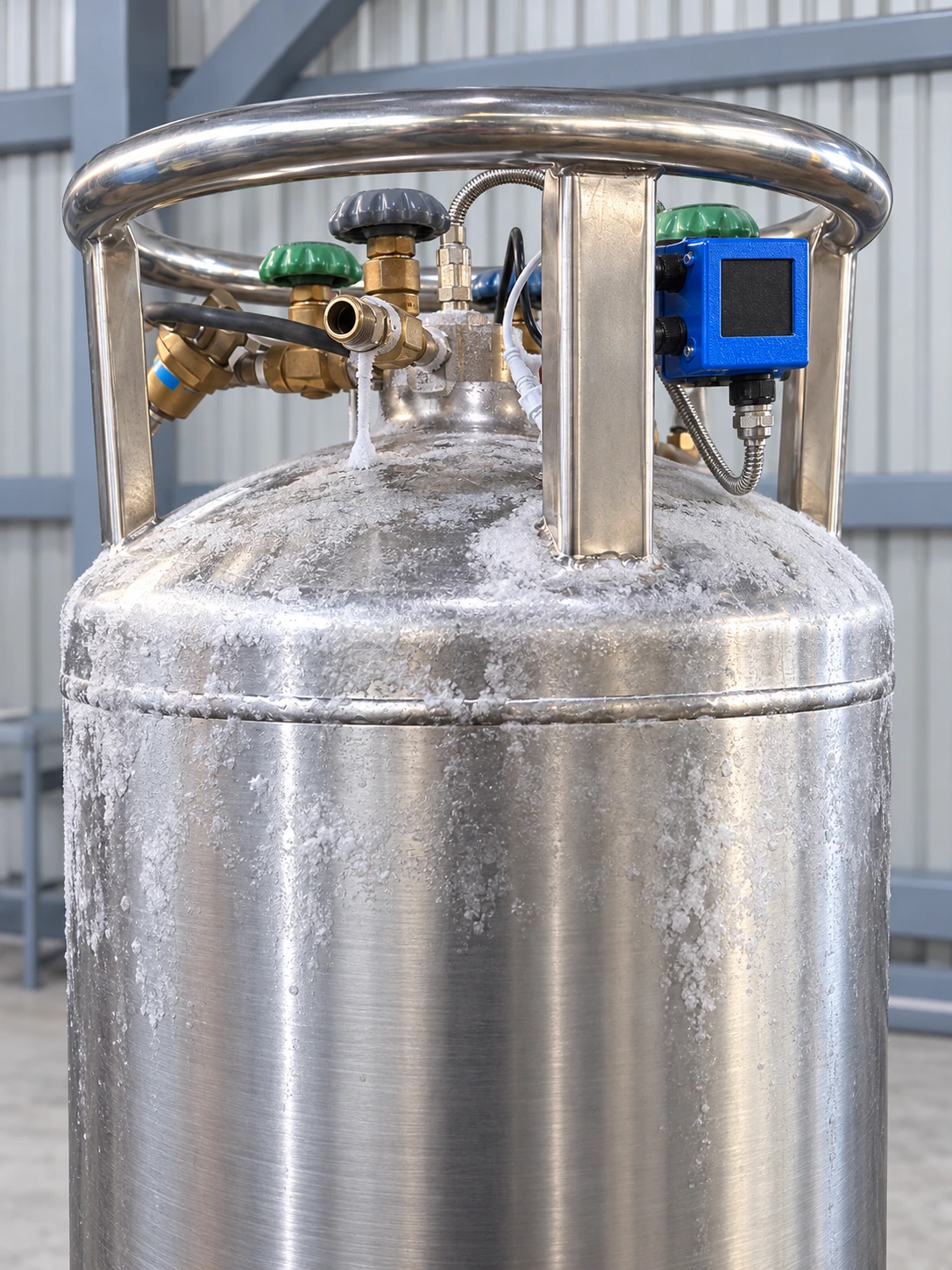
TM2 at a glance:
- Level: capacitive probe input, 120–500 pF across the fill range. Calibration uses 0% and 100% reference points; at each fill, the fill event is registered and the calibration is recalculated.
- Pressure: a separate pressure sensor, connected over I²C.
- Radio: 2.4 GHz Wi-Fi (IEEE 802.11 b/g/n), external antenna, MQTT.
- Battery: Li-ion 3.7 V, 5.3 Ah, in a separate aluminium battery box; at least 6 months per charge at 30-minute reporting with an active window of up to 15 s (a calculated rating under normal ambient conditions, 25 ± 10 °C).
- Environment: outdoor installation, −40 to +50 °C, with the battery box kept within −30 to +50 °C.
- Options: housing type, display and hub operation, recorded in each unit’s passport. The version for oxygen sites comes only in a grounded cast-aluminium housing, installed outside zones of possible oxygen enrichment.
- Not in the kit: level probe, pressure sensor, hub, mounting hardware and sensor cables.
TM2 is a monitoring device, not a legal measuring instrument, and is not intended for classified explosive-hazard (Ex) zones. Conformity documents and radio approvals are confirmed per destination market and project; statutory import steps stay with the buyer or importer.
The CryoFor Telemetry platform
- Fleet dashboard: Online, Offline, Critical, Warning and Normal states, updating without a page reload, plus a map of sites.
- History: level and battery charts, plus pressure where a sensor is fitted, with fill markers and a run-out forecast.
- Alerts: low level, low battery, lost connection and, with a pressure sensor, high pressure; in the console and in Telegram.
- Daily reports: scheduled, with charts, in Telegram.
- Consumption analytics: use by gas, top consumers, trends and a heat map by hour and day.
- View-only links: one vessel’s charts, with an expiry date, no account needed.
- Roles: administrator, dispatcher/logistics, company user and read-only supplier, with data separated between companies at server level.
The interface is in English and Simplified Chinese.
Who it is for
Gas distributors: every customer’s reserve on one screen
Levels at every customer site replace phone rounds. Run-out forecasts let you schedule refills before they become rush deliveries and serve customers who need different gases on the same trip. Each customer can get their own view and alerts.
Industrial gas users: see your reserve before it stops production
Production, procurement and maintenance see the same level from the office or a phone. A low-reserve alert arrives while there is still time to plan, and consumption history shows unexplained overnight draw. Monitoring works alongside your current gas supplier.
Dispatchers: start every shift knowing which vessel comes first
The dashboard marks every vessel Critical, Warning or Normal and flags offline modules separately, so silence is never mistaken for a full vessel. Every fill shows on the chart, and roles give each person the view they need.
Equipment manufacturers: ship vessels that report their own level
With TM2 in place of the stock electronic level gauge, each liquid cylinder leaves the factory able to report its level, and its pressure once a pressure sensor is added. Buyers get a ready platform (service and hosting agreed per project), and with their consent a read-only supplier role shows how your vessels perform in the field.
Use cases
- Liquid cylinder fleets: LOX, LIN, LAr and LCO2 in cryogenic liquid cylinders such as the vertical cryogenic cylinder, new or already in service with a compatible capacitive probe.
- Multi-cylinder ramps: each cylinder on the manifold shows its own level and, with a pressure sensor, its pressure, so the shift can connect the reserve cylinder building pressure first rather than let it vent.
- Systems and filling: monitoring specified with a complete cryogenic gas system, or refills planned around your own gas filling systems.
A pilot in four steps
- Describe the fleet: gas, vessel models, the level gauges fitted today and Wi-Fi at the site.
- Check compatibility: probe, pressure sensor, mounting, cables and, if needed, a hub.
- Run a pilot on a few vessels, typically three to five, for several weeks.
- Review and decide from your own data. If wider monitoring does not pay off, we say so.
Articles
Common questions
Isn’t remote monitoring an expensive extra?
It is an investment to calculate against consumption, losses, downtime and delivery logistics. The CryoFor TM2 module replaces the stock electronic level gauge rather than adding a second instrument, and brings remote access, history and many vessels on one screen. Pricing for your market is confirmed per project.
We already have a gas supplier. Why would we need this?
Keep your supplier. CryoFor Telemetry replaces no one; it gives you both the same picture. If you choose, your supplier gets a read-only view and plans refills from real levels instead of waiting for your call.
What if it doesn’t fit our vessels?
Compatibility is checked first. TM2 needs a capacitive level probe within 120–500 pF across the fill range; the probe, pressure sensor and mounting hardware are not in the kit. Cylinders with only float or dial gauges need a compatible probe first.
Do we need a hub on site?
Not necessarily. TM2 reports directly through an ordinary 2.4 GHz Wi-Fi router. Where internet is unreliable, an optional local hub, not part of the TM2 kit, collects and buffers data from several modules. Its availability is confirmed per project.
Is TM2 a measuring instrument? Can we invoice by it?
No. TM2 is not a measuring instrument, is not subject to metrological verification and is not intended for commercial gas metering. Level accuracy depends on the connected probe, the calibration and the density of the medium. Invoicing stays with your metering equipment.
How long does the battery last, and how is it charged?
At least 6 months per charge at a 30-minute reporting interval with an active window of up to 15 s, a calculated rating under normal ambient conditions (25 ± 10 °C); shorter intervals mean shorter life. For charging, the battery box is disconnected and is not opened. Voltage is reported every cycle, and the platform raises a low-battery alert.
Which gases and vessels does it work with?
Nitrogen, oxygen, argon, CO2 and other gases, with density set per gas, on cryogenic vessels with a capacitive level probe. Oxygen sites use a dedicated version installed outside zones of possible oxygen enrichment. The version for your gas and site is confirmed per project.
Where does our data go, and who can see it?
Readings travel over Wi-Fi to the CryoFor Telemetry cloud, then to the web console and Telegram. Data is separated between companies at server level, and access is by role. Data hosting and service terms are confirmed per project.
See it on your own vessels
Tell us your gas, fleet size and the level gauges your liquid cylinders carry. We will arrange a live CryoFor Telemetry walkthrough and say honestly whether a pilot makes sense. Request a demo.