
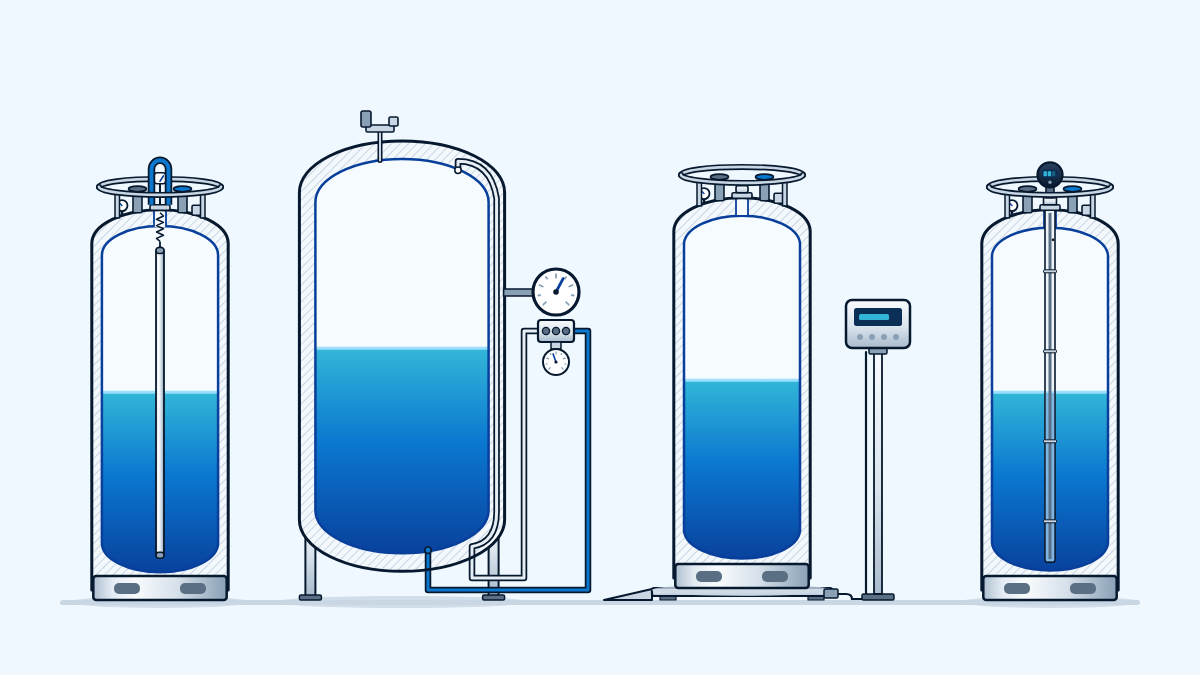
There are six ways to find out how much liquid is left in a liquid cylinder (a DPL-type dewar). Some show only pressure, some need a person at the vessel, and some can report remotely. The table compares them in general terms; products that use the same method differ.
| Method | What it shows | What goes on the vessel | Power and connection | Cylinders already in service | Limits |
|---|---|---|---|---|---|
| Float or dial indicator, read on rounds | Approximate level, only when someone looks | Nothing new | None; readings go into a logbook or a phone call | Yes | Coarse scale; no reading between rounds |
| Pressure only | Head pressure, not the liquid left | The existing gauge, or an added pressure transmitter | Gauge: none. Transmitter: power and a data link | Yes | Does not follow the contents: held near its setting while liquid remains; over liquid CO2, set by temperature |
| Weighing | Gross weight; the contents once the tare is subtracted | Nothing; a platform scale under the cylinder | Scale power; a data output for remote reading | Yes, with no change to the vessel | One scale per position; hoses must not carry load |
| Differential pressure (DP) | Liquid head, converted into level or contents with the liquid’s density | DP gauge or transmitter on the liquid and vapor lines | Dial: none. Transmitter: power and a data link | Where both connections exist; usual on tanks | Set up per gas; sensing lines must stay leak-free |
| A capacitive probe supplied with the monitoring system and fitted into the vessel | Level along the probe | A new probe in the inner vessel, plus its electronics | Depends on the system | Only through work on the pressure boundary | Changes the vessel’s own instrumentation |
| Reading the vessel’s own capacitive probe (CryoFor TM2) | Level; pressure with a separately fitted sensor | TM2 in place of the stock electronic level gauge; oxygen sites use a dedicated version (see below) | Separate battery box: at least 6 months per charge at 30-minute reporting (a calculated rating); 2.4 GHz Wi-Fi through the site router | Yes, with a compatible capacitive probe (120–500 pF across the fill range); float-only cylinders need a probe first | Readout at the vessel only with the display option; a monitoring device, not for invoicing |
What you need to know: the liquid left, not only the pressure
A liquid cylinder keeps its own head pressure: a pressure-building circuit vaporizes a little liquid to hold it near its setting, and a relief valve limits it. The pressure gauge therefore tells you whether the vessel can deliver gas now, not how long it will last.
Delivery planning and downtime depend on the liquid left, measured as level or weight. Pressure still matters alongside it: a reserve cylinder that is not in use builds pressure from heat leaking in and vents at the relief setting.
Float and dial indicators read on rounds
Many liquid cylinders carry a float gauge on the vessel head: a float rides on the liquid and moves an indicator through a rod or a magnetic coupling. Some show the contents on a dial, driven by a float or by differential pressure.
These gauges need no power, but the scale is coarse, the value exists only when someone looks, and moving parts can stick. Across many sites they mean rounds and phone calls, and a missed reading can end in a rush delivery. TM2 does not read float or dial indicators.
Pressure only, and why it fails for liquid CO2
In a high-pressure cylinder of compressed nitrogen or argon, the pressure falls roughly in step with the contents. In a liquid cylinder it does not.
Above liquid CO2, the pressure is its vapor pressure, set by the temperature of the liquid rather than by how much liquid remains. It falls only once the liquid is gone, too late to plan a refill. That is why pressure can’t show liquid CO2 level, and why CO2 cylinders are filled by weight.
With liquid nitrogen, argon and oxygen, the pressure-building circuit holds the pressure near its setting. A falling pressure can mean a heavy draw or a nearly empty vessel, and the gauge alone cannot tell which.
Weighing the cylinder
A platform scale measures the gross weight; subtract the empty (tare) weight and the rest is the contents. Weighing gives the mass directly, with no assumption about density or vessel shape, and nothing is fitted to the vessel.
The limits are practical: one scale per cylinder position, rated for the empty weight plus a full load; hoses and piping arranged so that they carry no load; and a data output if the weight is to be read remotely. Cylinders that move often are hard to keep on scales.
Differential pressure
A differential-pressure (DP) gauge compares the pressure at the bottom of the liquid with the pressure in the vapor space above it. The difference is the hydrostatic head of the liquid column, which is converted into level or contents using the liquid’s density. A dial shows it locally; a powered DP transmitter sends it on.
DP is the usual method on bulk tanks and is also found on some liquid cylinders. It needs connections to both the liquid and the vapor space, is set up for a specific gas because densities differ, and relies on leak-free sensing lines.
Capacitive level: a new probe, or the one already in the vessel
A capacitive probe is typically a rod inside a tube, running down through the inner vessel. Liquid and vapor have different dielectric properties, so the capacitance changes with how much of the probe is covered. Electronics convert it into level and, with the vessel geometry and the liquid’s density, into contents. There are no moving parts. Some cylinders carry such a probe from the factory, read by an electronic level gauge, often called a capacitance gauge.
A capacitive probe supplied with the monitoring system
Some monitoring systems bring their own probe and transmitter. This can add remote level reading to a float-only cylinder, but the probe has to enter the inner vessel through a port in the head. That is work on the pressure boundary, usually agreed with the vessel manufacturer and done under local pressure-equipment rules.
Reading the vessel’s own probe with TM2
Where the cylinder already has a capacitive probe, the CryoFor TM2 module takes the place of the stock electronic level gauge and reads that probe, so nothing new goes into the vessel. CryoFor Telemetry works by reading the probe the cylinder already has; Cryofortune supplies it together with liquid cylinders sourced per order from a network of manufacturers.
- Probe. Capacitive, within 120–500 pF across the fill range; compatibility is checked first. The probe, pressure sensor and mounting hardware are not in the TM2 kit.
- Pressure. Reported only with a separately fitted pressure sensor.
- Calibration. 0% and 100% reference points; at each fill, the fill event is registered and the calibration is recalculated. Level accuracy depends on the connected probe, the calibration and the density of the medium.
- Power and connection. A separate battery box gives at least 6 months per charge at a 30-minute reporting interval, a calculated rating under normal ambient conditions (25 ± 10 °C); shorter intervals mean shorter life. TM2 reports on a set schedule, typically every 15–30 minutes, through the site’s 2.4 GHz Wi-Fi router.
- Readout at the vessel. Depends on the display option, recorded in each unit’s passport.
- Gases. Density is set per gas, and the version for a given gas and site is confirmed per project. Oxygen sites use a dedicated version where only the probe and its cable stay at the vessel and the electronics and battery box are installed outside zones of possible oxygen enrichment.
- Status. A monitoring device, not a measuring instrument, and not intended for commercial gas metering.
More in adding telemetry to liquid cylinders you already own and in the CryoFor Telemetry FAQ.
How to choose
- You need supply pressure and warning of venting: monitor pressure alongside level, not instead of it.
- Cylinders stay in fixed positions and you want the mass directly: weighing, if each position can have its own scale.
- The vessel already has DP connections: a DP transmitter.
- The vessel has an electronic gauge with a capacitive probe: read that probe remotely.
- Only a float indicator: weighing, or a capacitive probe fitted first, agreed per vessel model, for whichever system will read it.
- A few cylinders, checked daily: readings on rounds may be enough; remote reading starts to pay as consumption, swaps and sites grow.
For distributors, cylinders that report their own level let refills be scheduled from data; see liquid cylinder delivery planning. On new cylinders the level instrument is part of the vessel trim (level indicators and gauges), so mention planned monitoring when choosing the vessel itself. For vessel manufacturers, see smart cryogenic cylinder telemetry.
Microbulk and bulk tanks: what changes
Bulk tanks, and many microbulk vessels, usually carry a DP level gauge on their piping rather than a capacitive probe, and TM2 does not read a DP gauge. For a tank, ask us about the level instrument and remote reading together with the tank itself: see microbulk tanks and cryogenic storage tanks.
If cylinder swaps are the bottleneck, the answer may be a different supply format; see when to move from cylinders to microbulk.
Common questions
Can a pressure gauge show how full a liquid CO2 cylinder is?
No. The pressure above liquid CO2 is its vapor pressure, set by temperature rather than by the amount of liquid, so at the same temperature a nearly full and a nearly empty cylinder read almost the same. To know the contents, weigh the cylinder or measure the liquid level.
Can TM2 read a differential-pressure gauge?
No. TM2 reads a capacitive level probe within 120–500 pF across the fill range. For a vessel with only a differential-pressure gauge, as on most bulk tanks, ask about remote reading together with the vessel itself.
Does a remote level gauge replace the pressure gauge?
No. Level shows the reserve; pressure shows whether the vessel can deliver and whether it is building toward its relief setting. With TM2, pressure is reported once a separate pressure sensor is fitted, and the platform can then raise a high-pressure alert.
How can I tell which level gauge my cylinders have?
Check the vessel head and the datasheet. A float gauge is usually a mechanical indicator with no cable. An electronic gauge has a display or transmitter that reads a probe inside the vessel; if that probe is capacitive, TM2 can read it, subject to a compatibility check. A differential-pressure gauge is usually a dial connected by two sensing lines, one to the liquid side and one to the vapor side.
Send your fleet details
Tell us the gas, how many liquid cylinders you run, which level gauges they carry today and whether the site has 2.4 GHz Wi-Fi. We will say whether TM2 fits those cylinders and whether a CryoFor Telemetry pilot makes sense. Send an inquiry.