
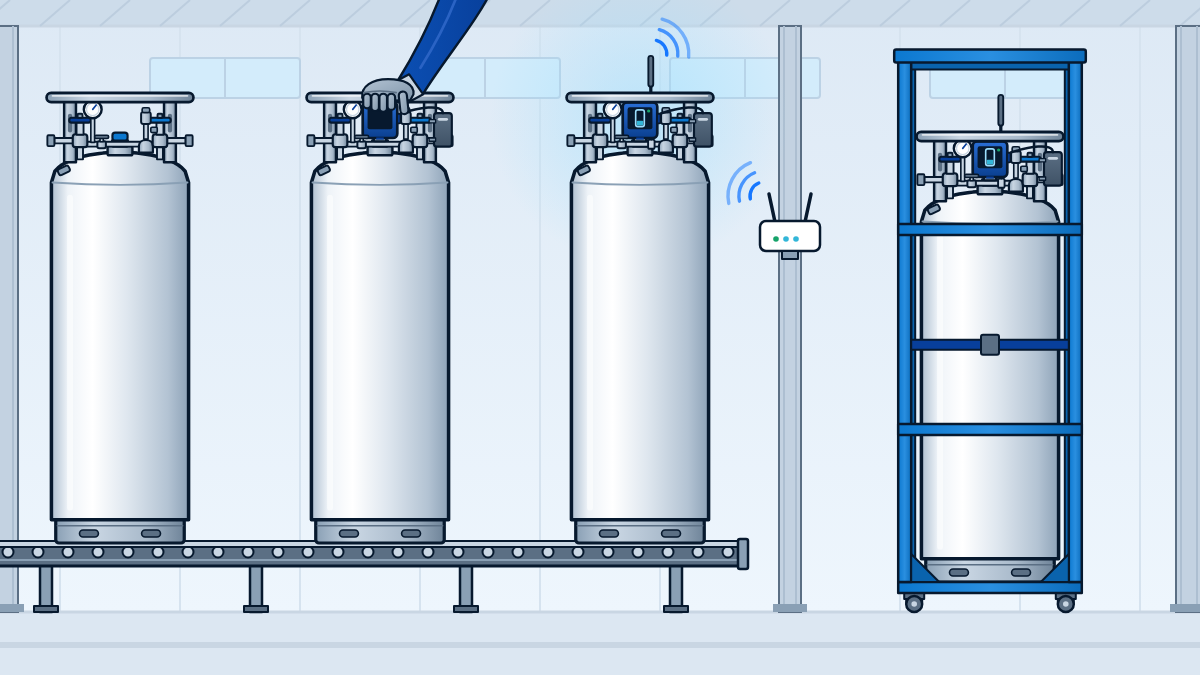
A telemetry-ready level gauge turns a liquid cylinder into a vessel that reports its own level. The CryoFor TM2 module takes the place of the stock electronic level gauge, reads the vessel’s own capacitive level probe and reports to the CryoFor Telemetry platform on a set schedule. Cryofortune supplies CryoFor Telemetry together with liquid cylinders sourced per order from a network of manufacturers in China. This article is for vessel manufacturers; the short version is on the hub page under CryoFor Telemetry for equipment manufacturers.
Ask about a pilot or jump to the questions your engineers will ask.
What buyers remember after a trade show
Illustrative scenario, not a customer case.
Picture a manufacturer of liquid cylinders at a trade show. Its vessels are solid, and so are the ones across the aisle. What buyers remember is what happens after delivery.
With TM2 fitted in place of the stock electronic level gauge, each vessel leaves the factory able to report its level and, once a pressure sensor is fitted, its pressure. The buyer gets a ready platform with a fleet dashboard, history, alerts and a map of sites in a web console, and nobody has to write software.
For the manufacturer, the offer moves from a vessel to a monitored vessel. With the customer’s consent, a read-only supplier role shows how its vessels actually perform in the field. That is a basis for service offers and for the next order.
Why buyers ask whether a vessel reports its level
On many sites, a liquid cylinder’s reserve is known only after someone walks the yard and reads the gauge, or when a customer calls to say the gas is running out. The result is a line waiting for gas, a rush delivery that breaks the day’s route, or reserve cylinders venting gas while nobody is watching.
- Gas distributors want every customer’s reserve on one screen, so refills are planned from levels and run-out forecasts instead of phone rounds. See liquid cylinder delivery planning.
- Industrial gas users want to see the reserve before it stops production, and a consumption history that shows unexplained overnight draw.
- Dispatchers want offline modules flagged separately, so silence is never mistaken for a full vessel.
Not every buyer needs this. At modest volumes, cylinders and manual rounds are often the right setup; monitoring starts to pay as consumption, swaps and sites grow. Vessels already in service can be monitored too if they carry a compatible capacitive probe; see retrofitting a level gauge on liquid cylinders in service.
One component, not a second sensor
TM2 works as the cylinder’s smart level gauge. It takes the place of the stock electronic gauge instead of being fitted beside it as a second instrument, and it reads the vessel’s own capacitive level probe, which must stay within 120–500 pF across the fill range.
- Pressure needs a separately fitted pressure sensor, connected over I²C. Without one, the vessel reports its level and battery voltage but not its pressure.
- A level readout on TM2 itself needs the display option, recorded in the unit’s passport. Without it, the level is read in the web console.
- Not in the kit: level probe, pressure sensor, hub, mounting hardware and sensor cables.
Cylinders with only float or dial gauges need a compatible capacitive probe first. The common designs are compared in liquid cylinder level gauge types.
What your buyer gets
The buyer works in the CryoFor Telemetry web console on a desktop or phone browser. The interface is in English and Simplified Chinese, and platform service and data hosting are agreed per project.
| Function | What the buyer sees |
|---|---|
| Fleet dashboard | Online, Offline, Critical, Warning and Normal states, updating without a page reload, plus a map of sites. |
| History | Level and battery charts, pressure where a sensor is fitted, fill markers and a run-out forecast. |
| Alerts | Low level, low battery, lost connection and, with a pressure sensor, high pressure. |
| Consumption analytics | Use by gas, top consumers, trends and a heat map by hour and day. |
| View-only links | One vessel’s charts, with an expiry date, no account needed. |
| Roles | Administrator, dispatcher/logistics, company user and read-only supplier, with data separated between companies at server level. |
Short connection drops lose no readings: up to 12 unconfirmed packets stay queued and are re-sent when the link returns.
One limit belongs in every sales conversation. TM2 is a monitoring device, not a measuring instrument, and is not intended for commercial gas metering. Invoicing stays with the buyer’s metering equipment.
From hardware to service
A vessel sold without monitoring leaves the manufacturer’s view at delivery. A vessel with TM2 keeps reporting its level, and its pressure where a sensor is fitted, on a set schedule, typically every 15–30 minutes. That record supports more than a one-off sale:
- Refill planning from run-out forecasts, for the buyer or its gas supplier.
- Consumption analytics, from use by gas to trends over time.
- Field feedback. With the customer’s consent, the read-only supplier role shows how your vessels perform in the field after delivery.
What a manufacturer builds on this is agreed with its own buyers. The data lets that conversation start from facts.
Questions your engineers will ask
Product and engineering teams usually want these points settled before a pilot.
| Topic | What applies |
|---|---|
| Level probe | Capacitive, 120–500 pF across the fill range. The capacitance range and the probe’s insulation are part of the compatibility check. |
| Pressure, mounting, cables | A separate pressure sensor connects over I²C. The sensor, mounting hardware and cables are not in the kit and are checked for each vessel model. |
| Connection | 2.4 GHz Wi-Fi (IEEE 802.11 b/g/n) through the site router, external antenna, MQTT. An optional local hub, not part of the kit, buffers data where internet is unreliable; its availability is confirmed per project. |
| Radio approvals | Radio approvals, such as SRRC, NCC or RED, and conformity documents are confirmed per destination market and project. |
| Power | Li-ion 3.7 V, 5.3 Ah, in a separate battery box that is disconnected for charging and is not opened. At least 6 months per charge at a 30-minute reporting interval, a calculated rating under normal ambient conditions (25 ± 10 °C). Battery voltage is reported every cycle. |
| Environment | Outdoor installation, −40 to +50 °C, with the battery box kept within −30 to +50 °C. Not for classified explosive-hazard (Ex) zones. |
| Calibration | 0% and 100% reference points. At each fill, the fill event is registered and the calibration is recalculated. |
| Accuracy | Depends on the connected probe, the calibration and the density of the medium, so there is no single figure. |
| Options | Housing type, display and hub operation, recorded in each unit’s passport. |
| Gas and site | Density is set per gas. For oxygen sites there is a dedicated version where only the probe and its cable stay at the vessel and the electronics and battery box are installed outside zones of possible oxygen enrichment. The version for a given gas and site is confirmed per project. |
How to start with Cryofortune
Cryofortune matches each order to a factory in its network by destination country, equipment type, standard and required documentation; see how we match each order to a factory. For a manufacturer that wants to offer telemetry-ready vessels, the steps are:
- Describe the vessels. Models, such as a vertical cryogenic cylinder, the level gauges and probes fitted today, the gases and the export markets.
- Check compatibility. Probe, pressure sensor, mounting, cables, radio approvals per market and, where needed, a hub.
- Run a pilot on a few vessels and review the data. If wider monitoring does not pay off, we say so.
- Document the scope. Telemetry modules are part of the delivered scope and belong in the technical file; see documenting accessories, including telemetry.
Common questions
Cost, hubs, vessel fit, invoicing, battery charging, gases and data handling are covered in the CryoFor Telemetry FAQ. The questions below are the ones vessel manufacturers add.
Does TM2 show the level at the vessel?
Only with the display option. TM2 takes the place of the stock electronic level gauge, and the display is a per-unit option recorded in the unit’s passport. If buyers expect to read the level on the gauge at the vessel, specify the display option with the order.
Can the vessel manufacturer see how its vessels perform after delivery?
Only with the buyer’s consent. CryoFor Telemetry has a read-only supplier role, access is by role, and data is separated between companies at server level. The buyer decides whether a supplier view is granted.
Do buyers need to write their own software?
No. Buyers use the CryoFor Telemetry web console on a desktop or phone browser, with a fleet dashboard, history, alerts, consumption analytics and access roles. Platform service and data hosting are agreed per project.
Is TM2 approved for radio use in our export markets?
There is no blanket answer. Radio approvals, such as SRRC for mainland China, NCC for Taiwan or RED for the EU, and conformity documents are confirmed per destination market and project. Statutory import steps stay with the buyer or importer.
How often does a telemetry-ready vessel report?
On a set schedule, typically every 15–30 minutes, not continuously. A shorter interval means shorter battery life: the rating of at least 6 months per charge applies at a 30-minute interval and is a calculated rating under normal ambient conditions (25 ± 10 °C).
Talk to us about telemetry-ready vessels
Tell us your vessel models, the level gauges and probes they carry today, the gases and your export markets. We will check compatibility first and say plainly whether a pilot makes sense. Send an inquiry.