Specifying a liquid nitrogen dewar looks simple until you compare two units side by side and find that “50 litres” tells you almost nothing about how the vessel will actually perform in your lab or in the field. Capacity is one number among several that decide whether a container keeps samples cold for weeks, survives transport, and fits the workflow it was bought for. Choosing the right liquid nitrogen dewar supplier means understanding what those numbers mean before you send an inquiry, not after the unit arrives. This guide uses the YDZ-50 as a worked example to walk an engineer or procurement buyer through the specifications that matter, how to compare options sensibly, and the mistakes that quietly inflate running costs.
The YDZ-50 is a 50-litre stainless steel, vacuum-insulated liquid nitrogen container. Because it can also be lightly pressurised for dispensing, it sits between a pure static storage vessel and a transport dewar, which is exactly why it appears in fertility and cryopreservation clinics, veterinary practices, sample-storage rooms, research laboratories, and field technician kits. Reading its datasheet carefully is a good way to learn how to read any dewar’s.
Start With the Specs That Actually Drive Cost
Capacity sets the ceiling, but evaporation rate sets the running cost. The YDZ-50 carries a static evaporation rate of 2.2%, which corresponds to roughly 1.10 litres of liquid nitrogen lost per day under static conditions. That figure is the single most useful number on the page, because it tells you how often you will refill and how much LN2 you will buy over the unit’s life. A vessel that looks cheaper on the quote but evaporates faster can cost more within a year through nitrogen consumption alone.
Pair evaporation rate with usable hold time. With a 50-litre charge and a daily loss near 1.10 litres, the static reserve is measured in weeks, not days, which is what makes a unit like this practical as an on-site LN2 reserve between scheduled refills. The neck opening, here 50 mm, is the other quiet cost driver: a narrow neck like this slows evaporation, but the YDZ-50 is a supply container, not a canister store — samples on canisters, racks or canes go in a YDS-type storage dewar, where a wider neck (up to 210 mm) makes loading easier at the cost of higher evaporation. Match the neck to your sample format before you commit.
When you brief a liquid nitrogen dewar supplier, ask for static evaporation rate, neck diameter, empty and full weight, and overall dimensions together. The YDZ-50 lists 46 kg empty and 84 kg full, 1000 mm tall and 505 mm in external diameter. Those are not trivia; they decide whether the dewar fits through a doorway, onto a bench, into a vehicle, and whether one person can reposition it safely.
Match the Dewar to How You Will Actually Use It
A storage-room dewar and a field dewar face different problems, even at the same capacity. For static laboratory or clinic storage, prioritise the lowest evaporation rate and the longest hold time, because the vessel mostly sits still and you want minimal refill labour. The 2.2% static rate and 50-litre volume of the YDZ-50 suit that pattern well.
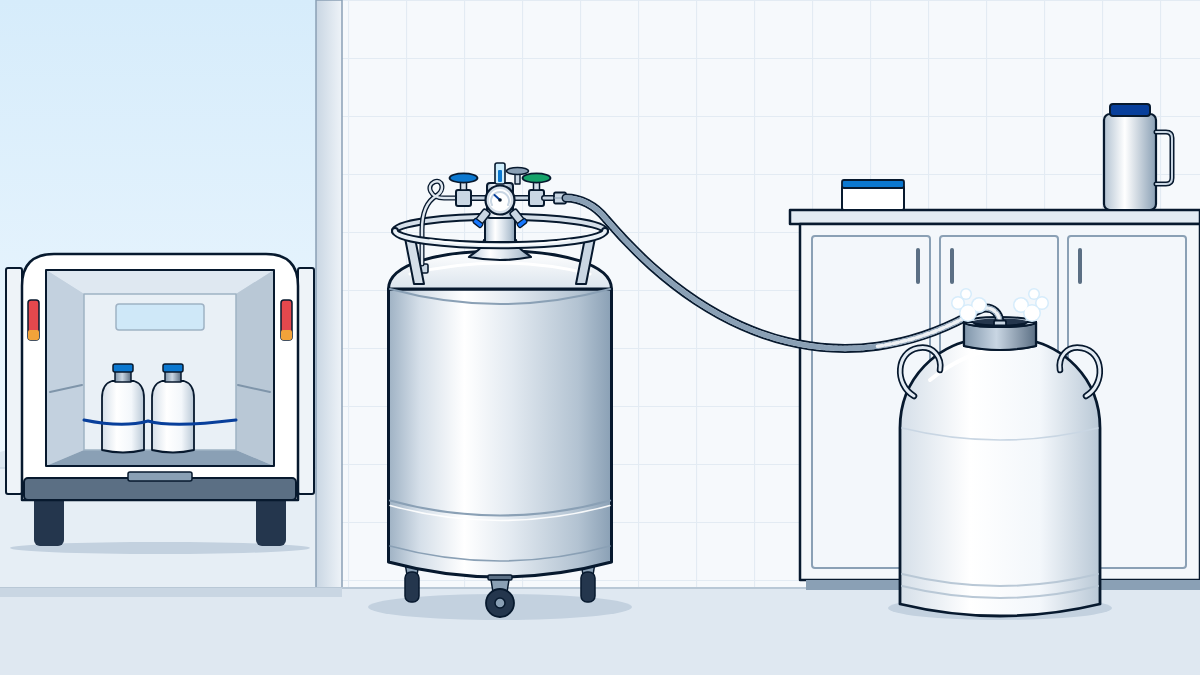
Field and dispensing use change the calculus. The YDZ-50 supports an liquid dispensing rate of 8 L/min and a standard working pressure of 0.05 MPa, with a maximum working pressure of 0.09 MPa, so it can pressurise enough to transfer liquid rather than relying on pouring. If your technicians need to top up smaller flasks on site or fill veterinary insemination equipment in the field, that dispensing capability matters more than squeezing out the last fraction of a percent of hold time. Confirm the pressure and liquid dispensing behaviour explicitly, because a pure static dewar will not dispense the same way.
Also weigh frequency of movement. At 84 kg full, this is a wheel-it-or-two-person-lift unit, not something to carry up stairs daily. If the application demands constant relocation, that should steer cart, base, and handling accessories into the conversation early.
Read the Safety and Pressure Numbers, Not Just the Headline Capacity
Pressure-capable dewars carry a safety story that static buyers sometimes skim, and that is a mistake. The YDZ-50 specifies safety valve opening pressures of 0.099 MPa for the primary and 0.15 MPa for the secondary, with a pressure gauge range of 0 to 0.25 MPa. These are the features that keep the vessel within safe limits as nitrogen boils off and as you pressurise for dispensing.
Two practical points follow. First, verify that the working pressure, maximum pressure, and valve settings are consistent and clearly documented; mismatched or vague pressure data is a red flag about the unit or the seller. Second, remember that liquid nitrogen handling carries asphyxiation and cold-burn risks regardless of vessel quality, so a gauge you can actually read and valves rated to known pressures are part of safe operation. A credible liquid nitrogen dewar supplier will state these numbers plainly rather than burying them.
Compare Options on a Like-for-Like Basis
The most common comparison error is lining up headline capacities and ignoring everything else. Build a small table instead, and for each candidate dewar fill in: capacity, static evaporation rate (percentage and litres per day), neck diameter, empty and full weight, overall height and diameter, working and maximum pressure, liquid dispensing rate, and safety valve and gauge ratings. The YDZ-50 gives you a complete reference row to compare against: 50 L, 2.2% (about 1.10 L/day), 50 mm neck, 46/84 kg, 1000 by 505 mm, 0.05/0.09 MPa, 8 L/min.
Construction belongs in the comparison too. Stainless steel construction and genuine vacuum insulation are what hold the evaporation rate down over time, and a vacuum that degrades will quietly raise nitrogen consumption long before the vessel obviously fails. When two quotes look close, the difference often lives in build quality and the integrity of the insulation, not the spec sheet.
Avoid the Common Mistakes Before You Inquire
A few recurring errors are worth naming. Oversizing wastes nitrogen, because a larger vessel evaporates more in absolute terms even at the same percentage rate; size to your real sample volume plus a margin, not to the biggest unit in the catalog. Undersizing the neck is the opposite trap, forcing awkward sample handling for the life of the dewar. Ignoring full weight leads to handling and ergonomics problems that only surface after delivery.
For international buyers, documentation is its own checklist item. Confirm that the supplier provides export-ready paperwork and packaging suitable for your destination, because a dewar that cannot clear customs cleanly is not actually available to you. Cryofortune, based in Foshan, Guangdong, China, supplies this equipment for export-oriented projects with export packing and English-language documentation, which is the kind of support distributor supply and project delivery depend on. Ask any prospective liquid nitrogen dewar supplier to confirm the same before you order, alongside lead time and replacement-part availability.
Selection Checklist
Before sending an inquiry, confirm you can answer these:
- What sample format and volume must the dewar hold, and does it need canisters and racks (a YDS-type storage vessel) rather than an LN2 supply container like the YDZ-50?
- What static evaporation rate and resulting daily LN2 loss can you accept, and how does that translate to refill frequency and annual nitrogen cost?
- Is the use static storage, on-site dispensing, or both, and do the working pressure (0.05 MPa) and liquid dispensing rate (8 L/min) suit it?
- Will the full weight (84 kg) and dimensions (1000 by 505 mm) fit your space, doorways, transport, and handling plan?
- Are the safety valve openings, gauge range, and maximum pressure clearly documented and internally consistent?
- Does the supplier provide export documentation, suitable packaging, lead time, and spare-part support for your location?
Work through that list and the right specification usually becomes obvious, because the dewar is chosen against your workflow rather than against a marketing headline. If the YDZ-50’s numbers match your lab or field requirements, you can review the full specifications and request export details on the YDZ-50 liquid nitrogen container product page to confirm fit before you inquire.