
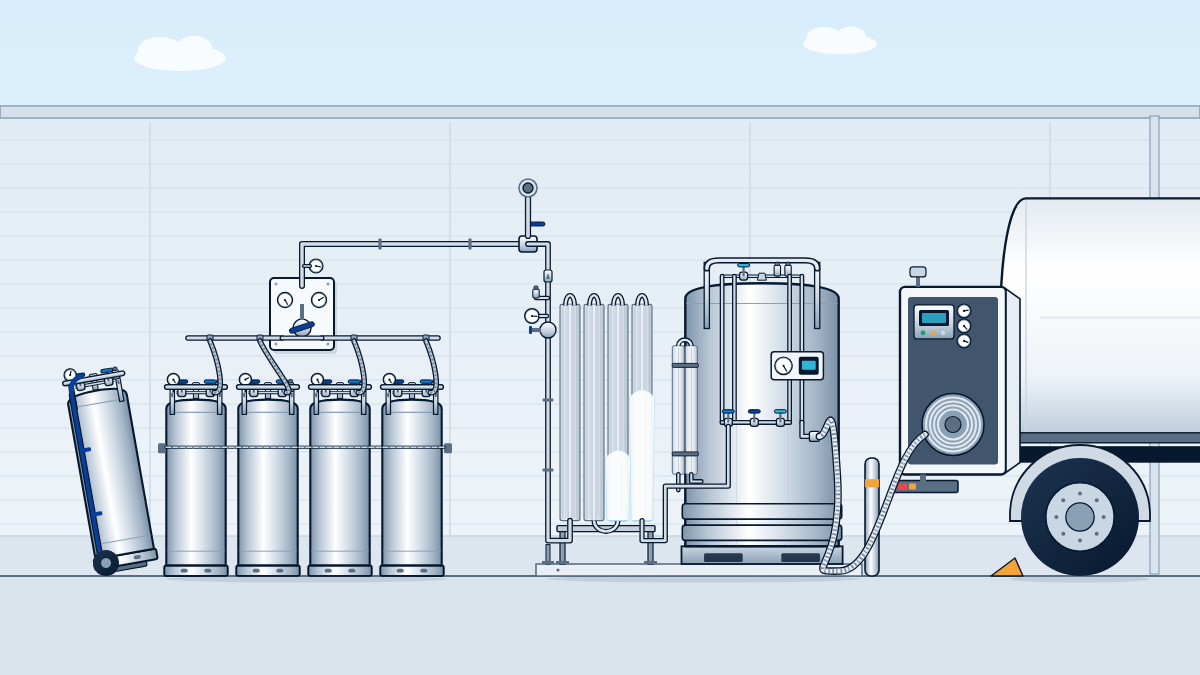
Choosing how to receive your industrial gas is a quiet but consequential decision. For a welding shop, a laboratory, or an electronics line running on LN2, LOX, LAr, or CO2, the supply mode shapes your floor space, your labour hours, your safety exposure, and your cost per cubic metre delivered to the point of use. The microbulk vs cylinders question becomes pressing as soon as your consumption outgrows the format you started with. This guide walks through how to compare the two honestly, what an engineer should measure before inquiring, and where the typical mistakes hide.
The point here is not to declare one format universally better. It is to give procurement and engineering a shared, fact-based framework for deciding when staying on cylinders still makes sense and when consolidating into bulk cryogenic supply will pay back.
What “Cylinders” and “Bulk” Actually Mean Here
When people say cylinders in a cryogenic context, they usually mean vacuum-insulated liquid cylinders rather than high-pressure compressed-gas bottles. These are also called DPL or DPW cylinders, or simply liquid dewars. A vertical vacuum-insulated cryogenic cylinder holds cryogenic liquid such as LN2, LOX, LAr, or CO2 and delivers it as liquid or gas at a controlled working pressure, typically 1.4 to 2.9 MPa depending on the variant (1.37, 2.01, 2.3 and 2.88 MPa classes).
These cylinders are portable, self-pressurising vessels in the small-to-medium range. Gross volumes run from 50 L to 500 L, with models spanning the DPL450 series (for example DPL450-50, DPL450-100, DPL450-175, DPL450-195, DPL450-210) including the DPL700-500 at 500 L. Useful volume is about 95% of gross (185 L stored on the 195 L model). Empty weights range from roughly 65 kg on the smallest to about 425 kg on the largest, which matters for handling and for how many you can realistically rotate through a site.
Bulk cryogenic supply, by contrast, means a larger fixed storage tank fed by tanker deliveries, with vaporisers converting liquid to gas for the pipeline. Microbulk is the bridge between the two: small permanent or semi-permanent vessels, larger than a single cylinder but smaller than a full bulk tank, refilled on site by a delivery truck rather than swapped out. The microbulk vs cylinders comparison is really a question of where on this continuum your demand sits.
How to Compare Total Cost, Not Sticker Price
The most common error in the microbulk vs cylinders analysis is comparing the gas price per unit and stopping there. Cylinders look cheap per vessel, but the real cost is the system around them.
Build a total-cost-of-supply picture that includes:
- Cylinder rental or demurrage charged per vessel per day, which scales with how many you hold to cover peak demand and buffer stock.
- Labour for changeovers — every empty swapped for a full one is handling time, paperwork, and a potential line stoppage.
- Product loss. Vacuum-insulated cylinders do evaporate. Published evaporation rates on these units fall in the range of under 2.1% to under 4.0% per day depending on the model and gas. Across a large fleet of part-used cylinders, that boil-off compounds.
- Delivery frequency and minimum-order effects that come from ordering many small vessels rather than fewer large fills.
- Floor space and logistics for staging full and empty stock.
Bulk and microbulk shift the economics toward fewer deliveries, less handling, and lower boil-off per unit of gas stored, at the cost of a fixed asset and a tanker-access requirement. The crossover point is specific to your volumes — which is exactly why you measure before you commit.
Reading the Signals That You Have Outgrown Cylinders
Certain patterns reliably indicate that cylinder supply has reached its ceiling:
- Changeover frequency. If staff are swapping cylinders multiple times a shift, you are paying skilled-labour rates to move vessels.
- Cylinder count creeping upward. A site that has quietly accumulated dozens of liquid cylinders to keep up with demand is usually past the point where consolidation pays.
- Run-out incidents. Unplanned empties that stall a welding bay, a laboratory run, or an electronics process are a direct production cost and a strong upgrade signal.
- Pressure or flow limits. If your process needs steadier delivery pressure or higher continuous flow than a self-pressurising cylinder comfortably sustains, larger storage with dedicated vaporisation is the cleaner answer.
- Boil-off on idle stock. Cylinders sitting part-used between shifts lose product; the more buffer you carry, the more you waste.
If two or more of these describe your operation, microbulk or bulk deserves a serious look. If none do — for example a low-throughput lab drawing modest LN2 — well-chosen cylinders remain the rational, lower-commitment choice.
See your consumption before you upgrade
Every signal above is easier to judge from data than from memory. A CryoFor TM2 module takes the place of a liquid cylinder’s stock electronic level gauge and reports its level on a set schedule; the history and consumption analytics in CryoFor Telemetry, with use by gas, trends and a heat map by hour and day, show your real draw before you size a microbulk vessel. Liquid cylinder telemetry explains how the monitoring works, and liquid cylinder level gauge types compared shows what each gauge type on your cylinders can and cannot tell you.
Matching the Format to the Application and the Gas
Different applications stress the supply system differently, and the gas itself constrains the decision. Welding and cutting shops, laboratories, electronics, food processing, and medical or industrial gas points each have distinct duty cycles. A laboratory with intermittent LN2 draw is well served by a few cylinders. A continuous electronics or food-processing line drawing steadily is a stronger candidate for microbulk or bulk.
Gas choice matters too. LN2, LOX, LAr, and CO2 each have their own handling and material considerations. LOX in particular demands oxygen-clean components and disciplined handling regardless of format, so the upgrade decision should never compromise on the safety and cleanliness specification of valves, connections, and instrumentation. Whatever the gas, vacuum insulation is what keeps these vessels efficient, and the level indication — electronic or float-type — is what lets you manage stock without guesswork.
A practical middle path many sites use: standardise on vertical vacuum-insulated cylinders for flexible and backup supply while sizing a microbulk vessel for the steady base load. This keeps the resilience of swappable cylinders without paying the full handling penalty for your continuous demand.
Common Mistakes Engineers and Buyers Make
A few recurring errors distort the microbulk vs cylinders decision:
- Sizing to the average, not the peak. Supply has to cover your busiest shift, not your monthly mean. Under-sizing forces emergency cylinder top-ups that erase the savings.
- Ignoring boil-off in the model. Treating evaporation as negligible understates the true cost of holding many part-used cylinders.
- Overlooking site access. Bulk and microbulk need reliable tanker access and a compliant standing area. Confirm this before specifying the vessel, not after.
- Forgetting documentation and compliance. Cross-border projects need correct export documentation, pressure-vessel paperwork, and connection standards that match the destination. Cryofortune supplies vertical cryogenic cylinders for LN2, LOX, LAr, and CO2 service worldwide with export documentation, which removes a common source of customs and commissioning delay.
- Neglecting instrumentation and connections. The right level indicator, valve package, and connection set determine how easy the system is to run day to day. These are configurable, so specify them deliberately rather than accepting a default.
A Practical Selection Checklist
Before you inquire, gather the following so any supplier conversation is grounded in numbers:
1. Daily and peak consumption per gas (LN2, LOX, LAr, CO2), in litres or cubic metres. 2. Required delivery pressure and flow at the point of use, checked against the 1.4–2.9 MPa working-pressure range of cylinder options. 3. Duty cycle — continuous, batch, or intermittent — and the number of shifts. 4. Current cylinder count, rental, and changeover labour, to establish your real baseline cost. 5. Acceptable boil-off, compared with the published evaporation rates of candidate vessels. 6. Site logistics — floor space, handling equipment, and tanker access for any microbulk option. 7. Capacity headroom — choose a gross volume (from the 50 L to 500 L range, including the DPL700-500) that covers growth without over-committing. 8. Documentation needs — export paperwork, standards, and connection packages for the destination.
Work through this list and the crossover between cylinders, microbulk, and bulk usually reveals itself without guesswork.
Closing Thoughts
There is no single right answer to microbulk vs cylinders — only the answer that fits your consumption, your duty cycle, your site, and your gas. Cylinders win on flexibility and low commitment; microbulk and bulk win on labour, boil-off, and cost per cubic metre once your volume is high enough. Measure your peaks, model the full cost, and check site access before you decide.
If you are sizing or comparing options, the vertical vacuum-insulated cryogenic cylinder range is a useful reference point for capacities, working pressures, and configuration choices. Cryofortune supplies this equipment worldwide with export documentation and configurable instrumentation, connection, and packaging sets, so the specification you settle on can be matched to your site and your destination.