
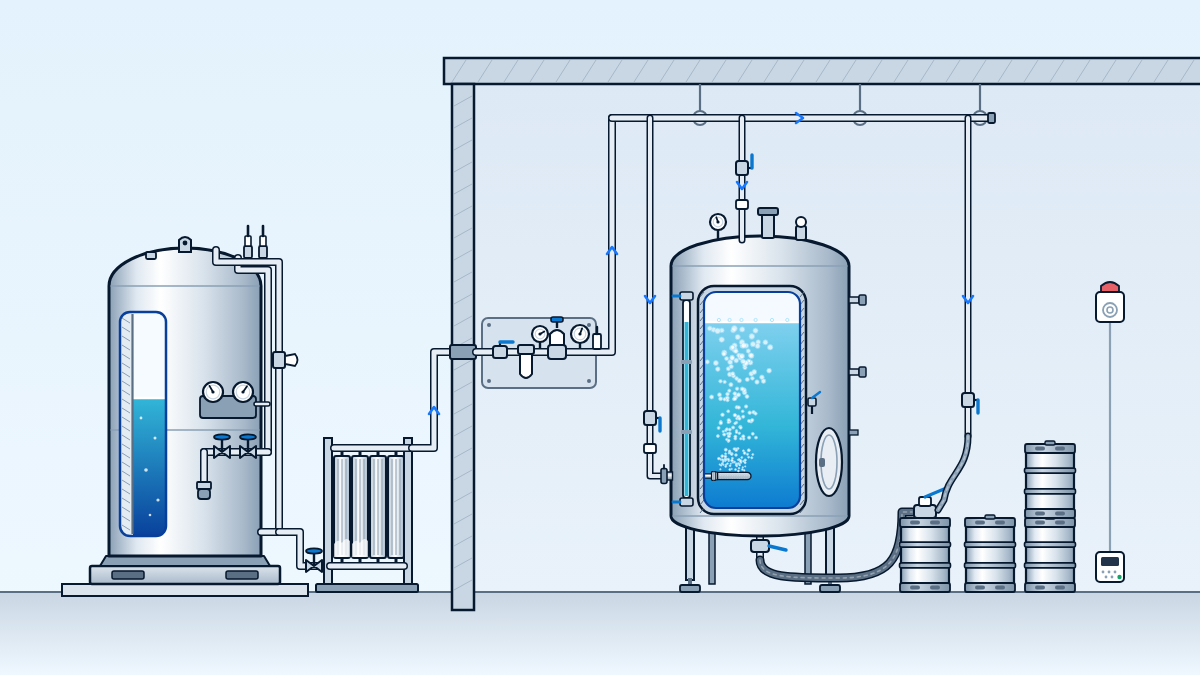
Every beverage business lives with two versions of the same molecule. One is the prized fizz in the glass — the sparkle in a lager, the bite in a cola, the lively head on a draught pour. The other is the invisible gas that collects, unseen and unsmelled, on the floor of the cellar where the cylinders are kept. Carbon dioxide (CO2) is both. Understanding how it moves from a bulk tank or a swapped cylinder into the drink — and what it does on the way — is the difference between a reliable carbonation supply and an expensive, occasionally dangerous, afterthought.
What CO2 actually does in a beverage business
CO2 creates the carbonation in carbonated drinks. Dissolved under pressure, it forms the carbonic acid and the bubbles that define a sparkling beverage. But its job does not end at the fizz. Brewers and bottlers use CO2 to purge tanks, lines and fillers of oxygen and to blanket finished beer or soft drink, protecting flavor and shelf life from oxidation. In the taproom and the restaurant, CO2 is also the muscle that pushes draught beer and post-mix soda from the keg or bag-in-box to the tap.
Three jobs — carbonate, protect, dispense — mean one thing for procurement: a brewery, cannery or bottling plant is a steady, daily CO2 consumer, not an occasional one. That steady demand is exactly what should shape how the gas is supplied.
The CO2 supply ladder
CO2 supply scales in recognizable steps, and most beverage producers move up the ladder as they grow.
- Small and starting out: buy or swap high-pressure CO2 cylinders from a local gas filler. Simple, low capital, but you pay a premium on every kilogram and you are tied to someone else’s delivery schedule.
- Growing: bring filling in-house. A CO2 filling station, fed by bulk liquid CO2, fills your own pool of cylinders on site. The heart of it is a cryogenic cylinder filling pump, which raises the liquid pressure above what already sits in the cylinder so the CO2 transfers in liquid phase.
- Large and steady: install bulk liquid CO2 storage — a refrigerated pressure vessel in the class of our liquid CO2 equipment and pressure vessels, typically rated around 2.2 MPa and refilled by tanker. A vaporizer then converts the liquid to gas on demand, feeding carbonators and dispense lines directly.
Why CO2 cylinders are filled by weight
Here is a detail that trips up newcomers: a CO2 cylinder is filled by weight, not by pressure. Under cylinder pressure CO2 is a liquid, so the gauge reads the same near-constant vapour pressure whether the cylinder is nearly full or nearly empty. Only the mass tells you how much product is inside. That is why scales and load cells sit at the center of any filling loop — they define the fill accuracy and the overfill protection that a pressure gauge simply cannot provide. When you specify a filling station, you are specifying a weighing system as much as a pump.
Liquid CO2 held in cryogenic liquid cylinders raises the same question: the pressure gauge does not tell you how much liquid is left. Liquid cylinder level gauge types compared explains why pressure can’t show liquid CO2 level and what each gauge type reads instead, and remote level monitoring with a CryoFor TM2 module is covered under liquid cylinder telemetry. TM2 is a monitoring device, not intended for commercial gas metering, so invoicing stays with your metering equipment.
When bulk beats cylinders
The economics follow the same logic as any consumable bought in small versus large packages. Every cylinder swap carries a premium per kilogram — for the handling, the transport and the rental of someone else’s steel. That premium is invisible when you use a cylinder a month and painful when you empty several a day. Past a threshold, a bulk tank with on-site filling, or direct vaporized supply, pays back the capital and keeps paying.
The honest way to size a CO2 system is to start from your daily kilograms of CO2 — across carbonation, purging and dispense combined — and work outward. That single number tells you whether you belong on swapped cylinders, a filling station, or a bulk tank, far better than the number of beers you brew.
“Beverage-grade” is a property of the gas, not the tank
Beverage-grade or food-grade CO2 is a specification of the gas supply and of the local food regulations that govern your market. It is not a property of the tank, the pump or the vaporizer. A pressure vessel stores whatever liquid CO2 is fed into it; a pump moves whatever it is given. The equipment does not make gas food-safe.
So the grade has to be confirmed twice: with the liquid CO2 supplier who fills your tank, and against the food rules of the destination market where the drink is sold. We flag this at the point of equipment selection rather than making blanket claims that a machine is “beverage-grade.” Choosing hardware that is clean, correctly specified and compatible with food-grade CO2 is our job; certifying the gas itself is the supplier’s and the regulator’s.
Safety: the invisible gas that pools low
CO2 is colorless, odorless and an asphyxiant, and it is heavier than air. That combination is why it pools in exactly the low, enclosed places where beverage CO2 lives — cellars, cold rooms, walk-in coolers and enclosed dispense areas. A leak does not rise and disperse; it settles, silently displacing the air a person breathes.
Three controls belong in every specification: ventilation sized for the space, fixed CO2 gas monitors that alarm before levels become dangerous, and cold-burn PPE for anyone handling liquid CO2 or working the filling loop. Note the important distinction from nitrogen systems: for CO2 the correct instrument is a CO2 detector, not an oxygen monitor. An oxygen depletion sensor can miss a CO2 build-up until it is already hazardous, so the gas being measured must match the gas in the room.
Configuring your CO2 supply chain
Cryofortune configures the whole CO2 supply chain — high-pressure cylinders, filling station, cryogenic pump, bulk tank and vaporizer — sourced from a network of vetted Chinese manufacturers and matched to the codes and documents of your destination market. We are a sourcing and engineering supplier, not a factory, which means we specify the right equipment for your daily kilograms and your local rules rather than pushing a single product line.
Tell us your daily CO2 usage, your number of kegs or your bottling throughput, and we will size the supply from there. Start at our contact page.
Availability and applicability of any standard, certificate, marking or registration procedure are confirmed for the specific manufacturer, model and order before production.