
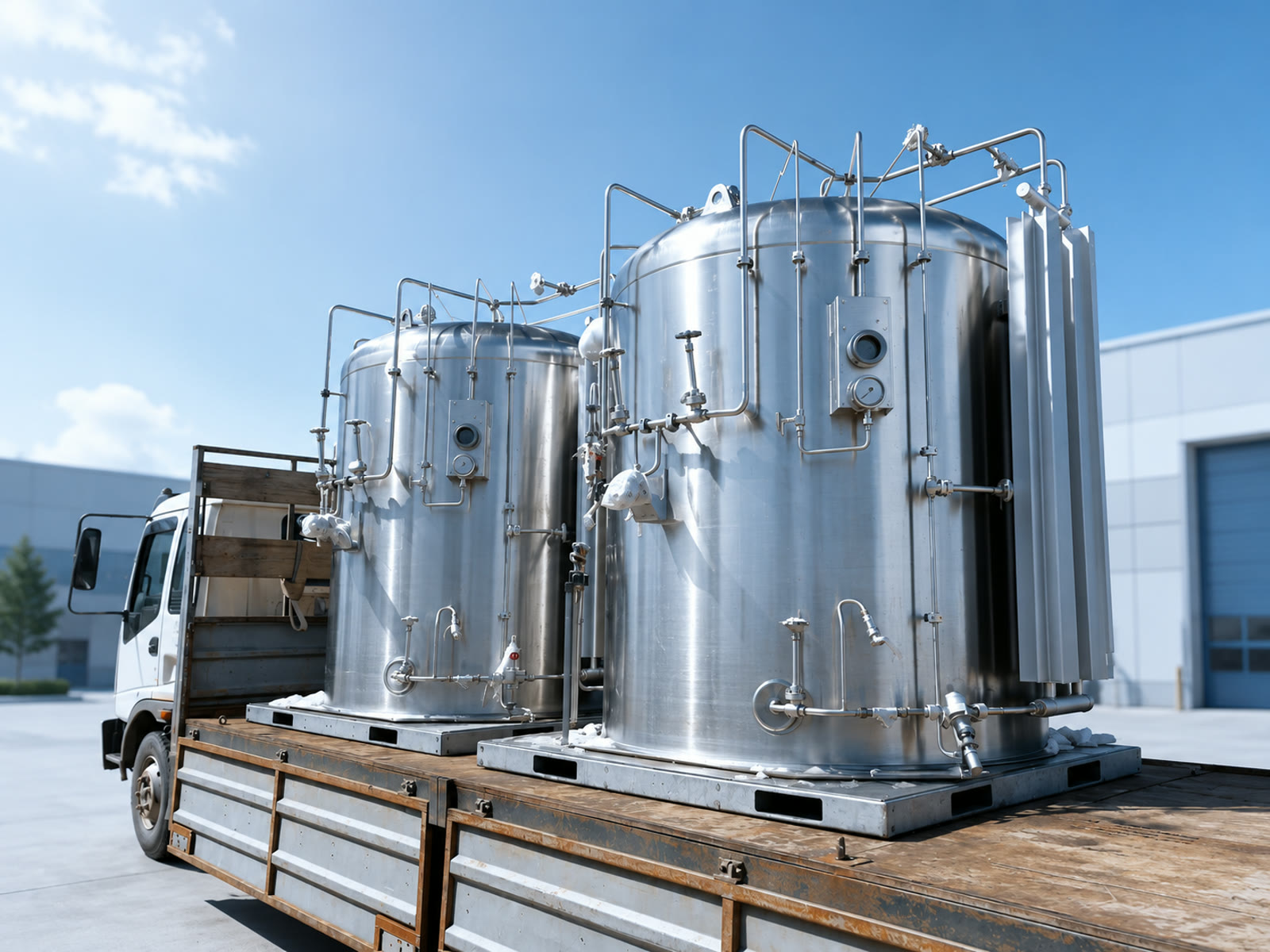
A gas supply system contains more vessels than the storage tank at its centre. Receivers, buffer tanks and mixture vessels hold gas at ambient temperature and elevated pressure, absorbing the difference between steady supply and stepped demand.
This page describes where such vessels sit in a station, which catalogue items belong to the class, and how design codes are routed by destination country.
What counts as a pressure vessel in a gas supply station
In the regulatory sense, a pressure vessel is any closed container operating above atmospheric pressure. That definition also covers vacuum-insulated cryogenic tanks, which the industry engineers and certifies as a family of their own. Those are covered on their own product pages — the vertical cryogenic storage tank for bulk reserve and the vertical cryogenic cylinder range for local storage — and in the storage tank price guide.
Here the term is used the way station designers use it: ambient-temperature vessels that condition pressure and flow on the gas side. The group includes receivers downstream of vaporizers, buffer tanks inside gas-mixing systems, and seamless cylinders that carry compressed gas to the point of use.
Where receivers and buffer vessels appear
Three positions account for most receiver duties in a gas station.
- After the vaporizer. A vaporizer converts stored liquid into gas as demand draws it, and a receiver behind it damps pressure swings when the draw is uneven. Where outlet temperature also needs support, a gas heater is added between the two.
- Inside gas-mixing systems. A mixer doses two components to a set ratio, and a buffer vessel holds the prepared mixture so outlet pressure stays within the band when consumption steps.
- Ahead of filling lines. Filling stations use receivers to decouple the supply side from pumps and filling manifolds. The cylinder filling pump page and the CO2 filling station setup guide cover this arrangement in detail.
Gas receivers and buffer tanks in the catalogue
The current catalogue concentrates on receivers for gas-mixing service. Vessels for other receiver duties are sourced per project through the same manufacturer network, against the same documentation logic.
- Gas Mixture Buffer Tank — a standalone receiver installed after the mixing unit. Two sizes, 600 L and 2,000 L, both rated 0.8 MPa working pressure, for prepared Ar/CO2, Ar/O2, Ar/He and N2/CO2 mixtures.
- Gas Mixer with Buffer Tank — dosing and buffering in one package. Outlet flow 50–300 m³/h, mixing accuracy 0.5–1%, outlet pressure adjustable 0.05–0.6 MPa (0.3–0.5 MPa on 50 m³/h units).
- Gas Mixing Cabinet with PLC Control — a cabinet-format mixing and control unit with PLC, centralizing dosing, pressure regulation and operator monitoring. Where mixture demand steps sharply, it is typically installed with a separate buffer tank.
- High Pressure Gas Cylinder — transportable seamless vessels, 5–50 L, working pressures 150–300 bar, manufactured to ISO 9809-1; approvals confirmed per destination. A different regulatory family from stationary receivers, listed here for completeness.
Design codes follow the destination
Stationary pressure vessels are certified against the rules of the country where they are installed, not where they are built. Depending on destination, ASME Section VIII, the European Pressure Equipment Directive with EN 13445, or AS 1210 may apply; the governing code is confirmed per order. The standards hub maps these regimes by region.
Because Cryofortune works with a network of manufacturers rather than one factory, the vessel supplier is selected per destination against the required code and documentation set. The export certification guide explains how that routing works in practice, and country pages such as Australia and New Zealand describe local specifics.
Specifying a receiver
A receiver enquiry is short. Five parameters set most of the configuration.
- Volume — sized from the flow swing and the allowable pressure band, not from the pipe diameter.
- Working pressure — set by the upstream source and the downstream regulation stage. The 0.8 MPa catalogue buffer tanks cover mixing-system outlet pressures of 0.05–0.6 MPa (systems fed at 0.6–1.2 MPa on the inlet side).
- Media — the gas or mixture composition determines shell material, internals and sealing.
- Oxygen service — vessels for oxygen or oxygen-rich mixtures call for oxygen-clean preparation and compatible seals. State oxygen duty explicitly in the enquiry.
- Connections — relief valve, gauge, drain and port orientation are fixed at order stage, together with instrumentation.
Buffer tanks in gas mixing systems
A gas mixer blends two components — argon and CO2, argon and oxygen, or nitrogen and CO2 — to a set ratio, but the mixer on its own cannot hold steady pressure when downstream draw changes. As welding torches or packaging lines start and stop, flow through the mixer surges and drops, and outlet pressure, along with the blend ratio, wanders with it. A buffer tank, also called a gas receiver, placed downstream of the mixer solves this. It accumulates a reserve of prepared mixture, so the line sees stable pressure and a consistent blend while demand rises and falls, keeping the delivered gas within its set tolerance. The mixer then refills the tank between peaks instead of chasing every fluctuation in real time.
The buffer volume is sized to the demand swing: the larger and more abrupt the peaks in draw, the more accumulated mixture is needed to ride through them without pressure sag. The receiver itself is a pressure vessel, specified by its volume and working-pressure rating and matched to the mixer’s flow and outlet range rather than chosen in isolation.
For a packaged solution, we supply gas mixers with receiver that combine dosing control and short-term accumulation in one unit, while a standalone gas mixture receiver adds buffering to an existing mixer. Both sit within wider gas filling systems, and where the feed gas is drawn from cryogenic liquid, an upstream vaporizer supplies the gaseous components to the mixer. The full picture of gas blending is set out in our gas mixing system guide.
Frequently asked questions
What is a buffer tank (gas receiver) for?
A buffer tank, or gas receiver, is a pressure vessel that holds a reserve of gas between the source and the point of use. It absorbs short-term swings in demand so that line pressure stays steady when consumption starts, stops or surges. In a mixing system it stores prepared mixture; in a filling or supply line it evens out the flow to filling posts, compressors or process equipment.
What is the difference between a receiver and a buffer tank?
In practice the two terms are often used interchangeably. Both are pressure vessels that accumulate gas to stabilise pressure and smooth flow. “Receiver” is common where a vessel collects gas from a compressor or vaporizer, while “buffer tank” is often used for the reserve that sits after a mixer or ahead of a variable load — but the function, to accumulate and stabilise, is the same, and many catalogues list a single vessel under both names.
How is a gas buffer tank sized?
Sizing follows the demand swing and the working pressure. The bigger and more abrupt the peaks in draw, the more stored volume is needed to ride through them without a pressure drop; the working-pressure rating then sets the wall and flange class for that duty. Flow rate, inlet and outlet pressure, connection layout and how often demand cycles all feed into the final volume and pressure class. Share your consumption profile with our team and a vessel can be matched to it.
Do I need a buffer tank for a gas mixing system?
If your draw is steady, a mixer can feed the line directly; but where consumption varies — torches, packaging heads or process steps switching on and off — a buffer downstream of the mixer keeps both pressure and blend ratio steady. Without it, outlet pressure and the mixture ratio drift as flow changes. A gas mixer with receiver packages the mixer and buffer together for exactly this reason.
What certification does a pressure vessel / receiver need?
That depends on the destination market and how the vessel is used. Different regions follow different pressure-equipment rules and design codes, so the marking, documentation and registration for a receiver are set by where it will be installed rather than by any single global standard. A vessel can be aligned with the codes that apply to your project — see our overview of standards and of equipment by country — but the specific certificates always belong to a given manufacturer, model and order.
Configurations and documentation are confirmed for the specific manufacturer, model and order before production. Send a rough duty description — gas or mixture, flow, pressure band and destination country — and we will propose a receiver configuration with the matching documentation route.