
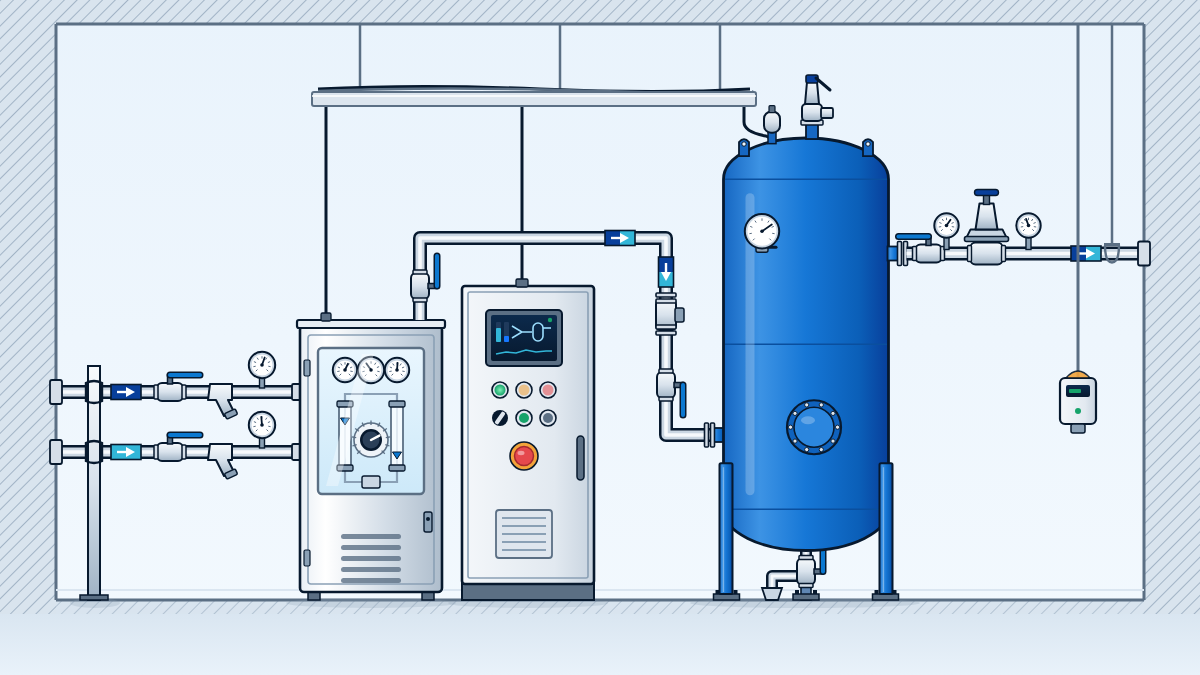
Many industrial processes do not run on a single bottled gas. They run on a precise blend of two gases, held at a set ratio and a steady pressure. A welding shop shields the arc with argon mixed with carbon dioxide; a food line flushes packs with nitrogen mixed with carbon dioxide to slow spoilage; a laboratory needs a repeatable process or calibration blend. Buying that mixture in premixed cylinders is fine at low volume, but as consumption grows it becomes costly and inflexible. A gas mixing system prepares the blend on site from two supply gases and keeps it stable while demand rises and falls.
The clue to why these systems have more than one part is in the two searches people run most: “gas mixing system” and “gas mixer with buffer tank.” The mixer sets the ratio; the buffer tank keeps that ratio and pressure steady at the point of use. This article walks through the building blocks, explains why the buffer tank matters as much as the mixer, and shows how the parts are sized for a specific job.
Why prepared two-component gas mixtures matter
Welding is the largest application. An argon and carbon-dioxide blend (Ar/CO2) is the standard shielding gas for carbon and low-alloy steel: the argon stabilizes the arc while the carbon dioxide improves penetration, and the exact ratio changes bead shape, spatter and heat input. Argon with a small percentage of oxygen (Ar/O2) is used on stainless and some alloy work. Argon with helium (Ar/He) raises heat input for thick sections and highly conductive metals such as aluminium and copper.
Outside the welding shop, a nitrogen and carbon-dioxide blend (N2/CO2) is the workhorse of modified-atmosphere packaging (MAP), where replacing the air inside a sealed pack with a controlled mixture slows microbial growth and extends shelf life. Laboratories and process lines use the same two-component blends where a repeatable, documented composition matters more than raw volume. In every case the value is the same: a consistent ratio, delivered continuously, without hand-swapping premixed cylinders.
The three building blocks of a gas mixing system
A complete system is built from three cooperating parts:
- The mixer doses two incoming gases to a set ratio. It takes both supply gases at a controlled inlet pressure and blends them continuously to the target composition. A gas mixer with a receiver combines this dosing with short-term accumulation so the blend reaches downstream lines with steadier pressure and flow.
- The buffer, or receiver, tank accumulates the prepared blend after the mixer. It is not the mixer itself: it holds ready mixture, absorbs short swings in demand, and makes the supply line easier to regulate. A dedicated gas mixture receiver keeps pressure and ratio steady when consumption jumps.
- The mixing cabinet with PLC control packages dosing, pressure regulation, operator indication, alarms and monitoring in one protected enclosure. A gas mixing cabinet acts as the control node of the package and can distribute the prepared mixture to several consumption points.
Why a mixer on its own gives unstable output
A mixer meters two gas streams in proportion. That works cleanly only while the draw downstream is constant. In real production the draw is never constant: torches are struck and stopped, packaging heads cycle, work areas come on and off shift. Each change in demand pulls on the mixer, and a mixer chasing every fluctuation delivers a blend whose pressure, and sometimes whose ratio, wanders.
The buffer tank is the fix. By holding a reservoir of already-blended gas, it absorbs short-term changes in consumption across one or several work areas, so the mixer does not have to chase every spike. Pressure at the point of use stays inside a tighter band, the ratio holds, and the whole line becomes easier to regulate. This is exactly why “gas mixer with buffer tank” is a buying pattern rather than two separate purchases: the tank is what turns a dosing device into a stable supply. That tank is a rated pressure vessel, sized and documented for the duty.
How a gas mixing system is sized
Sizing starts from the process, not the hardware. The key inputs are:
- Gas pair and target ratio, for example Ar/CO2 at a chosen percentage, which fixes the mixer’s dosing range and accuracy.
- Outlet flow, the continuous blend the line must deliver, quoted in cubic metres per hour.
- Inlet and outlet pressure, the supply pressure available to the mixer and the regulated pressure the process needs.
- Demand swing, how sharply and how often consumption changes, which drives the buffer volume. A steady single line needs a smaller receiver than several work areas cycling independently.
These figures point to a mixer of the right flow and mixing accuracy, and to a receiver of the right volume and working pressure. Configurations span roughly 50 to 300 m3/h of outlet flow with mixing accuracy on the order of a fraction of a percent, and receivers are offered in sizes such as 600 and 2,000 litres. The specific model is confirmed against the actual duty rather than assumed.
Feeding the mixer: cylinders or bulk supply
The mixer needs a reliable feed of each pure gas, and there are two ways to provide it. Cylinders or cylinder packs suit lower or intermittent consumption and are simple to start with; a gas filling system and manifold keep them switching without interruption. Higher or continuous consumption is usually cheaper and steadier from bulk: a liquid argon tank with a vaporizer on the argon side, and liquid CO2 equipment on the carbon-dioxide side, feed the mixer at stable pressure. The mixing package is the same in both cases; only the upstream supply changes, and the buffer tank helps decouple the mixer from swings on the supply side as well as the demand side.
Documentation and destination
Because the receiver is a pressure vessel, the paperwork depends on where the system will run. Design codes such as ASME Section VIII, the European Pressure Equipment Directive with EN 13445, or AS 1210 may apply according to the destination, and oxygen-bearing blends carry their own cleanliness and service requirements. Cryofortune does not manufacture these units; it sources them from a vetted network of Chinese manufacturers and configures the mixer, receiver and cabinet to the ratio, flow, pressure and documentation a project needs. If you are specifying a blend supply, tell us the gas pair, ratio, flow, pressures and destination, and we will match the configuration. Get in touch to start.
Availability and applicability of any standard, certificate, marking or registration procedure are confirmed for the specific manufacturer, model and order before production.