What “a complete system” means
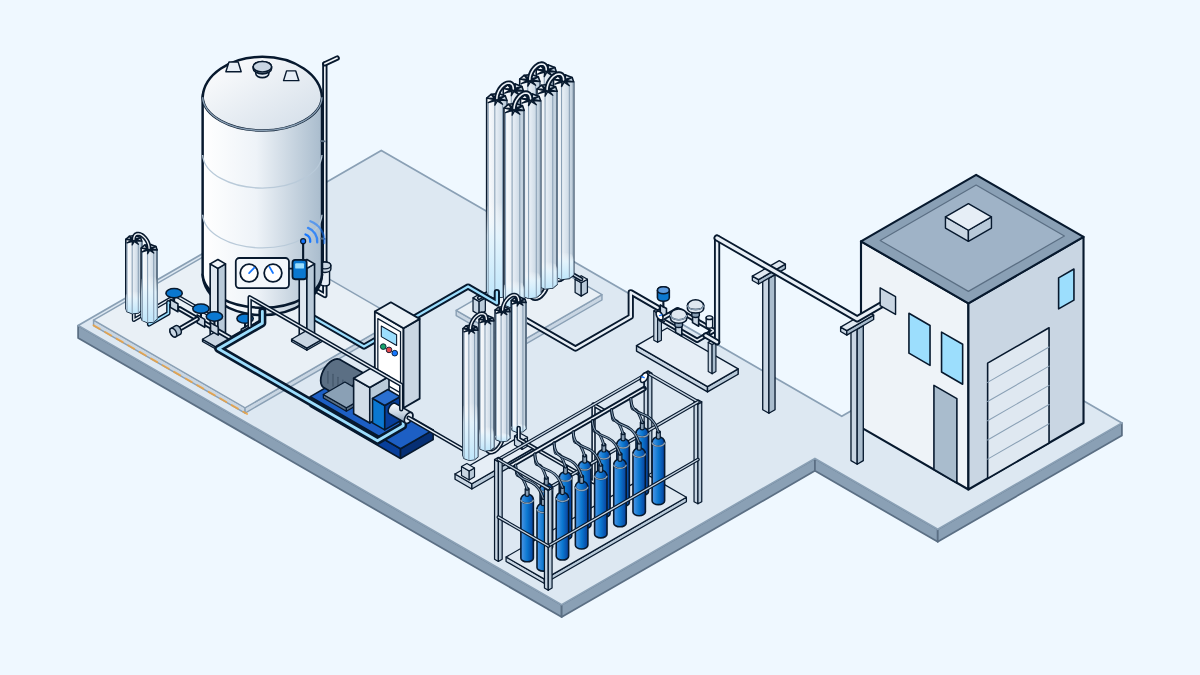
A complete system is the set of stages that move a cryogenic liquid from a storage vessel to gas at the pressure and flow your process actually consumes. In order, those stages are:
- Storage — a vacuum-insulated tank or cylinder holding the liquid.
- Pressure building — raising the liquid or head pressure so it will flow and vaporize.
- Vaporization — turning liquid into gas at a controlled rate.
- Pressure regulation — trimming gas to the delivery pressure the process needs.
- Distribution or filling — piping gas to points of use, or filling cylinders and tankers.
- Telemetry and controls — instruments, safety devices and remote monitoring across the chain.
Every stage has to be sized to the same duty. The number that ties them together is peak flow: the highest gas draw the system must sustain, not the average.
Walking the stages
Storage sets the buffer. For small or intermittent duties this may be microbulk tanks or vacuum dewars; for continuous supply it is a bulk vessel. Cryogenic storage tanks are chosen on four parameters — capacity, working pressure, evaporation rate and footprint — and come as fixed vertical site tanks or as 20 ft and 40 ft ISO-frame units when the same vessel doubles as transport. The tank’s working pressure quietly decides much of what follows downstream.
Pressure building comes in two forms. Small systems use a pressure-building coil on the tank itself; higher duties add a cryogenic pump — a reciprocating unit that lifts liquid to the discharge pressure a filling line or high-pressure process needs. Between stages, pressure vessels and buffer tanks hold gas so demand spikes do not stall the chain.
Vaporization is where the flow rating is won or lost. A cryogenic vaporizer converts liquid to gas; ambient-air units suit steady loads, while heated or trim units hold outlet temperature on CO2 and high-turndown lines. Undersize it and the gas leaves too cold or the flow collapses under peak draw — which is why the vaporizer sizing guide works from peak flow, ambient conditions and duty cycle, not nameplate averages.
Pressure regulation and distribution bring the gas to the working pressure of the pipe, cylinder or manifold. Telemetry and controls — level, pressure and temperature instruments, relief devices and remote monitoring — sit across the whole chain and are the part most often forgotten when boxes are bought separately. Gauges and level sensors let an operator see how much liquid remains and schedule refills, while interlocks and relief devices keep the chain safe when a stage trips.
Two common shapes
Most complete systems settle into one of two layouts.
A bulk gas supply feeds a plant that consumes gas — storage, pressure building, vaporization, regulation, then pipe to the process. Output is gas at a pipeline pressure.
A filling station turns liquid into filled cylinders or tankers. Here the pump and vaporizer are sized for fast, repeated fills, and a manifold with controls governs each cycle. Our gas filling systems page walks the five functional blocks — reserve, pressure-raising pump, vaporizer, manifold and optional heating — and the CO2 filling station setup shows how those blocks change for CO2, where trim heating and dry-ice lines enter the picture.
The two shapes share the same stages; what differs is where the flow and pressure peaks land, and therefore how each machine is rated.
Why a matched chain beats separate machines
Machines that look fine on their own datasheets can still fail as a set. Two failure modes dominate:
- Pressure classes must agree. If the tank is built to one working pressure and the pump discharges to another, the connecting pipe, valves and relief settings all have to be reconciled — sometimes with fittings that should have been specified up front.
- Flow must carry through. The chain delivers only as much gas as its smallest stage allows. A generous pump behind an undersized vaporizer gives you the vaporizer’s flow, cold; a large tank behind a small pump gives you the pump’s rate. Peak flow has to survive every stage.
Ordering the chain as one configured set means these agreements are checked before anything is built, not discovered at commissioning.
How a whole system gets configured across factories
Cryofortune is a sourcing and engineering supplier, not a factory. No single plant in the network makes every stage well, so a complete system is configured by matching each stage to a capable manufacturer and confirming the stages agree at their interfaces. The same duty-driven method described in how we select a manufacturer — destination country, equipment type, design standard, conformity route and documentation set — is applied to each item, then reconciled across the order so pressures, flows and fittings line up. The result is a matched set sourced from the network, not a pile of separately bought boxes.
Documentation for a multi-item order
A multi-item order carries more than one document trail. Each stage may sit under a different design standard and conformity route depending on the destination, and its certificates and technical files are defined before production. For the buyer this means one order can produce several coordinated document sets rather than a single blanket certificate — which is exactly why standards and paperwork are fixed per item at the start.
What to send for a system quotation
To configure a full set rather than quote a single box, send:
- Media — LN2, LOX, LAr, CO2, LNG or a mixture.
- Peak flow — the highest sustained gas draw, with duty cycle.
- Pressures — storage working pressure and the delivery pressure the process needs.
- Output type — gas to a pipeline, or filled cylinders and tankers.
- Destination — the country where the system will operate and be certified.
With those five, the whole chain can be sized together. Contact us with your duty and we will configure the stages as one system.
Availability and applicability of any standard, certificate, marking or registration procedure are confirmed for the specific manufacturer, model and order before production.