
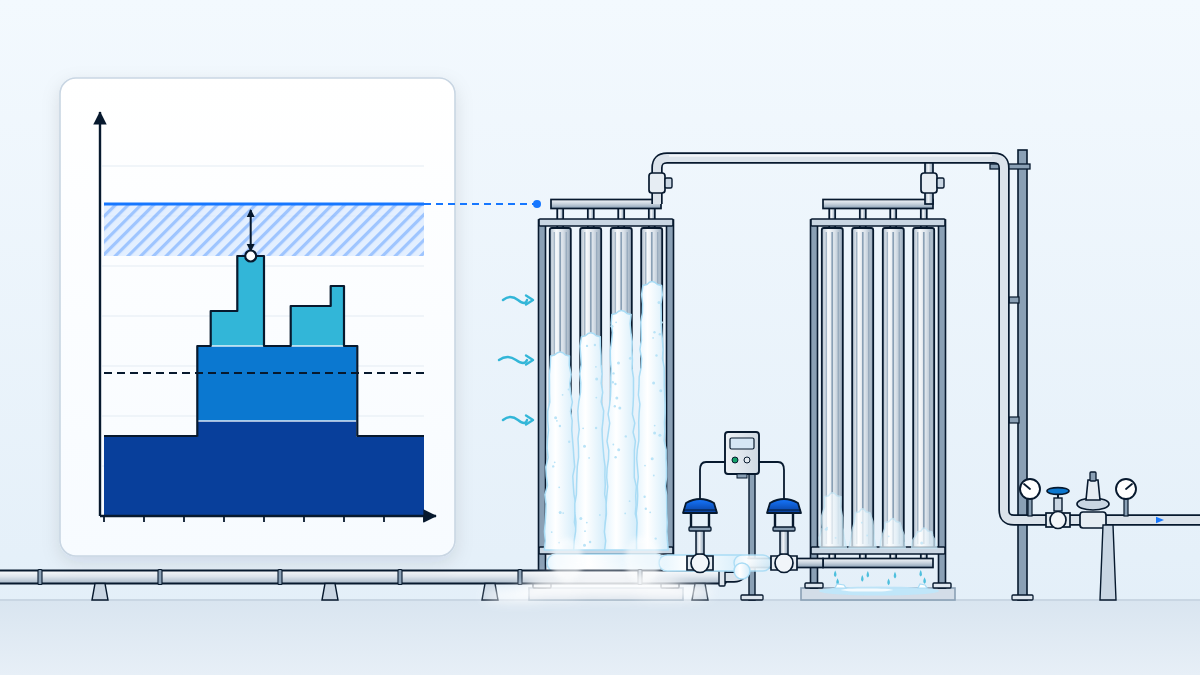
A cryogenic vaporizer converts stored liquid, LN2, LOX, LAr, or CO2, into gas at the temperature, pressure, and flow your process needs. Get the sizing right and the unit disappears into the background, delivering steady gas for years. Get it wrong and you face frosting, pressure droop, frozen pipework, or a vaporizer that simply cannot keep up at peak demand. Cryogenic vaporizer sizing is not guesswork: it follows from a handful of numbers you can establish before you ever send an enquiry. This guide walks through how to estimate the flow rate you actually need, how to decide between ambient-air and heated designs, and the common mistakes that lead to a wrongly specified unit.
Start with the four inputs that drive cryogenic vaporizer sizing
On the Cryofortune product page, selection is described as being built around four things: media, peak and average flow, inlet and outlet pressure, and site climate. Those are the right place to begin.
Media. Liquid nitrogen, oxygen, argon, and carbon dioxide each behave differently. Oxygen service demands cleanliness and material compatibility; CO2 has a much higher boiling point and triple-point behaviour that changes the thermal duty. Fix the gas first, because it constrains every downstream choice.
Peak and average flow. This is the heart of the exercise. A vaporizer must be sized for the peak instantaneous demand, not the daily average. A plant drawing 200 Nm³/h on average but spiking to 500 Nm³/h when several lines call at once needs a unit rated for the spike. Note the catalogue figures such as 500 m³/h and 350 m³/h are nominal capacity references; your duty case has to map onto them honestly.
Inlet and outlet pressure. The pressure your liquid source delivers and the pressure your process requires together set the operating envelope. The listed models illustrate the range, with working pressures around 200 bar (test pressure 300 bar) on the high-pressure TGV units and 3.0 MPa on the TGN unit. Specify the pressure you need at the point of use, after line losses, not at the tank.
Site climate. Ambient temperature and humidity are not background details; they directly determine whether an ambient-air design can carry your load. We return to this below.
How to estimate required flow rate
Convert everything to a single, consistent unit—usually normal cubic metres per hour (Nm³/h)—then build up your demand profile:
1. List every consumer. Each machine, burner, blanketing line, or filling point that draws gas, with its individual flow. 2. Find the realistic peak. Add the flows that can run simultaneously. Apply a diversity factor only where you are confident loads never coincide; when in doubt, assume they do. 3. Add a margin. A sensible safety margin (commonly in the 15-25% range) covers future growth, measurement uncertainty, and gradual fouling. Undersizing is far more expensive to fix than a modest overspecification. 4. Define the duty cycle. Continuous 24/7 supply, intermittent batch draw-off, and short high peaks are three different problems. A vaporizer that recovers easily between intermittent draws may frost solid under continuous load. 5. State average flow too. Average flow governs operating economics and, for ambient units, the recovery time the heat exchanger gets between peaks.
Carry these five figures, peak flow, average flow, duty pattern, outlet pressure, and gas, into every conversation with a supplier. They are what a competent engineer needs to confirm a model.
Ambient-air vs heated vaporizers: how to choose
Cryofortune supplies ambient-air, water-bath, and steam-heated or electrically heated configurations, matched to duty and climate. Each has a clear home.
Ambient-air vaporizers draw heat from the surrounding air across finned tubes. They consume no fuel or electricity for vaporization, which makes them the economical default for low-to-moderate, intermittent duty in temperate climates. Their weakness is the flip side of their strength: as the fins extract heat, they cool and accumulate frost, which insulates the surface and steadily reduces capacity. That is why ambient units are often installed in multiple banks that alternate, one running while another defrosts.
Heated vaporizers, water-bath, steam, or electric, supply an external, controllable heat source. Choose them when you need genuinely continuous high flow, when the climate is cold or humid enough to defeat ambient defrost cycles, or when outlet temperature must stay within a tight band regardless of weather. Steam-heated units suit sites with existing steam; electric suits sites without it. The trade-off is operating cost and utility infrastructure.
A useful rule of thumb: if your demand is steady, high, and around the clock, or you are in a cold or very humid location, lean heated. If your demand is intermittent and your climate is mild, ambient is usually the lower-cost answer, provided you allow space and bank capacity for defrost.
How to size an electric vaporizer in kW
Electric vaporizers are the one type you size in kilowatts rather than in nominal cubic metres, and that changes the arithmetic. The heater has to supply two things: the latent heat that turns the liquid into gas, and the sensible heat that warms that cold gas up to the outlet temperature the line requires. Add them together, divide by the heater efficiency, and add margin.
For liquid nitrogen the latent heat is roughly 199 kJ/kg, and warming the resulting gas from minus 196 degrees Celsius to around ambient adds a further 210 to 220 kJ/kg. One normal cubic metre of nitrogen weighs about 1.25 kg, so the total duty works out at roughly 0.145 kWh per normal cubic metre. Oxygen lands close to the same figure, argon a little lower at around 0.13 kWh because it warms with less energy, and liquid CO2 drawn from a refrigerated tank sits near 0.17 kWh. These are heat-duty figures, not nameplate power.
Turning duty into a heater rating means two more steps. Electrical heating is efficient but not free of losses, so divide by roughly 0.9 to 0.95 for element and vessel losses. Then add the same margin you would add anywhere else, commonly 15 to 25 percent, for fouling, voltage variation and future growth. The practical rule that comes out of this: allow about 0.18 to 0.20 kW of installed heater power for every normal cubic metre per hour of continuous nitrogen or oxygen flow. A line drawing 100 Nm3/h continuously therefore needs a heater in the 18 to 20 kW class, and 500 Nm3/h puts you near 100 kW, which is the point where the electrical supply, not the vaporizer, usually becomes the constraint.
That electrical supply deserves checking before anything is ordered. A 100 kW three-phase heater at 400 V draws on the order of 145 A per phase, so the incoming supply, the cable and the protection all have to carry it. On sites where that capacity does not exist, a steam-heated unit or an ambient bank with a smaller electric trim heater is often the cheaper answer, because the trim heater only has to cover the shortfall rather than the whole duty.
Three further points decide whether the sizing holds up in service. Control should be on outlet temperature, with stepped or thyristor control so the heater turns down cleanly instead of cycling hard at part load. Element sheath watt density matters: a heater rated correctly on paper but built with too much power per unit of surface area runs its elements hot and shortens their life. And electric units are effectively instant-on, which makes them a strong match for intermittent and peaking duty where a water bath would spend most of the day heating water nobody needs.
Don’t underestimate climate, frosting, and duty cycle
The most common sizing error is treating an ambient-air vaporizer’s nameplate capacity as a continuous figure. It rarely is. Capacity quoted under favourable conditions degrades as ambient temperature drops, humidity rises, and frost builds. A unit that comfortably meets your peak in summer at 30°C can fall short on a damp winter morning.
Three practical safeguards:
- Size ambient units for your worst-case climate, not the annual average. Use the coldest, most humid realistic operating condition.
- Plan for defrost. Either accept duty cycling with multiple banks, or move to a heated design if you cannot tolerate the capacity dip.
- Watch outlet temperature. Gas delivered too cold can damage downstream equipment and embrittle piping. Where this matters, trim heaters and multiple banks are added to hold a steady outlet temperature when continuous high flow or cold climates require it.
A practical cryogenic vaporizer sizing checklist
Before you request a quotation, confirm you can answer each of these:
- Gas / media: LN2, LOX, LAr, or CO2, with any purity or cleanliness requirements.
- Peak flow (Nm³/h): the simultaneous maximum, with margin added.
- Average flow (Nm³/h): for economics and recovery assessment.
- Duty cycle: continuous, intermittent, or short-peak.
- Inlet pressure: what the liquid source delivers.
- Outlet pressure at point of use: after line losses.
- Required outlet temperature: and the tolerance on it.
- Site climate: worst-case ambient temperature and humidity.
- Installation context: indoor or outdoor, available utilities (steam, power), footprint, and the application, whether industrial gas supply, food and beverage, electronics, medical oxygen, laboratory, or welding.
- Standards and documentation: the destination market’s requirements, since available certificates depend on product type, market, and the agreed supply standard.
Working through this list usually reveals the ambient-versus-heated decision on its own, and it gives the supplier everything needed to confirm a model rather than guess.
Closing thoughts
Sound cryogenic vaporizer sizing comes down to defining your real peak flow, being honest about duty cycle and climate, and matching those to the right ambient or heated configuration, with trim heaters or multiple banks where continuous high flow or cold conditions demand them. The numbers are not difficult to assemble, and assembling them before you enquire saves weeks of back-and-forth and protects you from the costly mistake of an undersized unit.
Cryofortune sources and supplies cryogenic vaporizers in ambient-air, water-bath, steam-heated, and electrically heated configurations for LN2, LOX, LAr, and CO2 service, shipping to export-oriented projects worldwide with the export documentation each destination market requires. If you have your flow, pressure, and climate figures in hand, you can review configurations and specifications on the cryogenic vaporizer product page and use them as the basis for a properly grounded enquiry.