
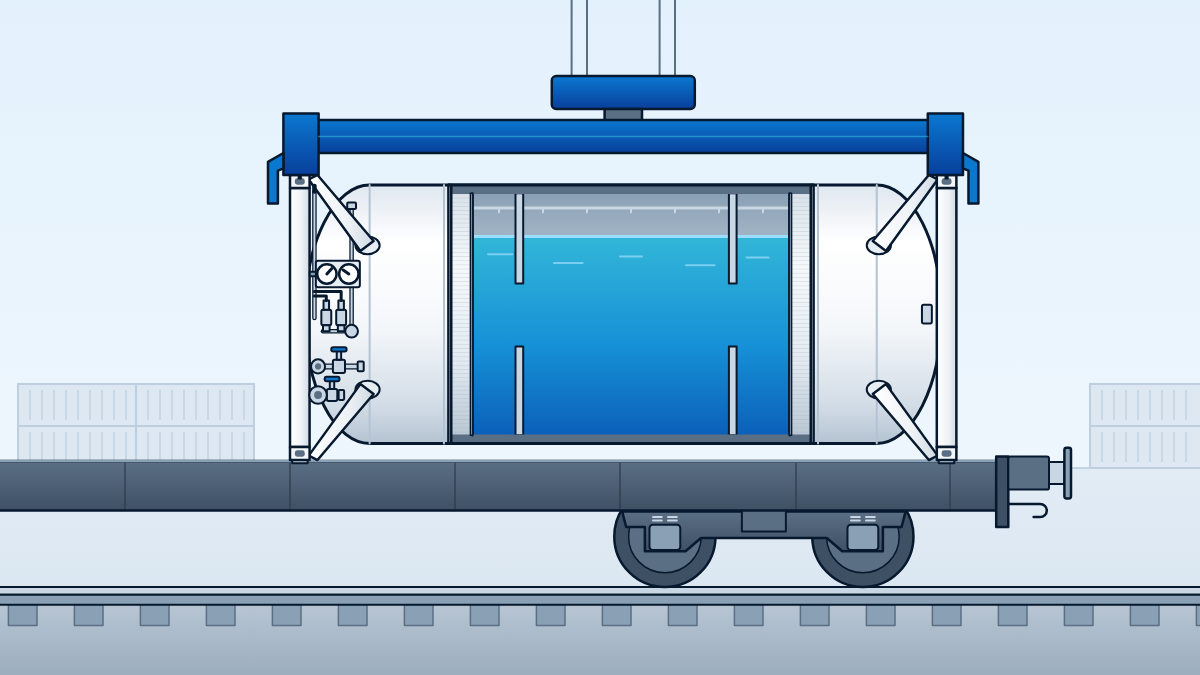
A 20 ft cryogenic ISO tank container is one of the most practical ways to move and hold liquefied cryogenic media, but it is also one of the easiest pieces of equipment to specify incorrectly. The same external footprint can hide very different working pressures, usable volumes and payloads, and those differences decide whether the unit fits your route, your gas and your filling regime. This guide explains what actually varies between configurations of a cryogenic ISO tank container, how to read the capacity and pressure figures, and which questions to settle before you send an inquiry.
The reference point throughout is a real 20 ft product line built around a vacuum-insulated inner vessel inside a standard ISO-style frame, offered in several pressure and volume variants. Use it to sanity-check whatever quotation lands on your desk.
What a 20 ft cryogenic ISO tank container actually is
A cryogenic ISO tank container is a double-walled pressure vessel mounted in a 20 ft ISO container frame so it can be handled, stacked and transported like any standard intermodal box. The inner vessel holds the liquefied gas; the space between the inner and outer shells is held under vacuum with multilayer insulation to slow heat ingress and keep the contents cold. You will also see the same equipment described as an ISO cryogenic tank container, a T75 tank container, or a 20 ft LIN/LOX/LNG container, depending on the market and the gas it carries.
The external dimensions stay close to the ISO standard across variants. On this product line the box measures roughly 6058 mm long and 2438 mm wide, with height between about 2519 mm and 2591 mm depending on configuration. That consistency is the whole point: it lets the unit travel by road, rail and sea and integrate with existing container handling without special arrangements.
Reading the specifications: pressure, volume and payload
Three numbers drive the decision, and they trade off against each other.
Working pressure. Across the available configurations, working pressure ranges from about 0.75 MPa to 2.3 MPa (roughly 7.5 to 23 bar). A higher-pressure tank holds gas more readily and supports pressure-driven discharge and longer holding before venting, but it tends to carry a heavier vessel and slightly less usable volume. A lower-pressure variant maximizes volume and is often suited to high-throughput logistics where the tank is filled and emptied quickly. Match the pressure rating to how the tank will be used downstream, not just to the gas.
Gross versus usable volume. Quotations list both, and the gap matters. On this line gross volume sits around 20.35 to 21.13 m3, while usable volume is roughly 19.33 to 20.4 m3. Usable volume is the figure that determines how much product you actually move, because a cryogenic vessel is never filled to 100 percent — ullage is reserved for thermal expansion and safe pressure management. Always compare suppliers on usable volume, not gross.
Payload by gas. The same tank carries very different masses depending on the liquid, because each cryogenic liquid has its own density. For the higher-pressure 2.3 MPa variant, for example, the stated payloads are approximately 22,845 kg of liquid oxygen, 23,100 kg of liquid argon, and 16,232 kg of liquid nitrogen. Argon and oxygen are dense and weight-limiting; nitrogen is lighter. This is where buyers most often go wrong — sizing on volume alone and then discovering the loaded unit exceeds a road weight limit. Net tank weights here run from roughly 7,380 kg to 10,945 kg, so confirm the combined tare-plus-payload figure against the legal gross weight for every leg of your route.
Matching the cryogenic ISO tank container to your gas and route
Start from the medium. This cryogenic ISO tank container family is configured for LCO2, LOX, LIN and LAR by variant, and the gas you carry should drive the pressure and volume choice rather than the other way around. A dedicated oxygen service unit, for instance, has cleanliness and compatibility requirements that you do not want to compromise by sharing across incompatible media.
Then layer in the route. Because the unit conforms to the ISO frame, it moves multimodally — but the binding constraint is usually the strictest weight or height limit along the journey, not the tank itself. A dense liquid like argon may force you toward a lower fill or a different variant to stay road-legal in a given country, even though the vessel could physically hold more. Map the full door-to-door path first, then pick the configuration that survives every leg.
Finally, consider duty cycle. Fast-turnaround distribution favors larger usable volume and lower pressure; intermittent use or longer site holds favor higher pressure and the pressure-building and discharge hardware that goes with it.
Instrumentation, valves and the connection package
A bare vessel is not an operating asset. Beyond the tank itself, a usable unit needs valves, gauges, fittings, relief devices and connection hardware, typically supplied as a connection package, plus instrumentation such as level indication, pressure monitoring and a control panel or operating accessories specified to the configuration. These determine how you fill, monitor and discharge in practice.
Treat the instrumentation list as part of the specification, not an afterthought. Two tanks with identical volume and pressure can behave very differently in service depending on their relief arrangement, level gauging and the fittings on the operating panel. Confirm that the connection package matches your filling station and receiving equipment — thread standards, connection types and relief settings — so the unit is ready to work on arrival rather than after a round of retrofits.
Common mistakes and a selection checklist
The recurring errors are predictable: buyers compare gross instead of usable volume; they size on volume and overlook payload mass for dense gases; they ignore the heaviest leg of the route; and they treat the connection package and instrumentation as a generic add-on rather than something that must match their site. Specifications such as static evaporation rate, inner and outer vessel materials, and exact certification scope are not universal across markets and should be requested in writing on a datasheet for the specific variant rather than assumed.
Use this checklist before you inquire:
- Gas and service — exact medium (LOX, LIN, LAR, LCO2) and whether dedicated service is required.
- Working pressure — matched to discharge method and holding needs (0.75 to 2.3 MPa range here).
- Usable volume — the real working capacity, not gross.
- Payload mass for your gas — checked against road, rail and port weight limits on every leg.
- Connection package and instrumentation — valves, relief devices, level and pressure monitoring matched to your filling and receiving setup.
- Documentation — datasheet, general arrangement drawing and operation documents for the specific variant.
- Certificates — confirmed for your destination market, since available certificates depend on product type, destination and the agreed supply standard.
20 ft vs 40 ft cryogenic ISO tank containers
Almost every cryogenic ISO tank container is a 20 ft unit, and the reason is weight, not volume. A cryogenic tank container carries a vacuum-insulated inner vessel, a heavy outer jacket and the ISO frame, and once filled with liquid it approaches the maximum gross weight allowed for road and rail transport. A 20 ft frame (ISO 1CC, nominally 6.06 m long × 2.44 m wide × 2.59 m high) reaches that weight limit before it runs out of length, so stretching to a 40 ft frame would add length that cannot be filled without exceeding axle and gross-mass limits. For dense cryogenic liquids the 20 ft format — typically built to the UN portable-tank T75 requirements for refrigerated liquefied gases — is the practical standard.
Where 40 ft ISO tank containers do appear is with lighter or non-cryogenic bulk liquids and gases, where volume rather than weight sets the limit. If you have seen “40 ft cryogenic ISO tank containers” advertised, confirm the actual medium, usable volume and filled weight against your transport limits before assuming the extra length buys extra cryogenic capacity — for most liquid nitrogen, oxygen and argon duties, more capacity comes from a fixed bulk storage tank on site rather than a longer container. The cryogenic ISO tank range is built around the 20 ft format for this reason. LNG is the exception: it is light enough that 40 ft T75 containers are common — see our 40 ft LNG ISO container.
Sourcing and export documentation
For international projects, the equipment is only half the order — the paperwork that lets it cross borders and pass acceptance is the other half. Cryofortune (cryofor.com/), an international sourcing and engineering supplier based in Foshan, Guangdong, supplies this 20 ft equipment for export-oriented projects worldwide, matching each order to a manufacturer selected from a vetted network in China, with the available certificates determined by product type, destination market and the agreed supply standard. Because requirements differ by country, confirm the exact certification and documentation scope for your destination early, while the configuration is still open.
A 20 ft cryogenic ISO tank container is a long-life asset, so the time spent matching pressure, usable volume and payload to your gas and route pays back over years of service. If you have your gas, route and duty cycle defined, you can review the full configuration table — pressures, volumes and per-gas payloads — and request a datasheet for your case on the 20 ft cryogenic tank container product page.
T75 ISO tanks: common questions
What does T75 mean on an ISO tank?
T75 is the UN portable-tank instruction for refrigerated liquefied gases — LIN, LOX, LAr, CO2, LNG. It defines design pressure, relief, insulation and approval requirements for multimodal carriage.
How long can a T75 container hold product without venting?
That is the declared hold time — typically days to weeks depending on media, fill level, pressure setting and vacuum condition. It is a key commercial spec for route planning.
What maintenance does a T75 ISO tank need?
Log the pressure-rise/boil-off trend as the vacuum health report, keep relief devices and periodic inspections (2.5/5-year) in date, exercise valves, and protect the frame and corner castings from corrosion.
What should I check on a used T75?
Periodic-inspection status, vacuum health via boil-off, relief-device test dates, valve condition, and that its approvals (ADR/RID/IMDG, TPED/Pi) match the routes you plan to run.