Specifying a cryogenic cylinder filling pump is one of those procurement decisions where the wrong call is expensive in ways that only surface months later: a pump that cannot reach your target cylinder pressure, a flow rate that bottlenecks the whole filling station, or a unit configured for the wrong liquid. Because these are reciprocating cryogenic machines moving liquids at temperatures down to roughly -196 °C and discharging at pressures up to 25 MPa, small mismatches between the duty and the equipment translate directly into downtime, cavitation, and rework.
This guide walks through the parameters that actually decide the selection — flow, discharge pressure, media, and installation format — so an engineer or buyer can shortlist sensibly before sending a single enquiry. The aim is to help you arrive at a specification you can defend, not to push a particular model.
Start With the Duty, Not the Pump
Before comparing any cryogenic cylinder filling pump on a datasheet, write down the duty in concrete terms. Three numbers anchor everything that follows:
- What you are pumping — liquid nitrogen (LN2), liquid oxygen (LOX), liquid argon (LAr), or carbon dioxide (CO2). Each has different density, vapour pressure, and, critically for LOX, different cleanliness and material requirements.
- How fast you need to fill — expressed as litres per hour of liquid throughput, derived from your cylinder size, fill cycle time, and how many cylinders you turn around per shift.
- The pressure you must reach — the discharge pressure required to fill your cylinders to working pressure with margin, not just the nominal cylinder rating.
A pump is only as useful as its fit to these three figures. Everything else — motor power, skid layout, instrumentation — follows from getting them right.
Match Flow Rate to Your Filling Throughput
Flow rate is where most undersizing happens. It is tempting to specify for average demand, but a filling station is sized for its busy periods. If a bay must turn around a full rack of cylinders before the next shift, the pump has to deliver that volume within the available window, including the dead time for connecting, purging, and disconnecting.
As a reference point, the DYB200 reciprocating family is offered at 800 L/h and 1000 L/h of liquid throughput, paired with 7.5 kW and 11 kW drives respectively. That step from 800 to 1000 L/h is not cosmetic: it is the difference between comfortably clearing a queue and watching cylinders back up. Calculate your peak hourly liquid demand, add a realistic contingency for connection overhead, and select the flow band above it rather than at it. Motor speed also matters here — reciprocating cryogenic pumps typically run in the 600–1250 rpm range, and the operating speed affects both delivered flow and wear life.
Get Discharge Pressure and Inlet Conditions Right
Discharge pressure is the second hard constraint, and it is media- and cylinder-dependent. The same DYB200 platform is built for two distinct pressure classes: a 16 MPa discharge version and a 22–25 MPa version. High-pressure industrial cylinders generally need the higher class; lower-pressure service is well covered by the 16 MPa build. Specifying 25 MPa capability when you only ever fill to 16 MPa adds cost and stress for no benefit, while doing the reverse leaves you unable to fill at all.
Inlet conditions are just as important and frequently overlooked. These pumps expect a stable supply of subcooled liquid — typically 0.3–0.8 MPa at the inlet from the storage tank. Insufficient inlet pressure or warm liquid causes cavitation, which destroys pump performance and shortens component life. Confirm that your storage tank’s pressure-build circuit can reliably deliver the inlet conditions the pump requires across your full operating range, not just on a cold morning.
CO2 duties sit slightly apart. A dedicated automatic CO2 filling station configuration runs at a 1.38–2.5 MPa inlet and around 10 MPa discharge with an 11 kW drive, reflecting CO2’s different phase behaviour. Do not assume an LN2/LOX/LAr pump can simply be repurposed for CO2.
Confirm Media Compatibility — Especially for LOX
Media compatibility is not a single yes/no answer; it is a configuration. The cryogenic cylinder filling pump range is offered for LN2, LOX, LAr, and CO2 by configuration, with availability varying by model. This matters for two reasons.
First, oxygen service is a safety discipline, not a parts swap. LOX demands oxygen-compatible materials, rigorous degreasing, and cleanliness controls throughout the wetted path. A pump built and cleaned for nitrogen is not automatically fit for oxygen.
Second, argon and nitrogen behave similarly but are not interchangeable in every detail when it comes to sealing and tolerances at the required pressures. Always state the exact gas — and whether the duty might change in future — so the unit is configured correctly from the outset. Retrofitting media compatibility after delivery is rarely clean.
Skid-Mounted vs Standalone: Decide Early
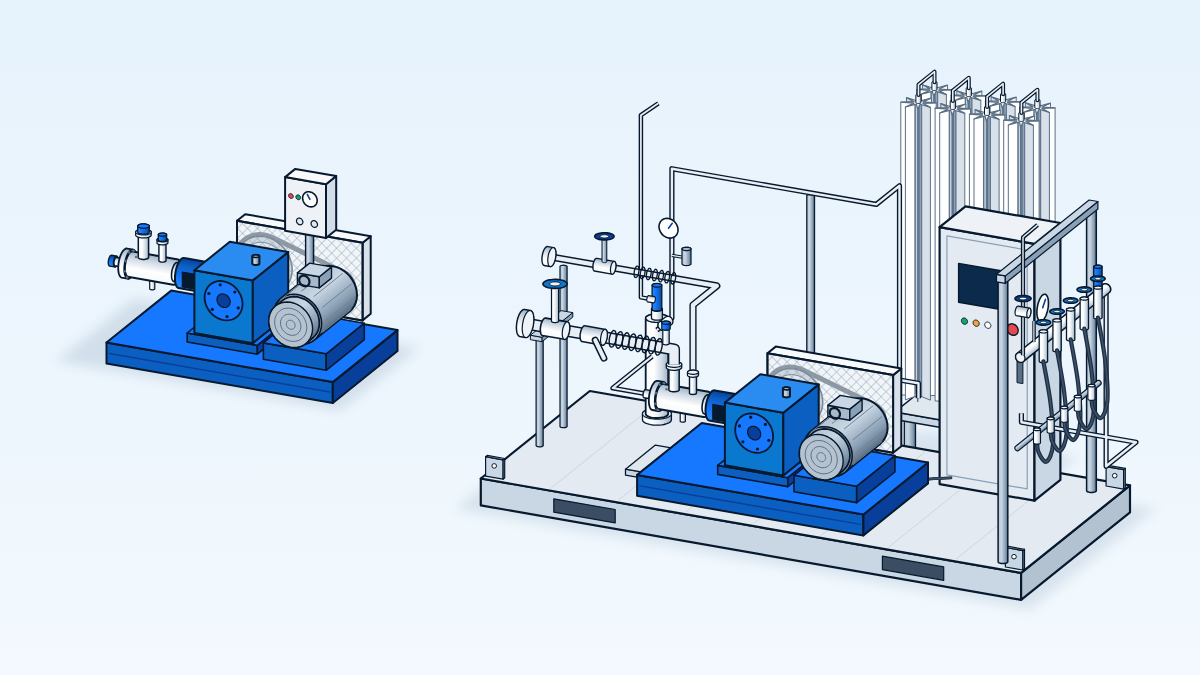
The choice between a standalone pump and a packaged pump skid shapes installation cost, commissioning time, and footprint, so make it deliberately rather than by default.
A standalone pump suits projects where an existing station already has the surrounding pipework, valving, controls, and a suitable foundation, or where a system integrator is assembling everything to a site-specific design. It gives maximum flexibility and a lower line-item cost, at the price of more integration work on your side.
A packaged pump skid arrives with the pump, drive, inlet and discharge piping, instrumentation, and controls pre-assembled and pre-tested on a single frame. For a new filling station, a remote site, or a fast project schedule, a skid compresses commissioning from weeks to days and reduces the risk of field assembly errors. It is also far easier to relocate later.
A useful rule: if you have in-house cryogenic engineering and existing infrastructure, a standalone unit is often the economical path; if you are building from scratch or want a turnkey, repeatable installation, specify the skid.
A Practical Selection Checklist
Before requesting a quotation, confirm you can answer each of these:
- Media: Exact liquid (LN2 / LOX / LAr / CO2), with LOX cleanliness flagged explicitly.
- Flow: Peak liquid throughput in L/h, including connection overhead — then select the band above it.
- Discharge pressure: Required fill pressure with margin, mapped to the 16 MPa or 22–25 MPa class (or ~10 MPa for CO2).
- Inlet conditions: Confirmed available inlet pressure (e.g. 0.3–0.8 MPa) and subcooled supply.
- Power and speed: Available drive (7.5 / 11 kW) and acceptable operating rpm.
- Format: Standalone vs packaged skid, based on existing infrastructure and schedule.
- Documentation: Export paperwork, test certificates, and material certs needed for your jurisdiction.
That last point is easy to forget until a shipment is held at customs. Cryofortune, based in Foshan, Guangdong, supplies this equipment for export-oriented projects worldwide, matching each order to a manufacturer selected from a vetted network in China, with the documentation support that cross-border industrial-gas installations require — worth confirming up front alongside the technical specification.
Get the duty defined, match it to the right flow and pressure class, lock in media compatibility, and choose your installation format deliberately, and the rest of the selection becomes straightforward. If you would like to review the available configurations, drive options, and skid arrangements against your own duty figures, see the full cryogenic cylinder filling pump range and use it as a reference point for your specification.