
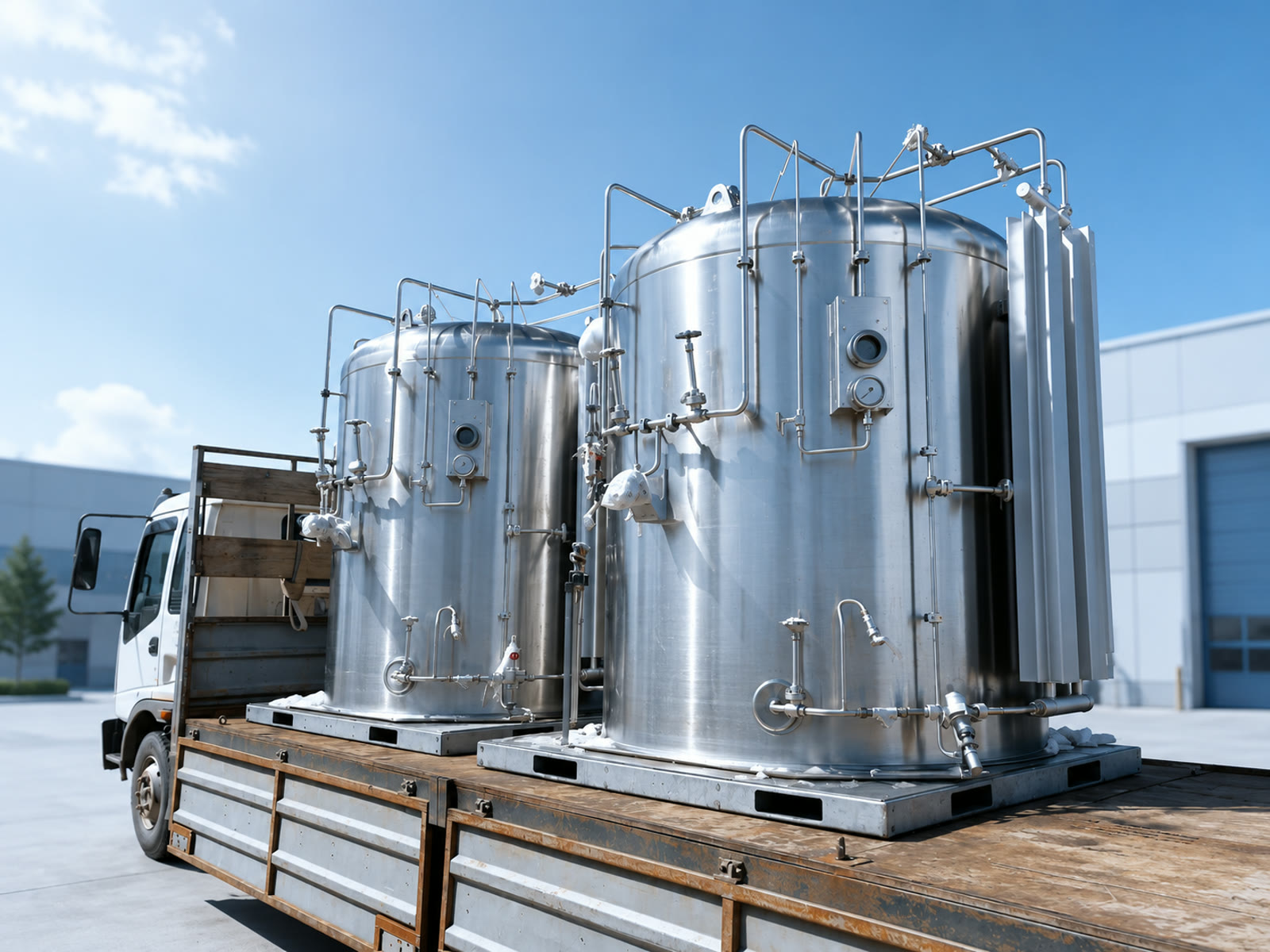
The European Union operates one conformity regime for placing pressure equipment on the market, and twenty-seven national regimes — thirty counting the EEA states — for operating it. A cryogenic tank that completes conformity assessment once may be placed on the market across the EU and the wider EEA. That same assessment settles nothing about siting, commissioning or in-service inspection, which remain national competence. Cryofortune Engineer & Supply Co., Ltd. structures EU supply around that split. Conformity is a factory-side matter, settled before shipment on a per-order basis. The national layer is mapped for the country where the equipment will actually stand.
Equipment supplied to EU and EEA buyers
Cryofortune sources cryogenic equipment from a network of Chinese manufacturers, with the factory selected per order rather than fixed in advance. For EU and EEA destinations the typical scope covers:
- Vertical cryogenic storage tanks for LIN, LOX, LAR and LCO2 service
- Ambient-air vaporizers matched to draw rate and climate
- Cylinder filling pumps for gas-filling operations
- Vertical and horizontal cryogenic cylinders for microbulk-scale users
- Liquid nitrogen dewar vessels for laboratory and biobanking use
- 20 ft cryogenic tank containers for bulk movement
- Dry ice pelletizers and high-pressure gas cylinders where the application calls for them
Demand in the EU concentrates in food and beverage processing, including nitrogen dosing and tunnel freezing; medical oxygen storage at hospitals and gas fillers; biobanking, IVF and cell-therapy cold chains; and inerting for metal fabrication, additive manufacturing and semiconductor plants. LNG and hydrogen projects form a smaller but growing configuration class.
Buying versus renting a cryogenic tank in Europe
Much of the installed bulk-tank base in Europe is owned by the gas supplier, not the gas user. Under that model the tank, its maintenance and the gas purchase are typically bound into one multi-year contract. Buying a CE-marked tank outright separates the vessel from the gas. The owner may then tender gas supply competitively, subject to the terms of any existing agreement. Whether ownership suits a given site depends on volume and utilisation, not on principle; the microbulk-versus-cylinders comparison is a reasonable starting point.
Layer one: PED 2014/68/EU conformity assessment at the factory
Static vacuum-insulated tanks, vaporizers and their pressure accessories fall under the Pressure Equipment Directive 2014/68/EU once maximum allowable pressure exceeds 0.5 bar. The directive sorts equipment into hazard categories I to IV by fluid group, pressure and volume. Cryogenic oxygen sits in fluid group 1, and bulk tanks in cryogenic service commonly land in the higher categories. From category II upward a notified body participates in conformity assessment, and its four-digit number accompanies the CE marking. Design to the harmonized EN 13445 and EN 13458 parts gives presumption of conformity with the essential safety requirements those standards cover. Other design codes may be used, but the notified body must then verify equivalence. A vessel built to ASME Section VIII is a sound vessel; it is not, by that fact alone, a CE vessel. The category, module and notified body route for a given tank are confirmed at quotation, not assumed.
TPED 2010/35/EU: transportable receptacles carry Pi, not CE
Transportable receptacles for Class 2 gases follow a different directive entirely. Gas cylinders, closed cryogenic receptacles and tank containers are assessed under TPED 2010/35/EU against the ADR and RID annexes, and carry the Pi marking rather than CE. The Pi mark covers placing on the market and use, including refilling, across the EU. Periodic inspection and testing of receptacles in carriage follows ADR, at intervals set per gas. Cryogenic ISO tanks and tank containers are specified against this track from the outset. Dewar vessels and high-pressure cylinders may fall under TPED or under national transport rules depending on use; the classification is settled per order.
The importer’s position under EU law
EU law assigns the importer formal duties as an economic operator, and it is worth stating them plainly. Before placing pressure equipment on the market, the importer verifies that conformity assessment was carried out, that technical documentation exists, and that the equipment bears the CE or Pi marking with its instructions. The importer’s name and postal address go on the equipment or, where that is not possible, on its packaging or a document accompanying it. A copy of the declaration of conformity is kept for ten years. An importer that sells under its own brand, or modifies the equipment in a way that can affect its compliance, takes on the manufacturer’s obligations in full. Cryofortune prepares the factory-side file so these duties can be met from the first shipment; the duties themselves sit with the EU-established importer, not with the supplier.
Layer two: national installation and inspection rules per member state
CE and Pi marking settle market access. They do not settle what happens once a static tank is bolted to a foundation. Installation permits, commissioning checks and recurring in-service inspection are member-state competence, and they differ by country. In Germany, operation falls under the BetrSichV, with recurring inspections by an approved inspection body (ZÜS). In France, the arrêté du 20 novembre 2017 prescribes periodic inspection and periodic requalification at defined intervals. Safety distances for oxygen tanks are set by national rules and industry codes, not by the CE marking. Instructions must be supplied in the language the destination member state determines, and the declaration of conformity translated as that state requires. These are actions taken by the buyer or importer in the country of installation; Cryofortune supplies the documentation that supports them. The two-layer structure differs from Australia, where designs and individual items of plant are registered with the state regulator, and New Zealand, where WorkSafe-recognized inspection bodies verify designs and certify individual items.
Selecting a Chinese factory for a CE-marked order
No single factory serves every EU order well. Within the manufacturing network, selection turns on which PED categories a factory’s notified-body certification actually covers, which media and capacities it builds routinely, whether it has shipped to the EU before, and in what language its documentation is produced. A factory strong on ASME export to the Americas is not automatically the right source for a CE tank bound for Rotterdam. The vetting questions worth asking of any Chinese pressure-vessel manufacturer are set out separately.
Documents that can accompany an EU order
Depending on the manufacturer and configuration, an EU order can be accompanied by the EU declaration of conformity; the notified body certificate reference for the applicable module; material certificates to EN 10204 type 3.1 for main pressure-bearing parts, as the PED requires from category II upward, with lower-tier certificates elsewhere; weld and NDE records; pressure and leak test reports; the Pi certificate of conformity for transportable items; and operating instructions in the required language. Which documents apply, and in what form, follows from the conformity route chosen for the specific order. The general logic is described in the export certification guide, and budgeting figures in the storage tank price guide.
Confirming an EU cryogenic equipment configuration
Availability and applicability of any standard, certificate, marking or registration procedure are confirmed for the specific manufacturer, model and order before production. A quotation for an EU destination starts from four facts: the medium, the capacity, the working pressure and the member state where the tank will stand. From those, Cryofortune proposes a configuration, names the conformity route it would follow, and lists the documents the order would carry. An overview of the design standards and directives referenced on this page is maintained on the standards index.
Choosing an EU supplier: the checklist that matters
“EU supplier” in practice means an EU-compliant supply chain, not a factory address. A cryogenic tank is legal to put into service in the EU when it is designed to the harmonized standard (EN 13458 for static vacuum-insulated vessels), certified under the right directive — PED 2014/68/EU for static tanks, TPED 2010/35/EU with the Pi mark for transportable vessels — with a notified body involved above the lowest hazard categories. Before paying any supplier, EU buyers should confirm four things: the PED module the factory works under, the notified body it certifies with, the delivery document pack (Declaration of Conformity, CE or Pi marking, EN 10204 3.1 material certificates, weld qualifications, NDE reports, pressure-test certificate), and operating instructions in the destination language. A supplier who answers those four questions in one email is a supplier; one who cannot is a risk.
Sourcing for the EU: common questions
Can a Chinese-made cryogenic tank be CE-marked for the EU?
Yes. CE marking under PED depends on design, conformity assessment and notified-body certification — not on where the vessel is welded. Factories with established notified-body relationships ship CE-marked vessels to the EU routinely.
What is the difference between PED and TPED?
PED covers static pressure equipment put into service at a site; TPED covers transportable pressure equipment moved under ADR/RID — cylinders, portable tanks, T75 containers — and carries the Pi mark instead of CE.
Who certifies the vessel — the factory or a third party?
Above the lowest categories an EU notified body must be involved: it reviews the design, witnesses testing and issues the certificate behind the CE mark. The factory then issues the Declaration of Conformity referencing it.
What documents must arrive with an EU-compliant vessel?
Declaration of Conformity, CE (or Pi) marking on the nameplate, EN 10204 3.1 material certificates, welding qualifications, NDE reports, the pressure-test certificate and operating instructions — the data book behind the nameplate.