CE and UKCA marking: one UK market, two routes
The United Kingdom left the EU conformity system but did not replace it with a single successor. Great Britain currently accepts CE marking on most pressure equipment, while UKCA marking remains available as an optional domestic route. Northern Ireland continues to follow EU rules under the Windsor Framework. Transportable receptacles sit under a separate transport regime with their own GB mark. A UK order is therefore a routing decision, not a single certificate. Cryofortune Engineer & Supply Co., Ltd. works with a network of Chinese manufacturers and selects the factory whose conformity route, documentation and production standard fit the destination and the duty.
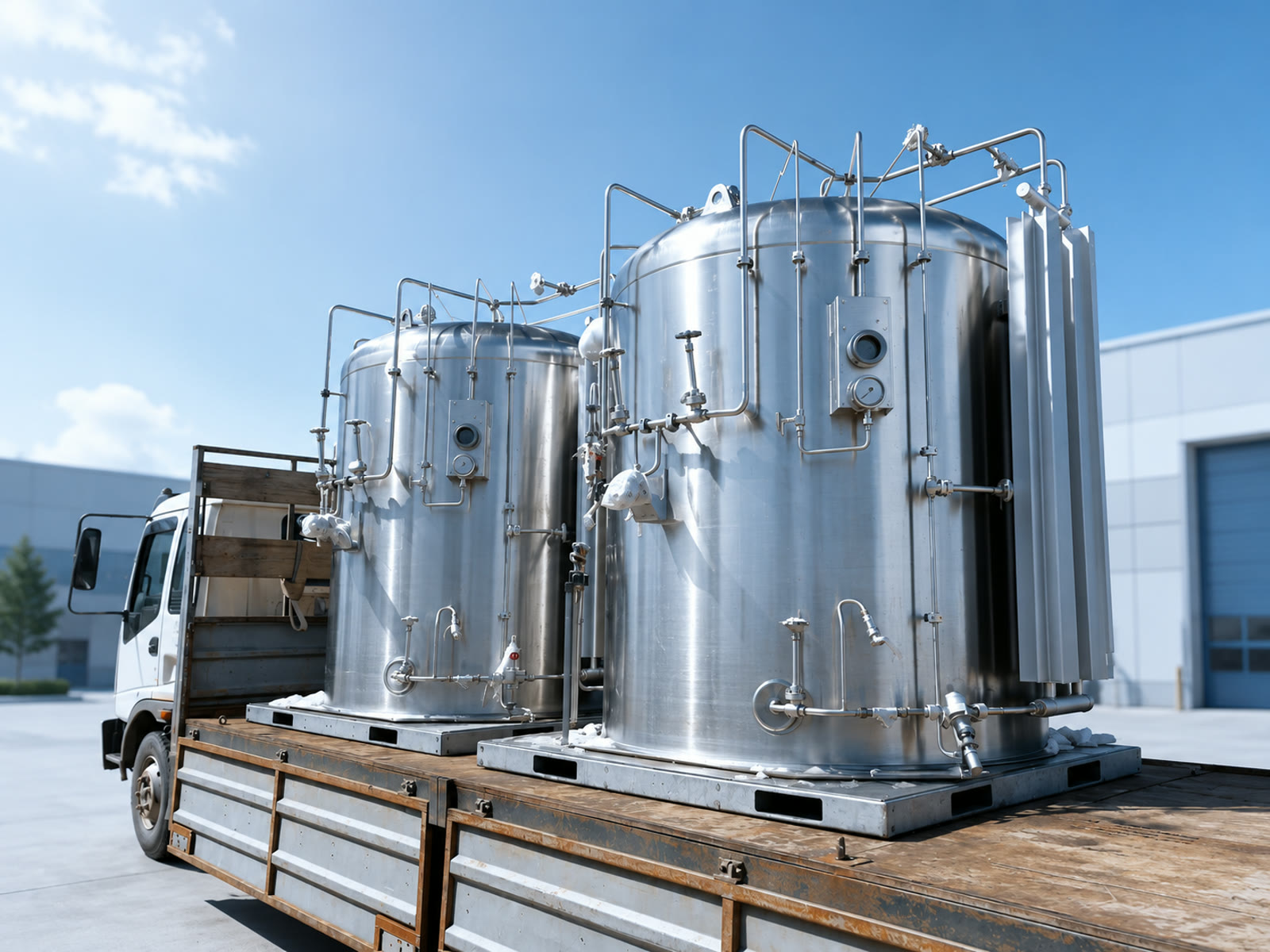
Cryogenic tanks, vaporisers and dewars for UK sites
The supply scope covers static storage and gasification equipment, laboratory vessels and transport units. Typical configurations for liquid nitrogen, oxygen, argon, carbon dioxide and LNG duties include:
- Vertical cryogenic storage tanks for bulk liquid supply at user premises, from a few thousand to tens of thousands of litres.
- Vertical and horizontal microbulk cylinders for sites stepping up from packaged gas, a segment discussed in our microbulk-versus-cylinders guide.
- Ambient-air vaporisers and cylinder filling pumps for gasification and filling stations.
- Liquid nitrogen dewars for laboratories, biobanks and IVF storage.
- 20 ft cryogenic tank containers and ISO tanks for liquid logistics, covered in the ISO tank container guide.
- Dry ice pelletisers and CO₂ storage for food, beverage and cold-chain users.
Media, working pressure, evaporation rate and connection standards are fixed per order, not taken from a generic datasheet.
Placing static pressure equipment on the GB market
Static vessels, vaporisers and assemblies above 0.5 bar fall under the Pressure Equipment (Safety) Regulations 2016, the GB counterpart of PED 2014/68/EU. Four concepts are worth separating. The design code, typically EN 13445, governs how the vessel is calculated and built. The legal regime, PER 2016, defines the essential safety requirements and hazard categories. The conformity procedure is the module carried out by a notified or approved body. The marking, CE or UKCA, is only the visible result of that chain.
Under legislation in force since October 2024, CE marking with EU notified-body assessment is accepted on the GB market with no end date announced. UKCA marking, assessed by a UK Approved Body listed on the UKMCAB database, remains a parallel option rather than an obligation. Dual CE and UKCA marking can be arranged where both assessments have been completed. The choice between routes may depend on where else the equipment will be sold, and is agreed before production. An importer under PER 2016 also carries its own duties: verifying the assessment, adding its UK name and address, and supplying English instructions. We assemble the manufacturer’s technical documentation into one package so that these importer checks can be completed without correspondence back to the factory.
Northern Ireland: CE plus UKNI marking
Equipment placed on the Northern Ireland market follows EU rules and must be CE marked. Where a UK-based body performs the assessment, the CE marking is accompanied by the UKNI marking, a combination valid for NI but not for the EEA. A configuration intended for both GB and NI is therefore specified as one conformity route from the start, not adapted afterwards. Delivery destination is confirmed at enquiry stage for exactly this reason.
Transportable receptacles follow transport law, not PER
Cylinders, transport tanks and cryogenic receptacles used for carriage sit outside the CE-recognition policy. Since the GB transitional arrangements ended in January 2023, new transportable pressure equipment for the GB market is generally assessed by a GB-appointed body and carries the Rho (ρ) mark under the carriage regulations, with an exception for qualifying Northern Ireland equipment. Pi-marked equipment under TPED 2010/35/EU remains the requirement for Northern Ireland, and legacy Pi receptacles already in GB may stay in use. For high-pressure gas cylinders and portable cryogenic receptacles, the applicable mark is therefore determined by the intended market and use, and the assessment route is confirmed with the manufacturer before order. Static site storage and transportable receptacles in the same project may follow two different conformity chains. That split is normal, not an error.
The written scheme of examination and the documents behind it
Great Britain adds an in-service layer that many markets handle through registration instead. Under the Pressure Systems Safety Regulations 2000, the user of an installed system may not operate it until a written scheme of examination is in place, drawn up or certified by a competent person, with examinations at defined intervals; Northern Ireland imposes the same written-scheme duty under its own equivalent regulations. This duty belongs to the operator, not to the supplier or importer. What the supplier controls is whether the competent person receives usable inputs: design calculations, safety-accessory data, relief valve settings, test records and marking documents. Site-safety layers then apply by gas. HSE guidance and BCGA separation-distance codes may apply to bulk liquid oxygen siting, and DSEAR risk assessment with hazardous-area zoning may apply to LNG, hydrogen and other flammable media. These are buyer-side assessments; we supply the equipment data they draw on.
Our documentation packages are assembled with that handover in mind. Depending on the conformity route and category, the package can include the declaration of conformity, the conformity-assessment certificate, design calculations to the applicable code, material certificates, weld and NDT records, pressure test reports, safety-accessory documentation and English operating instructions. The document list is fixed per order, because it depends on the manufacturer, the module and the destination. Pricing structure and what drives it are set out in the cryogenic storage tank price guide.
Matching a UK order to an assessed factory
No single factory in our network holds every approval for every model. Selection for a UK order weighs four variables: whether the model has a current EU notified-body or UK Approved Body assessment in the relevant category, experience with EN-series design codes, the documentation depth available in English, and commercial terms including duty treatment. Vetting criteria are described in our guide to vetting Chinese cryogenic suppliers, and typical certification paths in the export certification overview. Where a requested configuration has no assessed equivalent, we say so and propose the nearest assessed model, rather than adjusting paperwork to fit.
UK applications: breweries, biobanks, gas distributors
UK enquiries tend to arrive as supply questions — who supplies cryogenic tanks in the UK, what a CO₂ storage tank for a brewery costs, which liquid nitrogen dewar suits an IVF laboratory. Food and beverage sites weigh owned CO₂ storage against contract supply after the 2021–2022 shortage. Laboratories, biobanks and fertility clinics specify LN₂ vessels around sample security rather than price. Industrial gas distributors and mid-size manufacturers outgrow cylinder packs and look at microbulk or bulk vessels they own outright, not rent. Hydrogen and aerospace programmes represent a smaller, specification-led demand for cryogenic storage. Owning the vessel and buying the liquid separately is a configuration we can quote; gas supply contracts are not our product.
Before production: confirming the route
Availability and applicability of any standard, certificate, marking or registration procedure are confirmed for the specific manufacturer, model and order before production. A UK enquiry needs five inputs: medium, capacity in litres, working pressure, delivery point, and whether the destination is Great Britain or Northern Ireland. We respond with the proposed factory, conformity route, document list and lead time. Standards references for comparison are collected at the standards index.
Choosing a supplier for the UK: conformity after Brexit
The UK runs its own conformity regime — the Pressure Equipment (Safety) Regulations mirroring PED, with UKCA marking and UK approved bodies — while recognition of CE marking has been extended for most goods, so equipment certified for the EU commonly also serves the UK market; confirm the current recognition status per order. The engineering basis is unchanged: EN 13458 design for static vacuum-insulated vessels, and the same document pack — Declaration of Conformity, marking, EN 10204 3.1 material certificates, weld qualifications, NDE and pressure-test certificates, operating instructions in English.
Common questions
Does the UK require UKCA marking on cryogenic tanks?
The UK has its own UKCA regime under the Pressure Equipment (Safety) Regulations, but recognition of CE marking has been extended for most goods — many CE-marked vessels serve the UK market as-is; the current recognition status for your equipment category is confirmed per order.
Is the UK design standard different from the EU?
No — the engineering basis remains EN 13458 with the PE(S)R mirroring PED. The difference is administrative: UK approved bodies and UKCA marking versus EU notified bodies and CE.
What documents should arrive with the vessel?
Declaration of Conformity, the applicable marking, EN 10204 3.1 material certificates, welding qualifications, NDE reports, the pressure-test certificate and English operating instructions.