
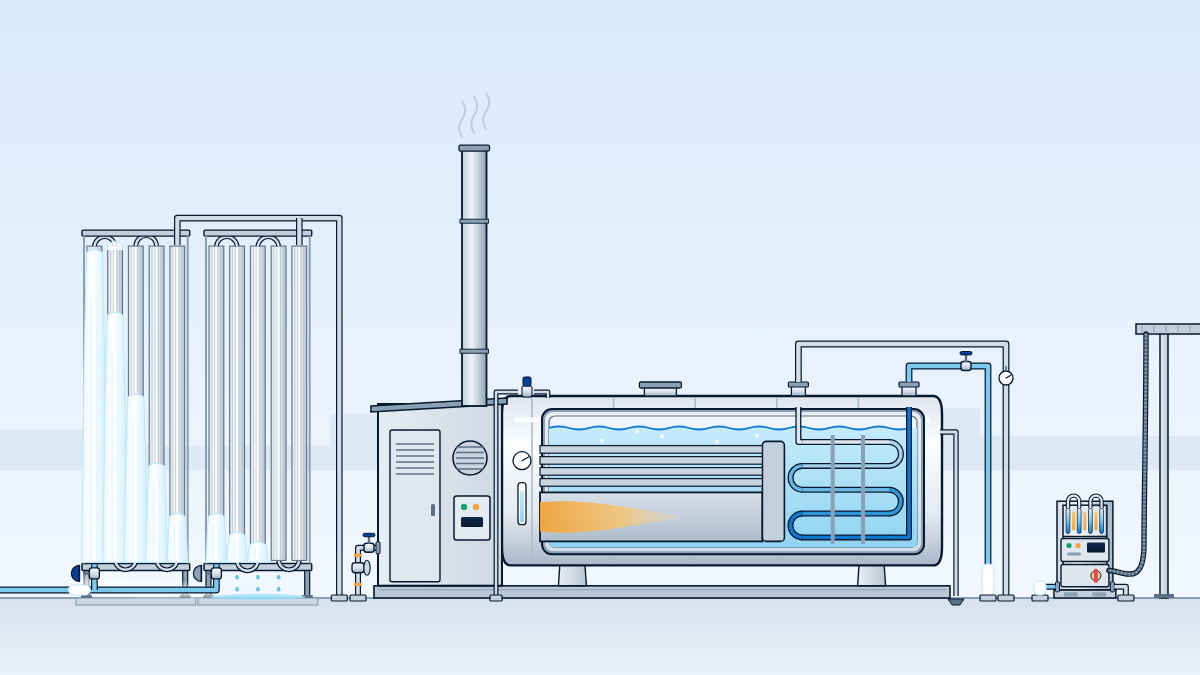
A cryogenic vaporizer is the link between your storage tank and the downstream line. It converts liquefied gas back into usable gas before it reaches the process, and the way it adds that heat determines your energy bill, your footprint, your reliability in winter, and how much your system can flow on a peak day. Choosing among the main types of cryogenic vaporizers is therefore one of the more consequential decisions in a bulk gas installation, yet it is often made on price alone.
This guide compares the three heating approaches that dominate industrial practice: ambient air, water bath, and steam or electric. It is written for the engineer or buyer doing the homework before sending an inquiry. The goal is to give you a clear framework for matching equipment to duty, media, pressure, and site climate, so you specify the right unit the first time rather than discovering its limits after commissioning.
How the main types of cryogenic vaporizers differ
All cryogenic vaporizers do the same job, but they source the heat of vaporization differently, and that single difference drives almost every trade-off you will weigh.
Ambient air vaporizers draw heat from the surrounding atmosphere. Cold liquid flows through finned tubes, usually aluminum, and the air around those fins gives up its heat to vaporize the gas. There are no burners, no electrical heaters, and no consumables, which makes this the lowest-operating-cost design. The catch is that performance is tied to the weather. As the fins run, they accumulate frost, which insulates them and gradually reduces capacity, so ambient units are typically run in banks that switch and defrost on a cycle.
Water bath vaporizers pass the cryogenic liquid through a coil submerged in a heated water bath. The bath holds a stable temperature regardless of outdoor conditions, so output is consistent and high. This makes water bath designs well suited to continuous, high-flow service where an ambient unit would frost out. They require an energy source to maintain the bath and more plant space, but they decouple your gas supply from the climate.
Electric and steam heated vaporizers use an electric element or a steam jacket to add heat directly and controllably. They deliver steady, repeatable output in a relatively compact footprint and are a strong fit where ambient air is unreliable, where plant steam is already available, or where precise outlet temperature control matters. Operating cost is higher because you are paying for energy on every cubic meter vaporized.
On the Cryofortune cryogenic vaporizer line, these heating methods are offered as configurations matched to the application rather than as fixed catalog items, so the same media can be handled by different heat sources depending on the site.
Match the type to your gas, flow, and pressure
Selection is built around four inputs: media, peak and average flow, inlet and outlet pressure, and site climate. Work through those in order.
Media. Cryofortune vaporizers are configured for LN2, LOX, LAr, and CO2. Oxygen service in particular demands oxygen-clean construction and careful material selection, so the gas you are vaporizing constrains the design before anything else.
Flow. Distinguish your average flow from your peak. A facility with a modest baseline but sharp demand spikes is a different problem from one running flat out around the clock. Ambient air handles intermittent and moderate continuous duty economically; sustained high flow usually points toward a water bath or a heated design, or toward multiple ambient banks.
Pressure. This is where the published specifications matter. The high-pressure models, TGV-20,0/500 and TGV-20,0/350, are rated for a working pressure of 200 bar with a test pressure of 300 bar, and offer 500 m³ and 350 m³ capacity respectively. The low-pressure model, TGN-3,0/500, runs at 3.0 MPa with a 500 m³/h flow. High-pressure cylinder-filling and pumping systems and lower-pressure pipeline supply are genuinely different duties; confirm both your inlet and your required outlet pressure against the rated envelope.
Climate is a specification, not an afterthought
Outdoor conditions belong in the data sheet, not in the assumptions. Ambient air vaporizers are the most climate-sensitive of the types of cryogenic vaporizers because the air itself is the heat source. In a cold, humid, or low-wind location, frost builds faster and clears slower, and a unit sized for a temperate average can fall short on the coldest, highest-demand days, which often coincide.
This is exactly why trim heaters and multiple banks are added where continuous high flow or cold climates require it. A trim heater polishes the outlet temperature so gas never enters the line too cold; multiple banks let one set of fins defrost while another carries the load. In harsh climates, a water bath or electric design may simply be the more honest choice. The practical rule: size for your worst-case combination of low temperature and peak draw, not for the annual mean.
Common mistakes when comparing vaporizer types
A few errors recur often enough to call out:
- Sizing to average flow. A vaporizer that meets average demand can starve the line during peaks. Specify against peak flow at the worst ambient condition.
- Ignoring outlet temperature. Gas delivered too cold can damage downstream equipment and embrittle piping. If ambient air cannot reliably warm the gas in your climate, plan for trim heating from the start.
- Treating ambient air as free and consequence-free. Operating cost is low, but frost cycling, the need for switching banks, and footprint for that redundancy are real. The economics still usually favor ambient air for suitable duties, but go in with eyes open.
- Overlooking the gas. Pressure and flow get the attention; oxygen cleanliness, material compatibility, and code requirements for the specific media get forgotten until late.
- Forgetting the downstream context. The vaporizer is one link in a chain from tank to point of use. Pressure drop, control, and the storage and regulation around it all shape what the vaporizer actually needs to deliver.
A selection checklist before you inquire
Have these answers ready and the conversation with any supplier becomes far more productive:
1. Gas and purity. Which media (LN2, LOX, LAr, CO2), and any oxygen-clean or purity requirements. 2. Flow. Average and peak flow in normal m³/h, with how long peaks last. 3. Pressure. Inlet pressure from the source and required outlet pressure to the line, mapped against the rated working pressure. 4. Climate. Site location, design minimum temperature, humidity, and prevailing wind. 5. Duty pattern. Continuous, intermittent, or peaking, and acceptable downtime for defrost. 6. Heating utilities. Whether plant steam or electrical capacity is available to support a heated design. 7. Space and layout. Footprint, orientation, and access for maintenance. 8. Redundancy. Whether the process can tolerate a single bank or needs switching for uninterrupted supply. 9. Codes and documentation. Applicable pressure-vessel codes and the certification and export paperwork your project requires.
Cryofortune supplies ambient-air and heated cryogenic vaporizers worldwide, sized to flow and climate, with export documentation, and accessories and export packing can be arranged with the selected equipment, which matters when the unit has to clear customs and satisfy inspection on arrival.
Closing: choose by duty, not by default
There is no universally best vaporizer, only the right one for your media, flow, pressure, and climate. Ambient air wins on operating cost for suitable duties; water bath delivers steady high flow independent of weather; electric and steam offer controllable output in tight or climate-challenged sites. Define the worst-case operating point, hold each option against it, and the choice usually makes itself.
When you are ready to translate these requirements into a sized unit, review the full specifications and configurations on the Cryofortune cryogenic vaporizer page or share your duty data for a configuration matched to your site.