
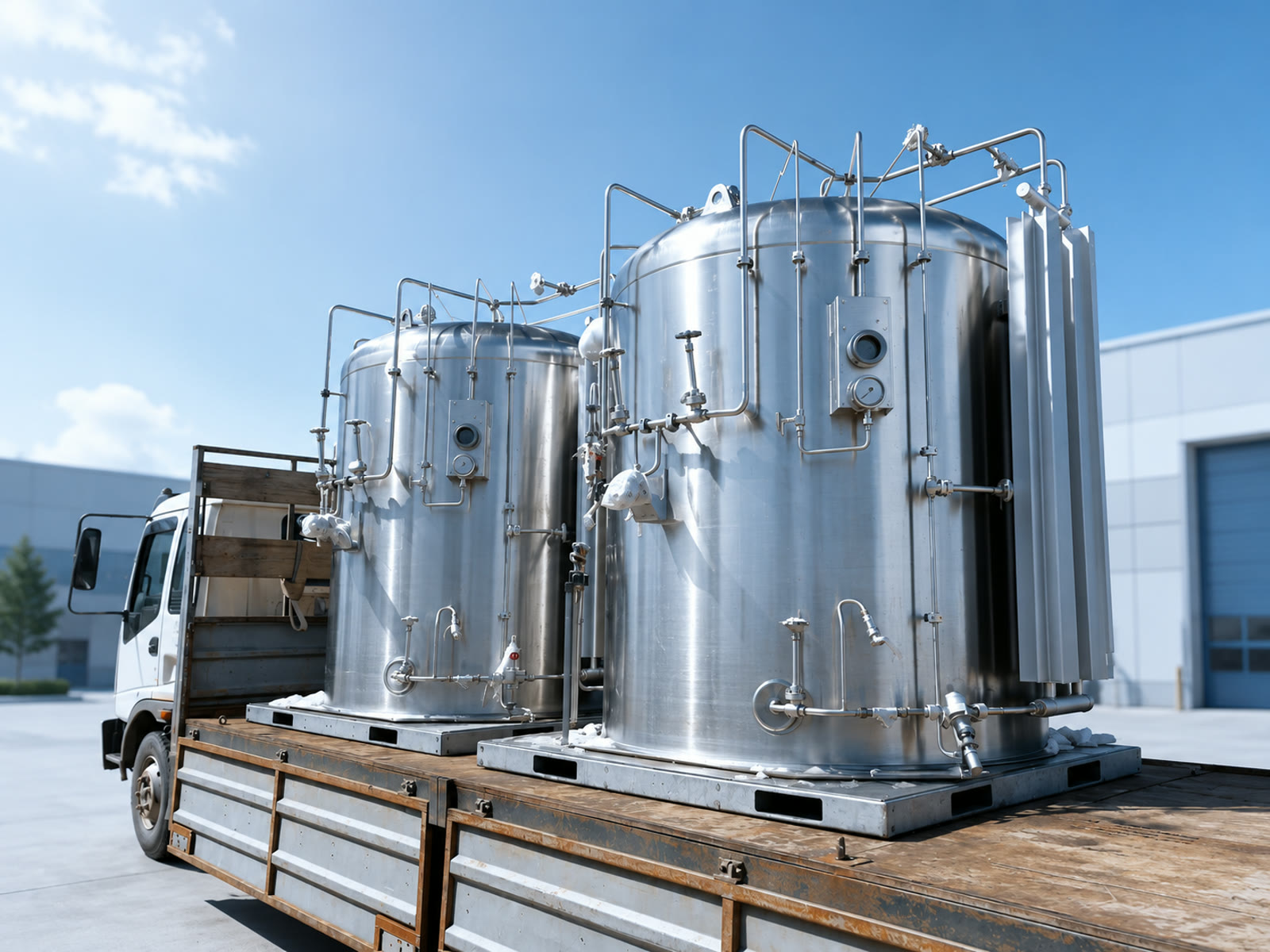
Cryofortune Engineer & Supply sources cryogenic storage tanks from a network of Chinese manufacturers. The factory is selected for each order by destination country, design standard, documentation package and duty. This page maps the storage-tank range, explains how the vessels are built, and sets out how a configuration is selected.
How a vacuum-insulated storage tank is built
A cryogenic storage tank is a double-walled vessel. The inner vessel contains the liquefied gas, and the outer jacket encloses an insulation space around it. That space is evacuated, so heat ingress from the surroundings is reduced to a small residual flow. The residual heat slowly evaporates the stored liquid, and this loss is expressed as a daily evaporation rate. Evaporation performance varies with vessel size, media and build, and is confirmed per model.
Vertical bulk tanks and ISO tank containers
The catalog covers three storage-tank configurations, separated by volume and by whether the vessel is fixed or transportable.
- Vertical site tanks. The vertical cryogenic storage tank line spans eight configurations from roughly 8,000 to 25,000 L, with working pressures from 0.8 to 2.2 MPa by variant. The tanks install outdoors on a prepared foundation and are configured for liquid nitrogen, oxygen, argon or CO2.
- 20 ft ISO-frame tanks. The 20 ft cryogenic tank container places a multilayer vacuum-insulated vessel in a standard ISO frame. Seven configurations cover 17.5 to 21.13 m³ gross volume by variant, for LCO2, LOX, LN2 and LAr; usable volume is confirmed per model. The format suits duties where storage must move between sites or double as logistics. The 20 ft ISO tank container guide covers the format in detail.
- 40 ft ISO tanks. The 40 ft LNG ISO container handles intermodal transport and temporary storage by road, rail and sea. It is the LNG-capable unit in the range, and its capacity, working pressure and holding time are indicative, confirmed per project. See also the LNG equipment page.
Below these volumes, local storage passes to cryogenic liquid cylinders and microbulk tanks. The crossover point between cylinder packs and a small tank is examined in microbulk vs cylinders.
Vertical vs horizontal storage tanks
Bulk tanks in this range are vertical. A vertical vessel keeps the footprint small, which usually matters more on a filling-station pad than height. Horizontal vessels trade height for length and suit sites with overhead limits; in this catalog that need is served at cylinder scale by the horizontal cryogenic cylinder 500 L. The trade-offs are set out in vertical vs horizontal cryogenic storage tanks.
Tanks for liquid nitrogen, oxygen, argon and CO2
Storage tanks in the range are configured for a single gas at order and are not normally re-purposed between media without requalification. The core services are liquid nitrogen, liquid oxygen, liquid argon and liquid CO2; LNG appears on the 40 ft ISO container only. Media selection typically drives valve trim, relief settings and cleaning requirements, all confirmed per order. A cross-media overview is given in cryogenic equipment by gas.
How to select a cryogenic storage tank
Four parameters usually settle the configuration before any model is discussed.
- Capacity. Sized from consumption between deliveries plus a reserve margin. A larger tank reduces delivery frequency but raises foundation, transport and capital cost.
- Working pressure. Matched to the downstream process and the vaporizer inlet requirement. The vertical line offers 0.8 to 2.2 MPa across its variants.
- Evaporation rate. Static losses weigh more on duties with slow turnover, so low-throughput sites should compare evaporation figures closely.
- Footprint and installation. Vertical tanks need a foundation and typically crane access for installation; ISO-frame units need container handling but no permanent civil works in most cases.
How these choices move the budget is covered in the cryogenic storage tank price guide.
The storage tank in a gas filling station
A storage tank rarely works alone. A typical bulk station pairs the tank with a cryogenic vaporizer that converts liquid to process gas on demand, and a gas heater where outlet temperature must be stabilized. Cylinder-filling duties add a cryogenic cylinder filling pump between tank and manifold. Vaporizer selection is covered in the vaporizer sizing guide; the adjacent equipment classes are mapped under cryogenic vaporizers and gas filling systems.
Design standards by destination country
Storage tanks are treated as pressure equipment in most jurisdictions, and the applicable design code follows the destination, not the factory. Codes and marks that may apply are mapped on the standards page, and the manufacturer is selected accordingly. Country-specific notes are collected on dedicated country pages, beginning with Australia. The paperwork side of an export order is described in cryogenic equipment export certification.
Vertical vs horizontal, and how tank size is chosen
Vertical tanks stand the vessel on end, so they occupy the least floor area for a given volume — the reason they dominate the bulk range, from roughly 8,000 to 25,000 liters. The trade-off is height: a 25,000-liter vertical vessel stands around 11.7 m tall, against about 5.1 m for an 8,000-liter unit. Where headroom is limited — indoor plant rooms, sites under a crane or roofline, or locations with a height restriction — a horizontal tank lays the same volume on its side and stays low, at the cost of a larger footprint.
The working-pressure class follows how the site takes its product. A site that draws gas relies on the tank’s own pressure to push liquid through a vaporizer into the gas line, so the class must sit above the required supply pressure — 1.6 or 2.2 MPa for higher line pressures. A site that mainly draws liquid, such as filling cylinders, feeding a pump or transferring to transport, can run the lighter 0.8 MPa class, which also vents less product.
Sizing works from usable, not gross, volume: these vessels give roughly 95% usable, and daily draw plus boil-off between deliveries has to stay above the reorder level, so a low evaporation rate lets a smaller tank do the same job. The medium matters too — oxygen service demands oxygen-clean construction, argon and oxygen are far denser than nitrogen, and CO2 is held as a refrigerated liquid rather than at deep-cryogenic temperature. See the vertical cryogenic storage tank range for the current size steps.
Frequently asked questions
How big a cryogenic storage tank do I need?
Start from your average daily gas consumption, convert it to liters of liquid, and multiply by the number of days you want between deliveries, then add a margin for boil-off and a safety reserve. The aim is to size the tank so a normal delivery refills it before the level reaches the reorder point. For steady industrial demand the vertical bulk range of about 8,000 to 25,000 liters is the usual answer; for a workshop or intermittent draw a microbulk tank or a bank of liquid cylinders is often enough.
Our conversion tables help translate gas demand in cubic meters into liters of liquid, and we can size the vessel with you from your usage figures — tell us your demand.
What is the difference between gross and usable capacity?
Gross, or geometric, capacity is the full internal volume of the inner vessel. Usable capacity is what you can actually draw in service: a tank is never filled completely, because vapor space and thermal expansion need ullage, and a heel of liquid stays below the outlet. On these vertical vessels usable volume is around 95% of gross, so a 20,000-liter tank delivers roughly 19,000 liters of product per fill. Plan consumption and delivery intervals around the usable figure, not the nameplate gross.
How much liquid does a cryogenic tank lose per day?
Even a well-built vacuum-perlite tank absorbs a little heat, so a small fraction of the contents boils off each day and vents through the safety valve — the normal evaporation rate, or NER. It is typically a fraction of a percent of the full volume per day, and proportionally lower on larger tanks because they have less surface area per liter of contents.
The exact figure depends on the specific model, the medium and ambient conditions, and is confirmed on the datasheet for the tank you order. Drawing product regularly keeps the tank below its vent pressure, so a vessel sized to real demand loses very little.
Can one tank hold nitrogen, oxygen and argon?
A vertical cryogenic vessel of the same design family can be built for liquid nitrogen, liquid oxygen or liquid argon, because the geometry is shared. The important difference is oxygen: a tank in oxygen service must be built and cleaned to oxygen-clean standards, degreased and free of hydrocarbons, because oxygen makes oils and greases combustible. A tank supplied and cleaned for oxygen can generally handle nitrogen or argon, but a tank built for nitrogen should not be switched to oxygen without proper oxygen cleaning.
Argon and oxygen are also much denser than nitrogen, so the filled weight and foundation are checked against the actual liquid. CO2 is a separate case — it is stored as a refrigerated liquid rather than at deep-cryogenic temperature and uses a different vessel.
Do I need a vaporizer with the tank?
If your site uses gas rather than liquid, then almost always yes. The tank stores the product cold as a liquid, and a cryogenic vaporizer turns it back into gas at the flow and pressure your process needs. The vaporizer is sized to your peak gas draw, not just the average, and our vaporizer sizing guide walks through that calculation.
You only skip the vaporizer if the site genuinely draws liquid — for example filling cylinders or feeding a liquid pump.
What certification does a cryogenic storage tank need?
It depends on where the tank is installed. Pressure vessels are regulated per destination, so the applicable code, marking and registration are matched to the destination market rather than assumed, and a tank built for one country is not automatically accepted in another. We set out the framework in our standards overview and by country.
We source from a vetted network of manufacturers whose tanks can be built to the relevant scheme, but certificates belong to a specific factory, model and order. We confirm exactly what applies before production rather than making a blanket claim.
Cryogenic bulk storage tanks: types and construction
Most fixed cryogenic supply runs on a bulk storage tank — a double-walled, vacuum-insulated vessel that holds liquid nitrogen, oxygen, argon, LNG or CO2 on site and feeds the plant through a vaporizer. Cryogenic bulk storage tanks come in two orientations: a vertical cryogenic storage tank saves floor area and suits tight yards, while a horizontal tank lowers the silhouette and is often easier to transport and install. The choice is driven by site geometry, capacity and transport access rather than performance — both are built the same way.
That construction is the defining feature. The inner vessel is an ASME (or PED/EAC) code pressure vessel in austenitic stainless steel; the outer jacket is carbon steel; and the annular space between them is evacuated to a high vacuum with multilayer or perlite insulation. This double-walled, vacuum-insulated design is what gives a bulk tank its low evaporation rate and long hold time. Fabrication quality — weld integrity, vacuum retention and the pressure-vessel code the inner shell is built to — is what separates a tank that holds its vacuum for years from one that does not.
Choosing a bulk storage tank and its manufacturer
Sizing starts from daily consumption, required outlet pressure and the interval between tanker deliveries — the method is set out in our guide to choosing a cryogenic storage tank, with indicative budgets in the price guide and the site side in the installation guide and maintenance guide. Where the tank sits inside a larger scope, it pairs with vaporizers and controls as a complete cryogenic gas system.
Selecting the manufacturer is a separate decision from selecting the tank. Cryofortune is a sourcing and engineering supplier, not a factory: for each order we match a cryogenic bulk storage tank to a manufacturer from a vetted network whose fabrication and certification fit the destination — ASME with National Board for North America, PED/CE for Europe, EAC for the EAEU, AS 1210 for Australia. The design margin and documentation come from the code the vessel is built to, confirmed for the specific manufacturer, model and order.
Cryogenic storage tank FAQ
What is a cryogenic bulk storage tank? A large, double-walled, vacuum-insulated pressure vessel that stores a cryogenic liquid (LN2, LOX, LAr, LNG or CO2) on site under modest pressure and supplies gas on demand through a vaporizer, refilled periodically by road tanker.
Vertical or horizontal cryogenic storage tank — which is better? Neither is technically superior. A vertical tank uses less ground area and suits compact sites; a horizontal tank has a lower profile and can be simpler to transport and install. Capacity, yard geometry and access decide it.
Who manufactures cryogenic storage tanks, and how do I choose one? Tanks are built by specialist pressure-vessel factories. As a sourcing supplier we select the manufacturer per order against the destination’s design code and documentation, rather than tying you to a single factory — the reasoning is in how we select a manufacturer.
Request a configuration
Send a rough duty description — media, monthly consumption, required outlet pressure, delivery interval and any site constraints — and we will return matched tank configurations from the appropriate manufacturer. Configurations and documentation are confirmed for the specific manufacturer, model and order before production.