
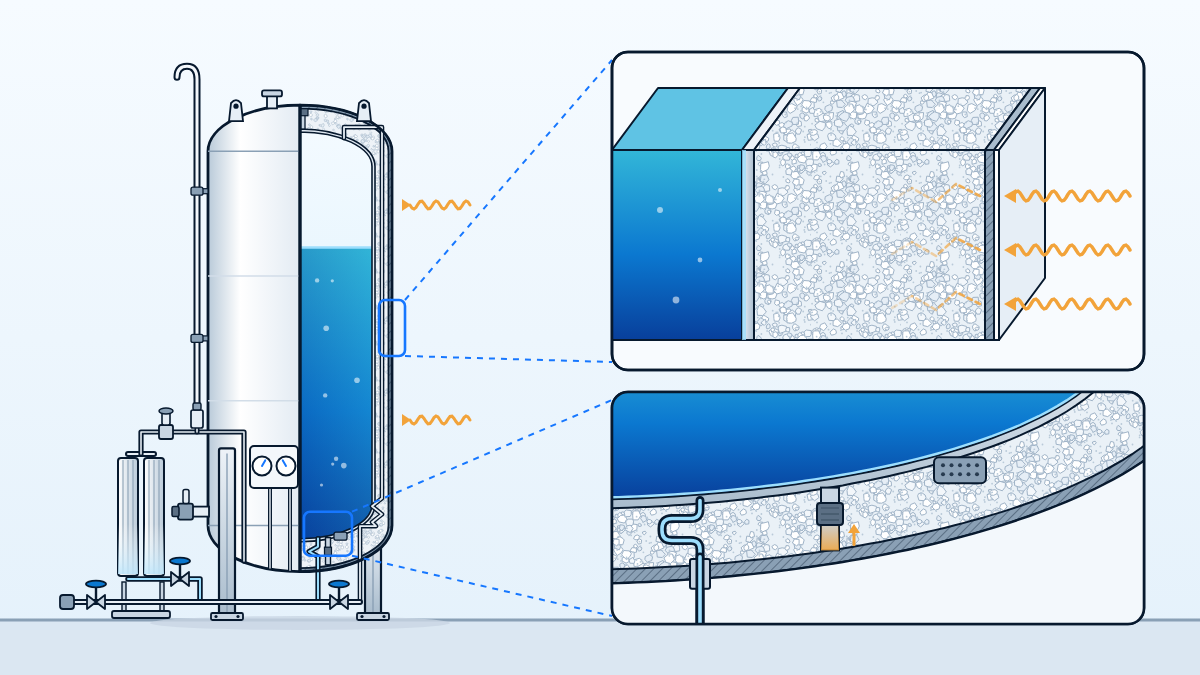
A cryogenic liquid is simply a gas cooled until it condenses: liquid nitrogen sits at about −196 °C, liquid oxygen near −183 °C, and LNG around −162 °C. Inside the vessel the liquid is happy to stay cold, but the surrounding world is roughly two hundred degrees warmer, and heat always flows toward cold. Every joule that reaches the liquid boils a little of it back into gas. The entire job of a cryogenic storage tank is to slow that heat down — and the way it does so, a double wall wrapped around a vacuum, is one of the most elegant pieces of everyday engineering.
Why a single wall cannot hold a cryogenic liquid
Pour a cryogenic liquid into an ordinary vessel — even a thick, well-lagged steel one — and it behaves like a pot left on a stove. Steel conducts heat readily, ambient moisture frosts the outside, and the liquid boils without pause. This is boil-off: the steady return of liquid to gas as heat leaks in. The problem compounds because one volume of cryogenic liquid expands into hundreds of volumes of gas (our conversion tables list the ratios), so the vapour must be vented or the pressure climbs dangerously. No amount of solid lagging can bridge a two-hundred-degree gap without emptying the tank in hours: cryogenics needs a different principle, not a thicker blanket.
The double wall and the vacuum between
A cryogenic tank is really two tanks, one inside the other. The inner vessel holds the liquid; the outer vessel, or jacket, surrounds it; and the space between them — the annular space — is pumped down to a hard vacuum. That evacuated gap is the insulation. The glossary sums it up as a double wall with the interspace evacuated: take the gas out of that space and you remove most of the routes heat could use to cross it. What remains is a slow trickle rather than a flood.
Three ways heat travels, three ways to stop it
Heat crosses a gap by three mechanisms, and a well-built tank defeats each one.
- Conduction is heat flowing through solid matter. It enters through the few things that link cold to warm: the neck, the fill and withdrawal lines, and the supports holding the heavy inner vessel centred inside the jacket. Designers fight it by keeping these connections few, long, thin, and made of low-conductivity materials such as stainless steel or composites. A long, slender neck is a poor heat path — which is exactly the point.
- Convection is heat carried by moving gas. This is the route the vacuum kills outright: with almost no molecules left in the annular space, there is nothing to circulate and nothing to ferry heat across. Below a certain pressure even ordinary gas conduction collapses, which is why vacuum quality matters so much.
- Radiation is heat crossing as infrared, and it is the stubborn one — it needs no medium and passes through a perfect vacuum. The warm outer wall glows, invisibly, onto the cold inner wall. Beating it takes more than an empty space.
Perlite for bulk tanks, multilayer film for cylinders
Radiation is blocked by filling or wrapping the vacuum space, and the choice of method separates large tanks from small ones. In bulk vessels the annular space is filled with perlite — an expanded volcanic glass powder — whose countless particle surfaces scatter and absorb radiant heat through the depth of the gap. Perlite under vacuum is inexpensive and robust, and it suits big stationary vessels such as a vertical site tank, where a large volume relative to surface area already works in the tank’s favour.
Smaller vessels use multilayer insulation (MLI), or super insulation: dozens of reflective, aluminised foil layers wound around the inner vessel under high vacuum, each reflecting radiation back toward its source. MLI reaches a far lower radiant heat leak per unit area, which is essential for liquid cylinders and dewars, where a small volume carries a comparatively large surface. It is more sensitive to vacuum quality, and microbulk tanks and transport units are specified with that in mind.
Evaporation rate — the one number that tells the truth
All of this design effort collapses into a single measurable figure: the net evaporation rate, or NER. It is the share of the tank’s contents that boils off per day when the vessel is full, settled, and not being drawn from. NER is valuable precisely because it is measured, not modelled — it sums up every conduction and radiation path in the finished vessel at once. Lower is better. For large bulk tanks NER is typically a fraction of a percent to a few percent per day depending on size; small dewars and cylinders lose rather more, because they carry more surface per litre. Two tanks of the same capacity, standard and price can post quite different NER figures, and that gap is the difference between a good vacuum jacket and a mediocre one.
Vacuum is not forever
The weak point of the whole system is that the vacuum degrades. Over years, gas slowly seeps back into the annular space — outgassing from interior surfaces, faint permeation through the walls, the occasional micro-leak. As interspace pressure rises, convection and gas conduction creep back and NER climbs: the tank boils off faster, vents more, and costs more to keep full. To slow this, manufacturers place getters — adsorbent materials — in the vacuum space to soak up stray gas and buy years of service. Eventually a vessel may need re-evacuation: pumping the interspace back down, sometimes with fresh getter, to restore its original performance. A tank that suddenly boils off far more than it used to usually has a vacuum problem, not a valve problem.
What this means when you buy
- Compare NER, not just capacity and price. A cheaper tank that loses more each day can cost more over its life in vented product, especially on duties with slow turnover.
- Ask for a measured NER at a stated fill level and gas, not a generic catalogue figure.
- Ask about the vacuum itself: is it warranted, and can the tank be re-evacuated in the field through a proper port?
- Match the insulation to the duty — perlite-vacuum bulk tanks for stationary storage, MLI for cylinders, dewars and anything that moves.
Cryofortune is not a factory. We source double-walled cryogenic tanks across a network of vetted Chinese manufacturers and match the vessel — its insulation type, NER, pressure rating and documentation — to how and where you will use it, with a working range of roughly 7,990 to 25,000 L at 0.8 to 2.2 MPa. Tell us your gas, throughput and site, and we will help you specify one.
Availability and applicability of any standard, certificate, marking or registration procedure are confirmed for the specific manufacturer, model and order before production.