
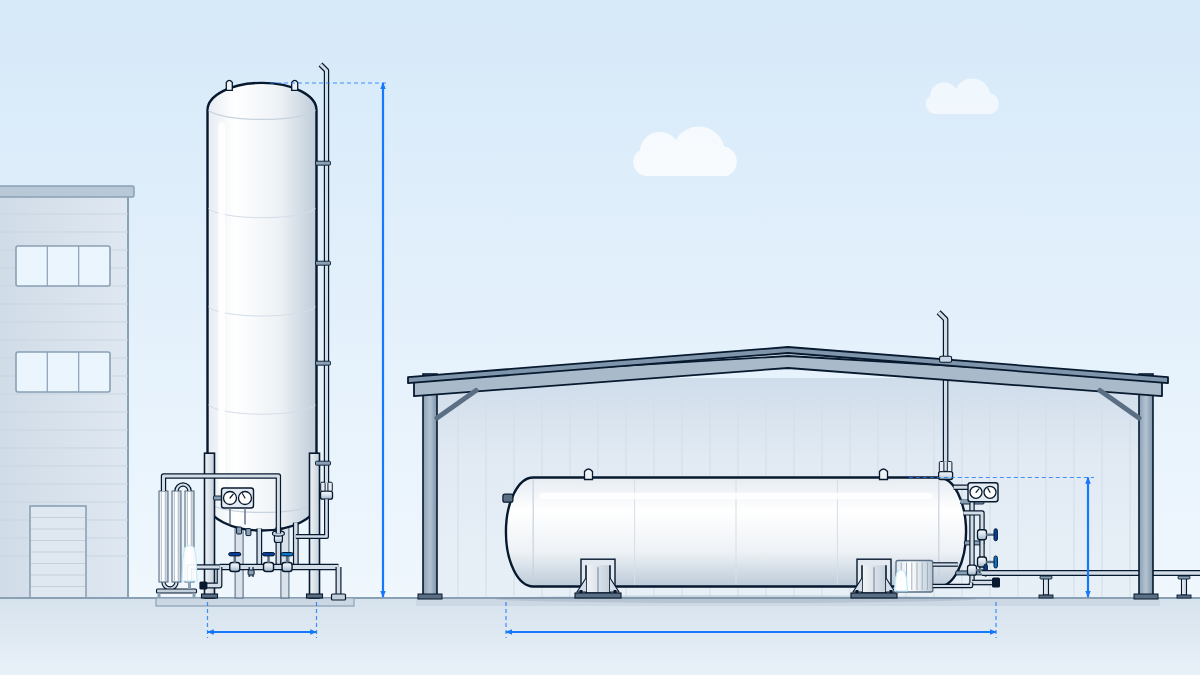
Choosing between a vertical and a horizontal cryogenic vessel is one of the first specification decisions an engineer or procurement lead makes when planning bulk liquid gas storage, and it is easy to get wrong. The two formats store the same products, use comparable construction, and often quote similar capacities, so the deciding factors are rarely the tank itself. The real question in a vertical vs horizontal cryogenic tank comparison is how the vessel fits your site, your throughput, and your installation constraints. This guide walks through what actually matters before you send an inquiry, so you arrive at the conversation with the right requirements already defined.
What both formats have in common
Before comparing orientations, it helps to anchor on what does not change. A modern bulk cryogenic storage tank is a double-walled, vacuum-insulated pressure vessel. On the Cryofortune vertical range, the annular space uses vacuum-perlite insulation to keep evaporation low and hold the liquid cold, and the same insulation principle applies whether the vessel stands upright or lies horizontal.
Both formats are configured for the common industrial cryogens: liquid nitrogen (LN2), liquid oxygen (LOX), liquid argon (LAr), and carbon dioxide (CO2), selected by configuration rather than being interchangeable in one tank. Both are designed around a defined working pressure, and on the vertical range these are offered at 0.8, 1.45, 1.6, and 2.2 MPa. Both quote a gross volume alongside a usable volume of around 95%, the rest being ullage the system needs to operate safely. And both are normally supplied as part of a system, matched with vaporizers, pumps, and safety valves rather than as a standalone shell.
Because construction, gases, pressure classes, and insulation are shared, orientation is mostly a question of geometry and logistics, not thermal performance. That reframing is the most useful thing to carry into the decision.
Vertical vs horizontal cryogenic tank: the core trade-off
The defining difference is the relationship between footprint and height.
A vertical tank concentrates its capacity over a small ground area. It keeps the foundation footprint small where floor space is limited, which makes it the natural choice for filling stations, distributor depots, production sites, and plant rooms where land is constrained or expensive. The trade-off is height: a tall vessel needs adequate vertical clearance, may attract more wind loading, and can complicate maintenance access at the top.
A horizontal vessel spreads the same capacity along the ground. It trades floor area for a low overall profile. In the Cryofortune catalog, bulk tanks are vertical (see cryogenic storage tanks); at cylinder scale the same low-profile logic appears in our Horizontal Cryogenic Cylinder 500 L, described as a compact unit for liquid storage with a low installation height. Low profile is valuable where there are height restrictions such as roofed areas, indoor bays, height-limited yards, or where keeping the centre of gravity low matters for stability or transport.
In short: choose vertical when ground area is your constraint, and horizontal when height or clearance is your constraint. Most sites have one binding limit, and identifying it early settles much of the debate.
Sizing, pressure, and throughput considerations
Orientation should follow your operating profile, not the other way around. Three numbers drive sizing.
First, working pressure. Match the pressure class to what your downstream system and end use actually require, rather than over-specifying. The vertical range spans 0.8 to 2.2 MPa, and a higher class is not automatically better; it affects vessel cost and the safety relief arrangement.
Second, usable capacity. Always size against usable volume, not gross. With roughly 95% usable, a tank quoted at a given gross figure delivers slightly less in practice, and across a refill cycle that margin matters for continuity of supply. The vertical range, for example, spans gross volumes from 7,990 L up to 25,000 L across eight variants, so there is room to match a real consumption curve rather than rounding up blindly.
Third, refill frequency. Estimate average and peak draw, then size so refills land at a manageable interval. Undersizing forces frequent deliveries and risks running dry; oversizing ties up capital and increases standing boil-off relative to what you use.
Insulation, boil-off, and total cost of ownership
The purchase price is a fraction of lifetime cost. The vacuum-perlite insulation system is what keeps a cryogenic tank economical day to day, because every unit of product lost to evaporation is product you paid for and cannot sell or use. When comparing options, ask for the static evaporation (boil-off) rate for the specific gas and capacity you intend to store, since it varies by product and vessel size and is the single largest recurring cost driver after the gas itself.
Orientation has only a second-order effect on thermal loss compared with insulation quality and vacuum integrity, so do not choose a format expecting it to fix boil-off. Instead, weigh insulation performance, the relief and venting arrangement, and how the vessel will be maintained over a multi-year service life. A tank that is slightly cheaper but harder to service, or that loses more product annually, is usually the more expensive choice.
Installation, foundation, and site logistics
Site reality decides more cryogenic tank choices than the datasheet does. Vertical vessels sit on an outdoor foundation or a prepared industrial pad, and the small footprint is an advantage only if you have the height and clearance to use it. Before committing, confirm vertical clearance and any overhead obstructions, wind exposure for a tall vessel, crane or delivery access for installation, and serviceability of valves and instruments at working height.
For horizontal vessels, confirm instead that you have the ground run available and that the low profile genuinely solves a height limit you actually have. Also plan the supporting equipment footprint early: vaporizers, pumps, and safety valves need their own space and access, and that layout often tips a borderline decision one way or the other.
Two common mistakes recur. The first is choosing orientation on price or habit before checking the binding site constraint, then discovering a clearance or access problem during installation. The second is sizing on gross volume and ignoring the usable figure and refill interval, which quietly undermines supply continuity.
A practical selection checklist
Work through these before you inquire:
- Which gas and at what working pressure class (0.8 to 2.2 MPa on the vertical range)?
- What is your binding site constraint, ground area or height clearance?
- What usable capacity do you need at peak draw, sized on 95% usable, not gross?
- What refill interval is operationally acceptable?
- What static boil-off rate applies to your gas and capacity?
- Is there room and access for vaporizers, pumps, and safety valves?
- What certification and export documentation does your destination market require?
That last point matters for international projects. Cryofortune supplies this cryogenic storage equipment worldwide, and certificates and export documentation are arranged according to product type, destination market, and the agreed supply standard, so confirming requirements early avoids customs and compliance delays later.
Once your constraints, capacity, and pressure class are defined, the vertical-versus-horizontal question usually answers itself. To review configurations, capacity variants, and working pressures for vertical bulk storage, see the vertical cryogenic storage tank range and use it to validate the specification you have just scoped.