Liquid oxygen typically carries far more product per delivery than compressed cylinders, which is why steady oxygen duties tend to migrate to LOX. Cryofortune Engineer & Supply Co., Ltd. sources liquid-oxygen storage, vaporization and filling equipment from a network of Chinese manufacturers. For each order the factory is selected against the destination country, the applicable design standard and the required documentation package. This page maps the catalog to the four duties where LOX supply is most common, and notes what oxygen service changes.
Oxygen service: cleaning and material compatibility
Oxygen is an oxidizer, and that single property separates LOX equipment from otherwise identical nitrogen or argon hardware. Equipment intended for oxygen duty is cleaned for oxygen service: wetted surfaces are freed of oils, greases and particulate to defined acceptance criteria. Sealing materials, lubricants and certain alloys are selected for compatibility with oxygen at the working pressure and temperature. These requirements run through the whole chain — tank, piping, vaporizer, filling pump and cylinder valves. A vessel built and cleaned for nitrogen service is not automatically suitable for oxygen, even where the pressure rating matches. When we place a LOX order, oxygen cleaning and material selection are stated in the specification rather than assumed.
Oxygen does not burn, but it intensifies combustion, so siting, venting and separation distances are treated soberly at the design stage. The oxidizing nature of the medium also has regulatory consequences. In several regimes oxygen sits in a stricter fluid group or hazard category than inert gases, which can raise the conformity-assessment level for the same vessel. Which categories apply depends on the destination; the standards overview summarizes the main regimes we design against.
Medical and healthcare oxygen supply
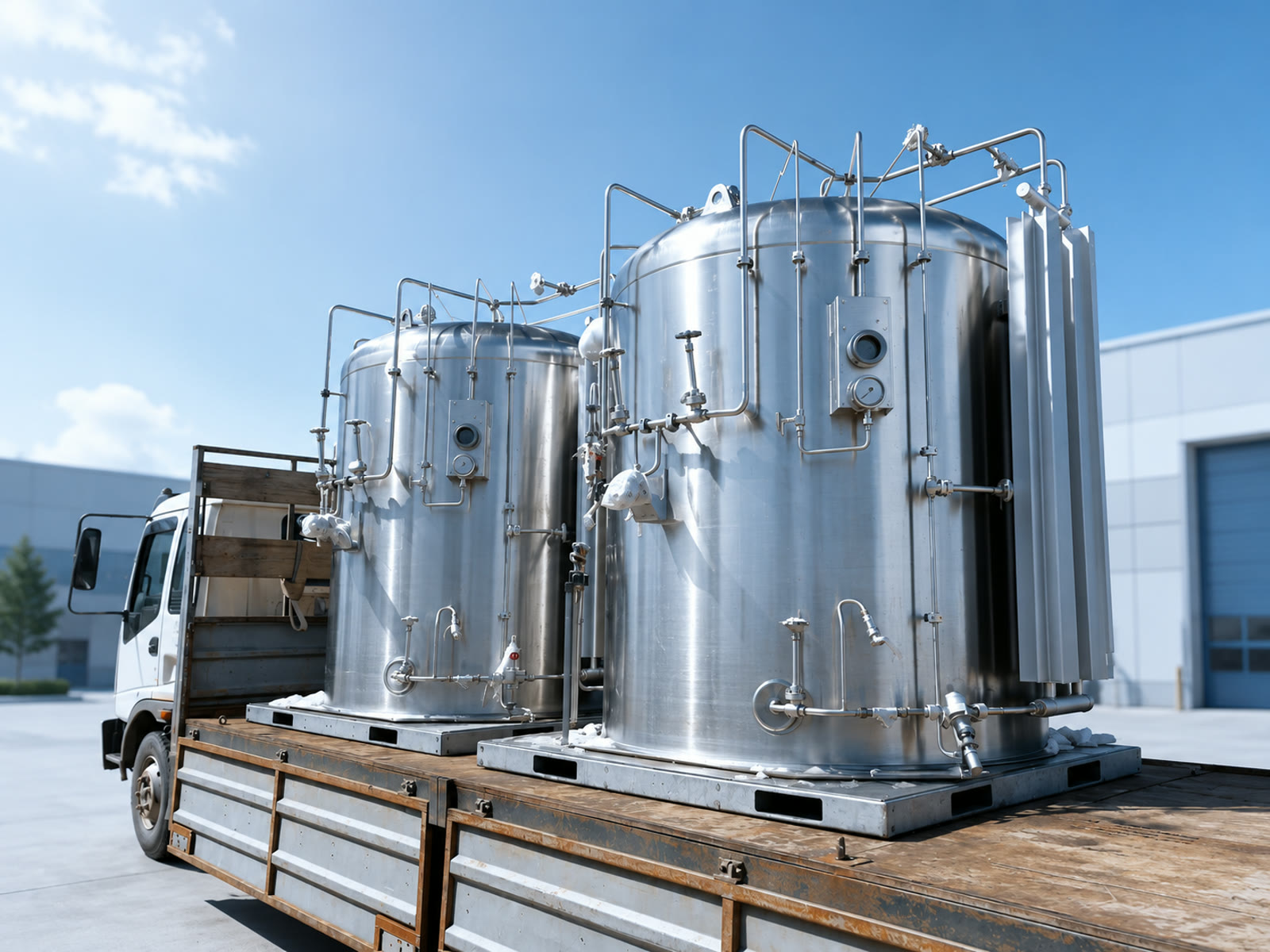
Hospitals and clinics typically run a bulk vertical cryogenic storage tank with an ambient vaporizer as the primary source. The catalog tank family covers capacities of 8,000–25,000 L (7,990–25,000 L gross) at working pressures of 0.8–2.2 MPa, with LOX among the configurable media. A reserve bank of high-pressure gas cylinders at 150–300 bar usually provides the backup leg. Medical oxygen is regulated as a medicinal product in many jurisdictions, so gas-quality obligations sit with the gas supplier; the equipment itself is specified for oxygen duty and the destination’s pressure rules. Bulk configurations are covered in more depth on the cryogenic storage tanks page.
Oxygen for metal cutting and fabrication
Oxy-fuel cutting and laser-assist duties need steady oxygen flow at moderate pressure across a full shift. Smaller fabrication shops often run vertical cryogenic cylinders with pressure build-up — the line spans 50–700 L gross volume across 21 configurations, with working pressure selected per model. Where roof height or door clearance is limited, the horizontal 500 L cylinder offers a low-profile alternative in the same liquid-cylinder format and holds 541 kg of LOX. Both formats are described under cryogenic liquid cylinders. Heavier fabrication plants move to a bulk tank with a cryogenic vaporizer; the note on microbulk versus cylinders outlines where the crossover tends to sit.
LOX liquid cylinders can also report their level remotely to CryoFor Telemetry. For oxygen sites the CryoFor TM2 module comes in a dedicated version where only the probe and its cable stay at the vessel and the electronics and battery box are installed outside zones of possible oxygen enrichment. The version for a given site is confirmed per project.
Oxygen for aquaculture
Oxygenation of rearing water lets fish farms raise stocking density and manage warm-water periods. Demand swings with biomass and water temperature, so storage and vaporization are sized for peak rather than average draw. Smaller cage sites often favor liquid cylinders, while centralized farms run a bulk tank with ambient vaporization. Catalog vaporizers reach 500 m³/h capacity across three configurations, with the unit selected per site conditions and duty profile.
Water and wastewater treatment
Treatment plants use oxygen to intensify biological stages and as feed gas for ozone generation. These duties are continuous and utility-critical, so bulk storage with redundant vaporization is the usual arrangement. Alternating between vaporizer banks limits capacity loss from frost accumulation during long runs; the vaporizer sizing guide covers the calculation, and options are compared under cryogenic vaporizers. Where outlet gas temperature must be held before instrumentation or ozone equipment, a gas heater stabilizes the stream; the heater family covers 2–25 MPa and 100–300 m³/h, with oxygen among the configurable media.
Oxygen cylinder filling and distribution
Sites that fill oxygen cylinders from a LOX tank combine a cryogenic cylinder filling pump with a high-pressure vaporizer. The pump family delivers 800–1,000 L/h at discharge pressures of 16–25 MPa, matched to cylinder filling. Seamless high-pressure cylinders built to ISO 9809-1 (confirmed per order) complete the distribution side. For moving LOX between sites, the 20 ft cryogenic tank container provides ISO-framed transport at 17.5–21.13 m³ gross volume. Station layout is described under gas filling systems and in the guide to choosing a cylinder filling pump.
Compliance and destination
Because oxygen is an oxidizer, several regimes assess oxygen vessels and piping in stricter categories than inert-gas equivalents. The applicable rules — pressure-equipment regimes, transport codes, separation distances — are selected per destination rather than claimed in blanket form. The standards hub and the note on export certification describe how documentation is arranged. Country pages for Australia and New Zealand cover destination-specific practice, with further country pages to follow. For oxygen set against nitrogen, argon and CO2 duties, see equipment by gas; the adjacent liquid nitrogen equipment page maps the same catalog for LN2 duty.
Availability and applicability of configurations and documentation are confirmed for the specific manufacturer, model and order before production. Send a rough duty description — application, daily and peak oxygen demand, pressure at the use point and destination country — and we will return a proposed LOX configuration with the compliance route.