
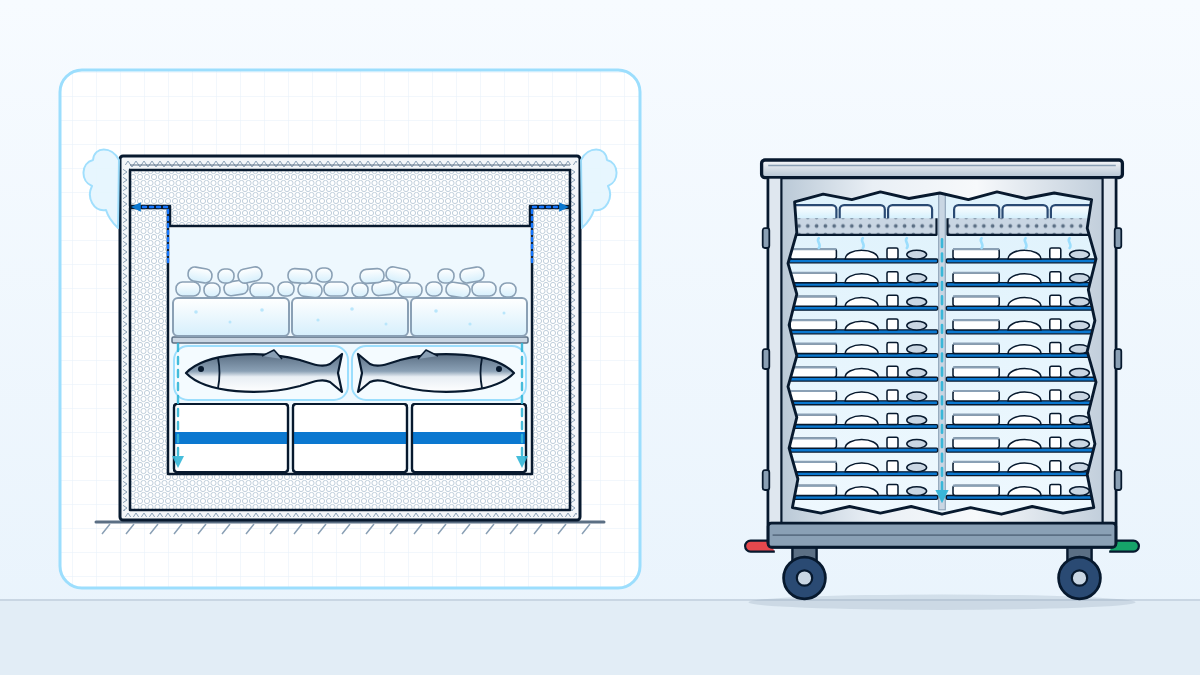
Food businesses reach for dry ice for one reason: it is the coldest practical coolant that disappears without a trace. Solid CO2 sits at −78.5 °C and sublimates — turns straight into gas — as it absorbs heat, so there is no puddle in the box, no soaked cartons, no spent coolant to drain at the destination. That makes it a standard tool for shipping frozen food, for catering and for temperature control in processing. How dry ice is made is covered in our guide to the dry ice production equipment chain; this article is about putting it to work on food.
Why dry ice suits food
Water ice holds product near 0 °C and turns into water as it works. Dry ice holds product far below freezing and turns into gas — and for food that second difference matters as much as the first:
- −78.5 °C working temperature: cold enough to keep meat, seafood and ice cream frozen solid rather than merely cool, with reserve for delays.
- No meltwater: a box cooled with water ice arrives soaked, the product sitting in a pool of tepid water — a bacterial soup after a long transit. A box cooled with dry ice arrives dry.
- Nothing to dispose of: the coolant leaves as gas, with no liquid to drain and no gel packs to return.
- Compact cold: dense solid CO2 carries a large cooling reserve per kilogram, so a modest charge replaces a much bulkier load of water ice or gel packs.
Dry ice for shipping food: the cold chain
The classic application is parcel-level cold chain: frozen meat, seafood and ice cream sent by courier or air freight in insulated boxes. Format matters. Fine Φ3 mm pellets expose a lot of surface per kilogram and sublimate fast; Φ16 mm sticks and compacted blocks last much longer, which is why they are the usual shipping format. The same dry ice pelletizer produces both diameters with a die change.
Packing follows two rules. Place the dry ice on top of the product: cold CO2 gas and chilled air sink, so the cold works down through the load. And never use airtight packaging — sublimation gas must escape, so lids and liners are closed but not sealed. For air freight, dry ice is treated as a dangerous good: carriers cap the kilograms per package and require specific labelling, and rules differ by carrier and route, so confirm current limits with your carrier before booking.
Catering and events
Between warehouse and plate, dry ice does quieter work. Airline and rail catering trolleys use it to hold meals cold for hours without powered refrigeration. Buffets, outdoor events and ice-cream vendors use it in displays and carts, where a small charge outlasts any gel pack. Restaurants use it for effect: a piece of dry ice in warm water throws a dense white fog over cocktails and desserts.
Dry ice releases CO2 and requires adequate ventilation. It must never be swallowed — it causes severe cold burns to the mouth and stomach — so serve it in a separate compartment or remove it before the item reaches the guest, and train staff accordingly.
Dry ice in food processing
Mixing and grinding put heat into food. In meat processing, dry-ice snow or fine pellets are dosed straight into the mixer or grinder to hold the batch at temperature without adding water: the CO2 sublimates away, where water ice would dilute the mix. Industrial bakeries use the same trick to control dough temperature during high-speed mixing, and processors use dry ice for shrink-chilling — rapid surface cooling of warm product before slicing or packing.
The small Φ3 mm pellet exists largely for this dosing role. The same pellets also clean the plant: dry ice blasting strips residues from ovens, conveyors and moulds without water, solvents or secondary waste.
Dry ice and modified-atmosphere packaging
CO2 is not only cold — it is the gas that slows mould and bacterial growth in modified-atmosphere packaging (MAP). Some processors use this in a rough-and-ready way: dry ice dropped into a tote sublimates and blankets the product in CO2 before the lid goes on, always with a vent path while sublimation continues. That buys margin in internal logistics, but it is not MAP. Packaging lines that need a defined blend at a defined ratio use proper gas mixing systems with buffer tanks, covered separately on this site.
Is dry ice food grade?
The answer is the one we give throughout this site: food-contact quality is a property of the CO2 gas supply and of local food regulations, not of the pelletizer. The machine presses whatever liquid CO2 it is fed. If dry ice will touch food — dosed into a mixer, fogging a dessert, packed against unwrapped product — raise the gas specification with your liquid CO2 supplier and check what your market’s food rules require; requirements differ by country and application and are confirmed case by case.
Handling dry ice in food premises
Two hazards dominate. Contact: at −78.5 °C, dry ice causes cold burns within seconds, so staff handle it with insulated gloves, tongs or scoops, never bare hands. Atmosphere: sublimating CO2 displaces air and collects in exactly the spaces food businesses use — walk-in freezers, cold rooms, closed delivery vans. Ventilate before entering, keep van cargo areas separated from the cab, and never let anyone ride in an enclosed space with a sublimating load.
Between uses, keep dry ice in dedicated insulated dry ice containers — polyethylene boxes from 33 to 350 litres whose insulated walls and non-airtight lids slow sublimation while letting gas escape. A household freezer does neither job.
Buying dry ice versus making it
An occasional shipper should simply buy dry ice locally and accept that purchased stock loses mass every day it waits. The arithmetic changes when demand becomes steady. A business that packs shipments or doses dry ice into production every working day is paying for sublimation losses and delivery scheduling on top of the product; at that point an on-site pelletizer making 40–50 kg per hour on demand, fed from liquid CO2 storage, starts to justify itself. The sizing logic — start from daily kilograms — is laid out in the production chain guide linked above.
Cryofortune is a sourcing and engineering supplier, not a factory. We select the pelletizer, the CO2 storage and the insulated containers from a vetted network of Chinese manufacturers and deliver them as one matched chain, with documentation for the destination market. Describe your daily volumes and we will propose a configuration.
Availability and applicability of any standard, certificate, marking or registration procedure are confirmed for the specific manufacturer, model and order before production.