
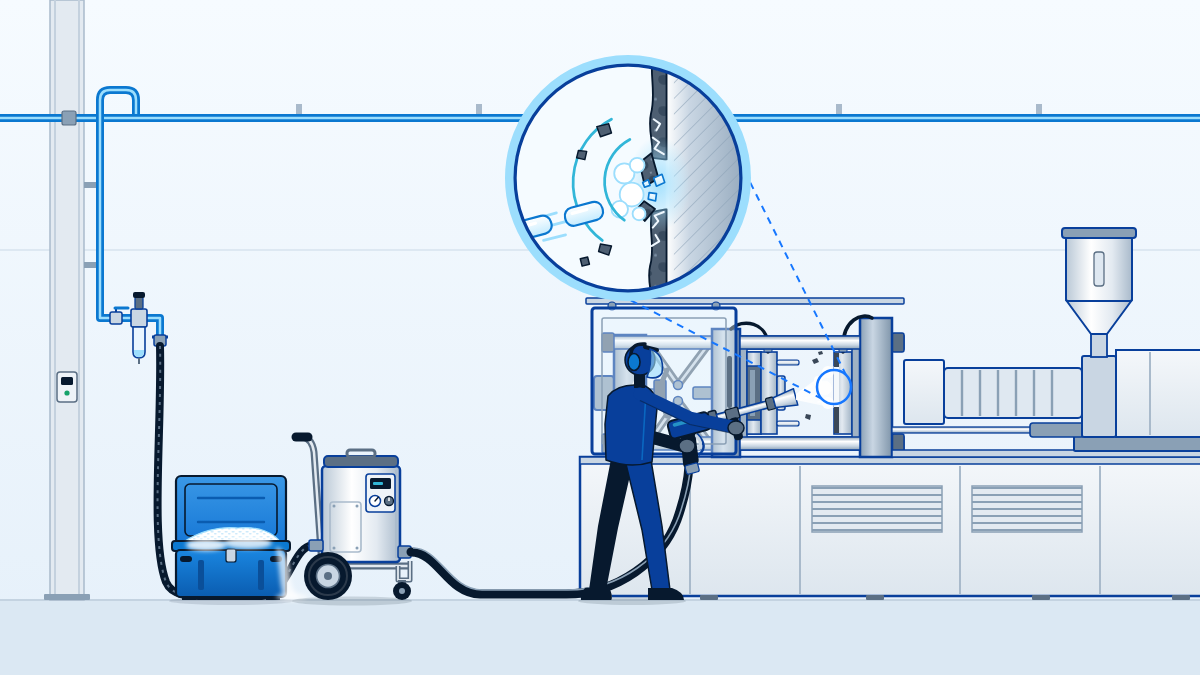
Dry ice blasting — also called dry ice cleaning or CO2 blasting — removes contamination by firing small pellets of solid carbon dioxide at a surface with compressed air. The pellets strike, chill the dirt and then vanish: at atmospheric pressure dry ice sublimates directly from solid to gas, so the cleaning medium disappears the moment its work is done. What is left on the floor is only the material that came off the surface.
That single property — a blasting medium that removes itself — explains why the method has spread from injection-moulding shops to food plants, printing houses and electrical maintenance. Below is how the process actually works, where it genuinely beats sandblasting, water and solvents, where it does not, and what equipment feeds it. Cryofortune is a sourcing and engineering supplier, not a factory: we configure dry-ice production and cleaning equipment from a vetted network of Chinese manufacturers, matched to each order and destination market.
How dry ice blasting works
A blasting machine meters dry-ice pellets — the Φ3 mm size produced by a dry ice pelletizer — into a stream of compressed air and accelerates them through a nozzle at the surface. The cleaning action combines three effects in the same instant:
- Kinetic impact. The pellet stream strikes the contamination layer and cracks it mechanically. Dry ice is far softer than sand or grit, so the blow breaks brittle deposits without gouging the substrate underneath.
- Thermal shock. Dry ice is −78.5 °C. The thin contamination layer chills far faster than the mass of the substrate, embrittles, shrinks and loses adhesion — grease, paint, resin and burnt residues crack loose.
- Sublimation micro-explosion. On impact each pellet flashes from solid to gas, expanding to hundreds of times its solid volume. Part of that expansion happens under the loosened layer and lifts it off the surface.
The contaminant falls away dry, and the medium leaves the room as CO2 gas. Nothing has to be rinsed, dried or collected except the dirt itself.
Dry ice blasting advantages: no secondary waste
Every traditional method leaves two things behind: the contamination it removed and the medium it used to remove it. Dry ice blasting deletes the second half of that equation. An honest comparison:
- Sandblasting and other abrasives cut fast, but the spent media — often tonnes of it on a large job — becomes contaminated waste that must be contained, collected and disposed of. Grit also erodes the surface and embeds in soft metals.
- Water and steam introduce moisture: drying time before restart, wastewater that may need treatment, corrosion risk on bare steel, and a hard stop near anything electrical.
- Solvents mean purchasing, storing and ventilating chemicals, residues left on the surface, and contaminated rags and liquids to dispose of.
After dry ice cleaning you sweep or vacuum up only what you removed. Where that contaminant is itself hazardous — old lead paint, for instance — it still must be handled accordingly, but the volume is a fraction of the contaminant-plus-media mix an abrasive method produces.
Gentle on surfaces, dry by nature
Solid CO2 is soft — roughly 2 on the Mohs scale — so it does not erode machined steel, aluminium, chrome plating or textured mould finishes the way grit does. Cavity dimensions, vents and polished faces survive repeated cleaning, which is exactly why the plastics industry adopted the method.
Because the process is completely dry and non-abrasive, it is also used on cables, connectors, printed circuit boards, control cabinets and generator windings — equipment that would never tolerate water or steam; electrical equipment is cleaned de-energised as standard practice. On food-contact surfaces the medium is carbon dioxide, the same gas used to carbonate beverages, and it leaves no chemical residue; whether a food-grade application meets local food-hygiene rules is confirmed separately in each case.
Where dry ice blasting earns its keep
- Injection mould cleaning in place: moulds are cleaned in the press, at operating temperature, with no cool-down, no disassembly and no risk to cavity dimensions — turning a shift-long maintenance stop into minutes. This is the single biggest production win the method offers.
- Food industry: ovens, conveyor belts, mixers and seasoning drums cleaned dry, without water in zones full of motors and sensors.
- Printing: ink, varnish and paper dust removed from rollers, gears and guides without dismantling the press.
- Electrical maintenance: switchgear, cabinets, generators and transformers cleaned de-energised, with no moisture or residue.
- Automotive and restoration: engine bays, chassis, underbody coatings, adhesive residues and fire-damage soot.
- Historic surfaces: soot and failed coatings lifted from timber, brick and stone where any abrasive would erase the detail.
Honest limits
Dry ice blasting is not a universal answer, and knowing its limits is part of using it well:
- It needs a supply chain. The process consumes compressed air from a site compressor and a steady flow of fresh Φ3 mm pellets. Pellets sublimate even in good containers, so they are produced on site or bought fresh — the logistics are covered in our guide to the dry ice production equipment chain.
- It is loud. High-velocity air and pellet impact generate serious noise; hearing protection is typical practice on every job.
- CO2 displaces air. The sublimated gas accumulates in pits, tanks and closed rooms, so work in enclosed spaces calls for ventilation and gas detection.
- It does not replace abrasives everywhere. Thick, heavy rust and scale bonded into the metal respond better to grit; dry ice excels at layers held by adhesion — grease, paint, resin, soot, food residue — not at bulk corrosion removal.
The equipment chain behind the nozzle
A blasting gun is the visible end of a short production chain. Its Φ3 mm pellets are either bought fresh and held briefly in insulated dry ice containers, or made on site with a dry ice pelletizer — machines of the HR-KL-50 class produce 40–50 kg/h and switch between Φ3 mm blasting pellets and Φ16 mm shipping sticks. Upstream sits a storage vessel with its liquid CO2 equipment, filled by a gas supplier or by the plant’s own CO2 filling station.
Cryofortune supplies dry ice blasting machines on request as part of this dry-ice equipment chain, configured per order from the manufacturer network — typically sized together with the pelletizer and storage so that pellet production, holding time and consumption match. As a sourcing and engineering supplier we select the manufacturer for each position and align the documentation with the destination market; contact us with your application and target country to scope a complete line.
Availability and applicability of any standard, certificate, marking or registration procedure are confirmed for the specific manufacturer, model and order before production.