
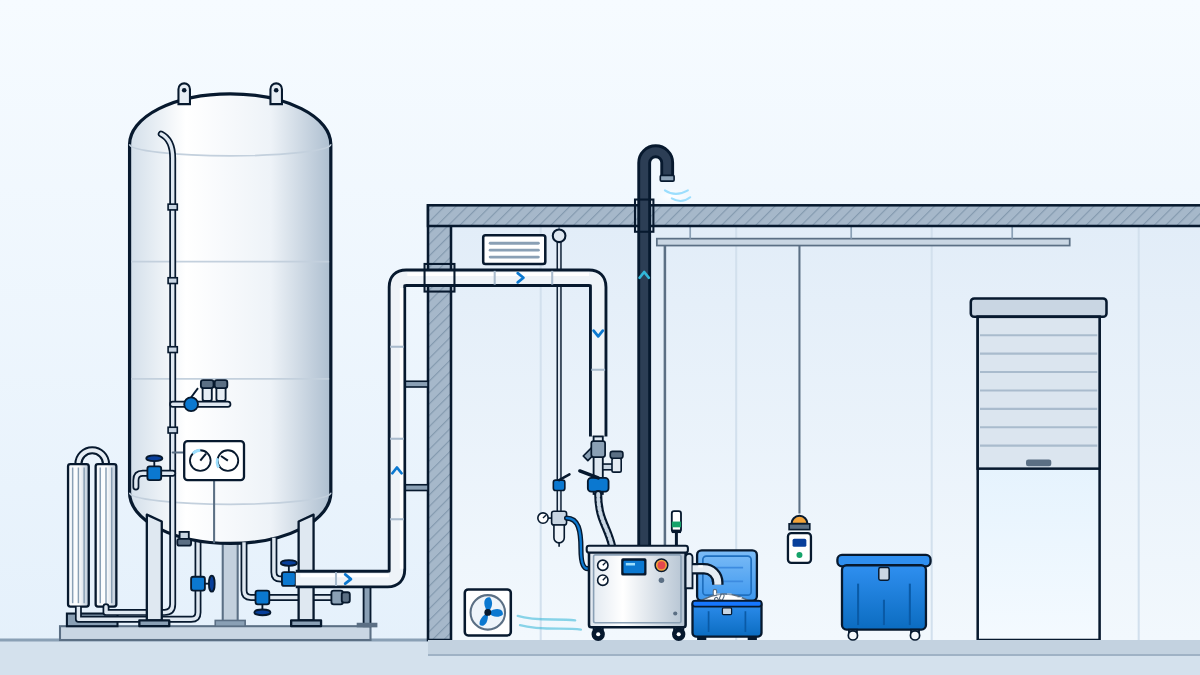
Dry ice is one of the few industrial products with a shelf life measured in days. From the moment a pellet leaves the press it begins to sublimate — passing straight from solid to gas at −78.5 °C — and no container, however well insulated, stops that loss completely. This one fact shapes the whole business: dry ice is produced close to where it is used, scheduled against real orders rather than stockpiled, and the producer who can hand over fresh pellets on short notice holds the advantage. The equipment side, fortunately, is compact. A working dry ice production line is essentially three items — liquid CO2 storage, a pelletizer and insulated containers — all drawn from the wider family of liquid CO2 equipment.
How dry ice is made
The feedstock is liquid carbon dioxide. Unlike nitrogen, oxygen or argon, which are deep cryogens boiling at about −183 to −196 °C, liquid CO2 is stored at about −20 °C and 2 MPa — a moderate low temperature in vessels rated up to about 2.2 MPa. That stored pressure is what drives the whole process.
Inside a dry ice machine, liquid CO2 is expanded to atmospheric pressure. The sudden pressure drop does two things at once: part of the liquid flashes off as gas, and the expansion cooling freezes the rest into fine CO2 snow. A press then compacts the snow through a die into dense pellets, nuggets or blocks. Nothing is added and nothing is burned — it is the same CO2, rearranged by pressure.
One honest number belongs in every business plan: only part of the liquid becomes product. In typical machines, commonly around 40–45% of the liquid CO2 feed turns into dry ice, and the rest leaves as flash gas. For purchasing, plan on roughly 2 to 2.5 kg of liquid CO2 per kilogram of saleable dry ice.
The equipment chain, stage by stage
Liquid CO2 storage comes first. A steady operation feeds the line from a dedicated vertical CO2 tank — the range we supply runs from 7,990 to 25,000 litres at up to 2.2 MPa — refilled by road tanker from a local gas producer, while a pilot operation can start on vertical cryogenic cylinders of 50–500 litres and scale up later. The tank must be configured and rated for CO2 service; an air-gas cryogenic storage tank cannot simply be switched to CO2.
The pelletizer is the heart of the line, and it is smaller than most buyers expect. A machine of the HR-KL-50 class in our dry ice pelletizer range produces 40–50 kg of dry ice per hour as Φ3 mm or Φ16 mm pellets with a density of 1550 kg/m³, draws 3 kW, and stands 105×48×102 cm at 180 kg — it fits in the corner of an existing filling hall. Output can be configured as pellets, nuggets or blocks.
Insulated storage closes the chain. Between the press and the customer, product waits in insulated containers designed to slow sublimation while allowing CO2 gas to escape. The dry ice storage containers we source come in nine polyethylene sizes from 33 to 350 litres, so the same box can move from press to van to the customer’s floor. The key word is slow: no container stops sublimation, which is exactly why production is scheduled against demand rather than run ahead of it.
The optional fourth stage is gas recovery. The share of feed that flashes to gas is still clean CO2; smaller sites simply vent it safely outdoors, while larger producers can capture and reliquefy it to cut liquid purchases. Recovery equipment exists and can be added to a quotation as an option — whether it pays depends on your volumes and local liquid supply terms.
Sizing the line: start from daily kilograms
Size the chain backwards from demand, not forwards from the machine. Begin with a realistic figure for kilograms of dry ice sold per day, including peaks — summer cold-chain shipping is a common spike. A 40–50 kg/h pelletizer on a six-to-eight-hour run yields roughly 250–400 kg per day; beyond that, you add shifts or a second unit.
Then convert product into feedstock. At the common 40–45% yield, producing 300 kg of dry ice consumes around 700 kg of liquid CO2 per day. Your storage vessel should comfortably cover the interval between tanker deliveries plus a reserve — if your supplier delivers weekly, that is a week of feed — and this is what moves most steady producers from cylinders to a vertical tank.
If you already run, or are planning, a CO2 cylinder filling operation, the economics improve further: the same storage tank can feed both the filling line and the pelletizer. Our guide to CO2 filling station equipment setup covers that side of the chain — dry ice is a natural add-on product for an operator who already holds a liquid CO2 supply contract.
Siting and safety
CO2 is an asphyxiant, and it is heavier than air, so it collects in pits, basements and closed rooms. Typical practice for a dry ice room is straightforward: mechanical ventilation with extraction at low level and CO2 gas detection in the production and storage areas. The same thinking follows the product out of the door — dry ice keeps sublimating in transit, so it travels in ventilated cargo spaces, never in a closed passenger cab, and cold rooms where containers are kept are ventilated too.
Buyers serving food and pharma customers often ask about food-grade dry ice. Food-contact quality is a property of the CO2 gas supply and of local food-safety rules, not of the machine — a pelletizer presses whatever liquid it is fed. Raise the gas specification with your liquid CO2 supplier and confirm the requirements of your market; we flag this during equipment selection rather than making blanket claims.
What to send for a quotation
A dry ice line is quoted as a matched chain, so the useful inquiry is short but specific:
- Expected dry ice demand in kg per day, with peaks and seasonality;
- Pellet size your customers need — Φ3 mm for blasting and laboratory work, Φ16 mm or blocks for shipping — or a mix;
- Your liquid CO2 situation: an existing tank or none, and the delivery sizes and frequency local gas suppliers offer;
- Electrical power available at the site;
- Destination country, so vessels are specified against your design codes;
- How many insulated containers daily distribution will need, and in which sizes;
- Whether cylinder filling or flash-gas recovery should be included as options.
Cryofortune Engineer & Supply Co., Ltd. is a sourcing and engineering supplier, not a factory: for each order the manufacturer is selected from a vetted network of Chinese factories against the destination’s design codes and the specification in hand — described in how Cryofor selects a manufacturer. Send your figures through our contact page and you will get back a coherent chain — storage vessel, pelletizer and containers that actually match — rather than a list of disconnected machines.
Availability and applicability of any standard, certificate, marking or registration procedure are confirmed for the specific manufacturer, model and order before production.