Search for a CO2 cannon or a cryo jet and you will find pages of vendors selling the same photograph: a white column of fog erupting over a crowd. Almost nobody talks about what feeds that column. The cannon itself is the simple part of the system — a valve, a nozzle, a mounting bracket. What event companies actually struggle with is everything upstream: the right cylinders, a reliable refilling routine and, once shows become regular, bulk liquid CO2. A cryo cannon for events is bought once; the CO2 behind it is bought again for every show.
Cryofortune is an international sourcing and engineering supplier of CO2 and cryogenic equipment, working from a network of vetted Chinese manufacturers. We are not a factory, and we do not sell the stage cannons themselves. What we configure is the supply chain that keeps them firing — cylinders, filling, bulk liquid. Here is how the effect works and what actually sits behind it.
What the CO2 jet effect actually is
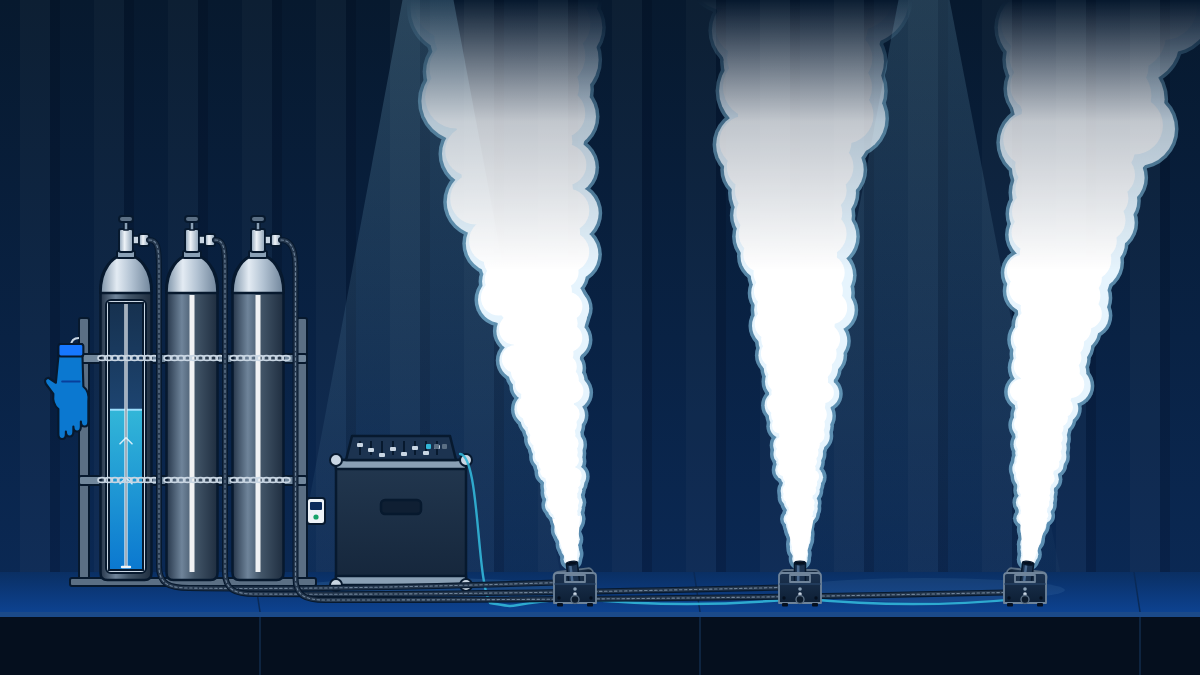
A cryo jet is mechanically simple. A high-pressure hose connects a cylinder of liquid CO2 to a fast valve; when the valve opens, liquid CO2 escapes through the nozzle and flash-expands into gas. The expansion chills the surrounding air so hard that ambient moisture condenses into a dense white plume. Most of what the audience sees is not CO2 at all — it is water fog created by cold.
That origin gives the effect properties glycol smoke cannot match. The plume is genuinely cold, and clubs and concerts use it as much for crowd cooling across the front rows as for the visual. It is heavier than air, so it sinks and stays sculptural instead of drifting into haze. And it vanishes in seconds without residue: no oily film on lighting and lenses, no slippery deck, no lingering haze wandering toward a smoke detector.
The fact most buyers miss: siphon cylinders
A jet only works if the cylinder delivers liquid CO2, not gas. This is the most common purchasing mistake in the market. A standard cylinder valve draws from the headspace at the top, where CO2 sits as gas; connect a jet to it and you get a few weak white puffs, then a hiss of invisible gas.
Cryo jets therefore run on siphon cylinders, also called dip-tube cylinders: a standard high-pressure CO2 cylinder fitted with an internal tube reaching to the bottom of the vessel, where the liquid phase sits. From the outside it looks identical, which is exactly why mix-ups happen at rental counters and gas depots. The high-pressure gas cylinder family we supply is configured per order — the siphon variant, valve type and thread standard for the destination country are specified at purchase.
Consumption: bursts, not hours
The second surprise is how fast a jet drinks. Effects are fired in short bursts, and a cylinder commonly yields minutes of total effect time, not hours. A show firing several jets together multiplies the draw, so one event can move through a rack of cylinders. The real cost of the effect is not the cannon; it is keeping filled siphon cylinders in rotation.
Occasional productions manage with cylinder swaps from a local gas supplier. Venues with a regular show calendar usually reach the point where swapping stops making sense and filling moves in-house: a CO2 filling station — storage, transfer pump, manifold and scales, since CO2 cylinders are typically filled by weight — refills the venue’s own cylinder pool on site. The heaviest users step up to bulk liquid CO2 storage and treat cylinders purely as the delivery format between tank and stage.
Rigging and operating basics
The operational rules are unglamorous and non-negotiable:
- Cylinders are secured upright, in stands or chained to structure — a siphon cylinder feeds liquid correctly only in its intended orientation.
- Hose is high-pressure and rated for CO2 service, routed where nothing can crush or kink it mid-show.
- Placement keeps real distance between nozzle and audience, and jets are never aimed at faces at close range — the plume is cold enough to hurt.
- Gloves go on before touching hardware after firing: valves, hoses and nozzles chill quickly, and bare skin on chilled metal is a cold burn.
The safety point that deserves respect
CO2 displaces air, and because it is denser than air it sinks. That combination is exactly what makes the visual work — and it is also the hazard profile: CO2 is both an asphyxiant and toxic. At about 1–2 % it causes drowsiness and loss of concentration, and around 4 % (40,000 ppm) it is immediately dangerous, even while oxygen is still adequate. On an open-air stage or in a well-ventilated hall, brief effect bursts are routine. In a basement club, an orchestra pit, an under-stage void or any enclosed low-lying space, gas from repeated firing can accumulate at floor level — the height where people sit, crouch or fall. Running multiple jets in a small sealed room is how incidents happen.
The mitigation is not exotic: ventilation that actually exchanges air at low level, conservative programming in tight spaces and, for venues using the effect heavily, fixed CO2 detectors (an oxygen monitor alone is not enough) at the low points — see our CO2 detection guide. Event, fire and workplace regulations differ by country and city, so the local rules for compressed gas and stage effects belong in show planning from the start.
Who buys what
The purchasing pattern follows the show calendar:
- Rental and production companies buy packs of siphon cylinders and build swap logistics with a regional filler, because their kit travels from venue to venue.
- Fixed venues — clubs, arenas, resident show stages — move to on-site refilling or a bulk tank once shows become weekly; the storage vessels behind that step sit in our pressure vessels program.
- Touring productions plan regional refills along the route instead of trucking full cylinders across borders.
Notice what this chain really is: liquid CO2 storage, transfer and cylinder filling. It is the same chain that feeds dry ice production, which is why venues that install a filling setup sometimes add a pelletizer later and run jets, dry ice fog and chilled logistics from one tank.
Cryofortune configures that supply side end to end — siphon cylinders, filling stations, bulk storage and vaporization — sourced from a network of vetted Chinese manufacturers and matched to the destination’s design codes and documentation. We do not sell the cannons; we keep them from ever firing dry. If you are planning a venue, a rental fleet or a tour, send us the duty and we will size the chain behind the effect.
Availability and applicability of any standard, certificate, marking or registration procedure are confirmed for the specific manufacturer, model and order before production.