
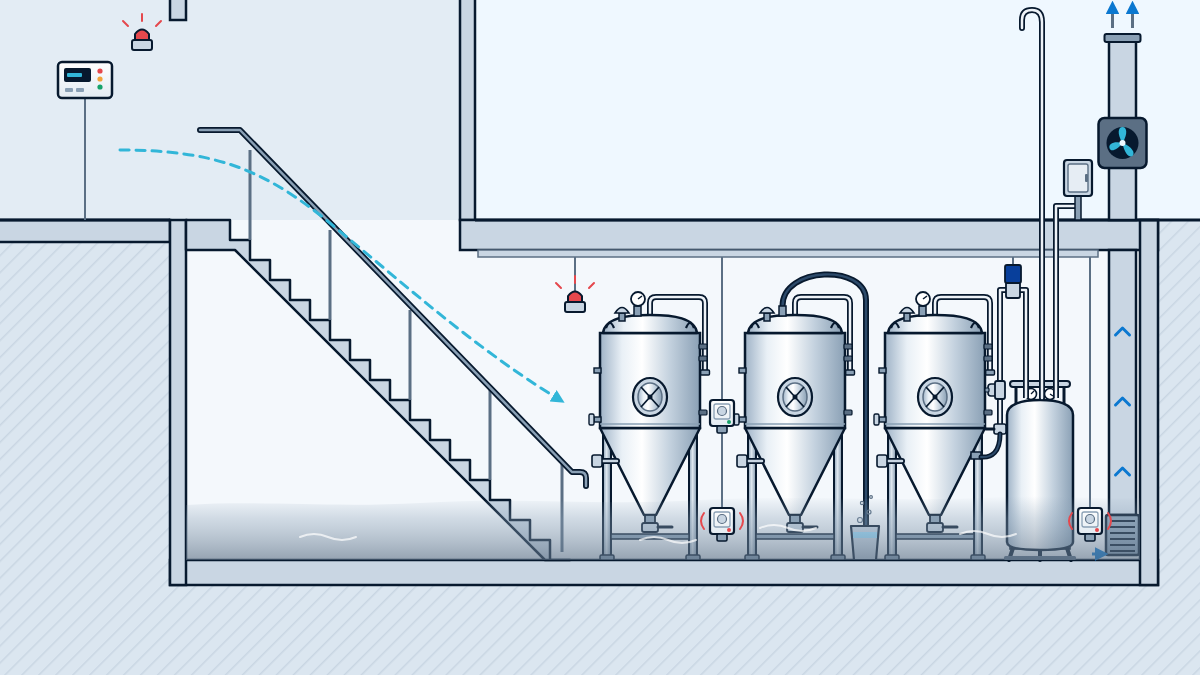
Among the gases supplied as cryogenic liquids, carbon dioxide is the only one that is poisonous before it is suffocating. Nitrogen and argon kill by pushing oxygen out of a room, so an oxygen monitor catches them. CO2 does that too, but it also acts directly on breathing and consciousness at concentrations where there is still plenty of oxygen in the air, which is why an oxygen sensor alone gives false reassurance. Add the fact that CO2 is about one and a half times denser than air, and you get the classic accident: a cellar, a pit or a bottom stair landing where the gas has quietly pooled while the room above reads normal. This guide explains where CO2 accumulates and why, what the exposure limits mean, how to detect it properly, and how detection differs from the dosing control used in greenhouse enrichment.
Why CO2 collects in low spaces
At room temperature CO2 has a relative density of roughly 1.5 against air. In a well-mixed, ventilated room that hardly matters, because air movement keeps the gas dispersed. In a still room it matters a great deal. Released slowly into a space with no air changes, CO2 behaves like an invisible liquid: it flows downhill, fills the lowest volume first and stays there. A cellar reached by a staircase is close to a worst case, because the stairwell acts as a channel that feeds the lowest point and the door at the top does nothing to help.
The places this happens in industry are predictable:
- Fermentation cellars. Brewing and winemaking produce roughly half a kilogram of CO2 for every kilogram of sugar fermented. A working tank can fill the space around it faster than a cellar ventilates, and the hazard peaks exactly when the crop is in and people are working long hours.
- Beverage dispense cellars and bar basements. A leaking CO2 cylinder or a failed regulator can empty into a small unventilated room overnight.
- Greenhouses under enrichment. Here the gas is added deliberately, and a dosing fault or a stuck valve turns a growing aid into a hazard, most dangerously at night when vents are closed.
- Dry ice storage and handling rooms. Dry ice sublimates continuously, so a closed cold room or a van with a pallet in it becomes an accumulation problem with no leak at all.
- Filling rooms and pump pits. Any place a liquid CO2 line can vent, especially below grade.
- Tanks, silos and manholes. Classic confined spaces, where CO2 from a previous process may still be sitting at the bottom.
What the exposure limits actually mean
Ordinary outdoor air sits a little above 400 parts per million, and occupied rooms typically run between 600 and 1,000 ppm. The occupational limits used in most markets are an eight-hour average of 5,000 ppm and a short-term limit in the 15,000 to 30,000 ppm range, depending on the jurisdiction. Concentrations around 40,000 ppm, that is 4 percent, are treated as immediately dangerous to life and health.
Between those numbers the effects climb quickly. At one to two percent people become drowsy and lose concentration. At three percent breathing deepens noticeably and headaches follow. At five percent the effects become severe within minutes, and above eight percent unconsciousness can come fast enough that the person never leaves the room. The dangerous part is that none of this is announced. CO2 is colourless and effectively odourless at these levels, and the drowsiness it causes removes the judgement needed to walk out. Always confirm the limits that apply in the destination country, because they differ and they are the numbers an inspector will use.
Detection: the right sensor in the right place
Use a CO2-specific sensor, not an oxygen depletion monitor. The standard technology is non-dispersive infrared, usually shortened to NDIR: the sensor measures how much infrared light the gas absorbs at a CO2-specific wavelength. It is selective, stable over years and unaffected by the humidity levels found in cellars and greenhouses. Electrochemical cells are not used for CO2. For fixed installations choose an instrument with two alarm thresholds, a relay output for ventilation and, where people enter, a sounder and beacon outside the door as well as inside.
Placement is where most installations go wrong. Because the gas is dense, a detector at eye level can read clean air while the floor is lethal. Practical rules:
- Mount the fixed sensor low, commonly around 0.3 to 0.5 m above the floor, and put a second head in the breathing zone where people work standing.
- Put a head near the likely source: the tank connection, the manifold, the fermentation vessel, the dosing line.
- Do not mount in the direct path of a ventilation inlet, where fresh air will mask a genuine build-up.
- Give anyone who enters a confined space a personal monitor as well. A fixed system protects the room; it does not protect the person who climbs into the tank.
- Calibrate on the manufacturer’s schedule, typically once a year, and bump test far more often. An uncalibrated detector is worse than none, because it is believed.
Two alarm levels are the usual arrangement: a pre-alarm at the eight-hour limit that starts ventilation and warns people, and a main alarm at the short-term limit that evacuates the room and shuts the CO2 supply. Interlocking the main alarm to an automatic isolation valve on the supply line is the single most effective improvement most sites can make, because it stops the source instead of only announcing it.
Remote level monitoring of the CO2 supply is a separate job. Liquid cylinder telemetry such as CryoFor TM2 reports how much liquid a vessel holds; it is not a gas detector and does not replace fixed CO2 or O2 detection.
Greenhouse enrichment: two instruments, two jobs
Growers raise CO2 deliberately, commonly to somewhere between 800 and 1,500 ppm, because photosynthesis responds to it. That makes the greenhouse a special case, and it is where the confusion usually starts. The controller that meters CO2 to the crop and the detector that protects the people are not the same instrument and should never be the same instrument.
The dosing controller measures at crop height, is tuned for accuracy in the few-hundred to few-thousand ppm band, and modulates the supply valve to hold a setpoint. Its failure mode is a bad crop. The safety detector measures near the floor and at working height, is set at occupational thresholds an order of magnitude higher, and its job is to close the valve and start the fans when something fails open. Its failure mode is a fatality. Sharing one sensor between the two functions means a single calibration drift takes out both the growing programme and the protection at the same moment.
Two situations deserve particular attention in a greenhouse. The first is night and closed-vent operation, when enrichment should be off and any leak has nowhere to go. The second is a flue-gas enrichment system, where CO2 comes from a burner rather than a tank and a combustion fault can add carbon monoxide and ethylene to the air alongside the CO2. If the site burns fuel for enrichment, the monitoring plan needs to cover those gases too. The supply side of all this is covered in our guide to greenhouse CO2 enrichment supply.
Ventilation and the written procedure
Detection tells you there is a problem; ventilation is what removes it. Because the gas sits low, extraction has to be taken from low level, and a high-level extract fan in a cellar can run all day while the floor stays loaded. Size the system for air changes that clear the worst credible release, interlock it to the gas alarm so it starts without anyone present, and make sure the make-up air path is open when it runs.
The procedural side is short but not optional. Nobody enters a space that has alarmed until the reading is confirmed safe with a calibrated instrument. Confined space entry follows the site’s permit system, with a personal monitor, a second person outside and a means of rescue that does not require the rescuer to enter unprotected. Most CO2 fatalities involve a second victim who went in to help. Written into a procedure and rehearsed, that single rule prevents the pattern.
What Cryofortune supplies
Cryofortune is a sourcing and engineering supplier: we match buyers with Chinese manufacturers and configure the equipment for the duty and the destination code. On the CO2 side that means the storage tank, the CO2 heater and vaporization equipment, the dosing and distribution hardware for greenhouse or beverage duty, and the fixed gas detection and alarm equipment specified alongside it so the supply and its protection arrive as one scope rather than two. We confirm sensor type, alarm thresholds, mounting heights and interlock logic against the rules that apply in the destination market before the order goes to production, because thresholds and certification requirements differ by country. Availability and applicability of any standard, certificate or marking are confirmed for the specific manufacturer, model and order.
CO2 detection and safety: common questions
Why does CO2 accumulate in cellars and basements?
Carbon dioxide is about 1.5 times denser than air, so in a still space it sinks and fills the lowest volume first instead of mixing. A cellar with little ventilation collects it, and the stairwell that reaches the cellar tends to feed the lowest point rather than drain it. The room above can read completely normal while the floor below is dangerous.
Can an oxygen depletion sensor be used to detect CO2?
No. Oxygen monitors suit inert gases such as nitrogen and argon, which harm only by displacing oxygen. CO2 affects breathing and consciousness directly at concentrations where oxygen is still adequate, so an oxygen sensor can read acceptable while the CO2 level is already hazardous. Use a CO2-specific NDIR detector.
Where should a CO2 detector be mounted?
Low, commonly 0.3 to 0.5 m above the floor, because the gas is dense, with a second head in the breathing zone where people work standing and one near the likely source such as the tank connection or fermentation vessel. Keep heads out of the direct airflow from a ventilation inlet, and give anyone entering a confined space a personal monitor as well.
What CO2 level is dangerous?
Occupational limits are typically an eight-hour average of 5,000 ppm with a short-term limit between 15,000 and 30,000 ppm depending on the country, and about 40,000 ppm, four percent, is treated as immediately dangerous to life and health. Drowsiness and loss of concentration start well below that, from around one to two percent, which is what makes the gas so dangerous in an unventilated room.