
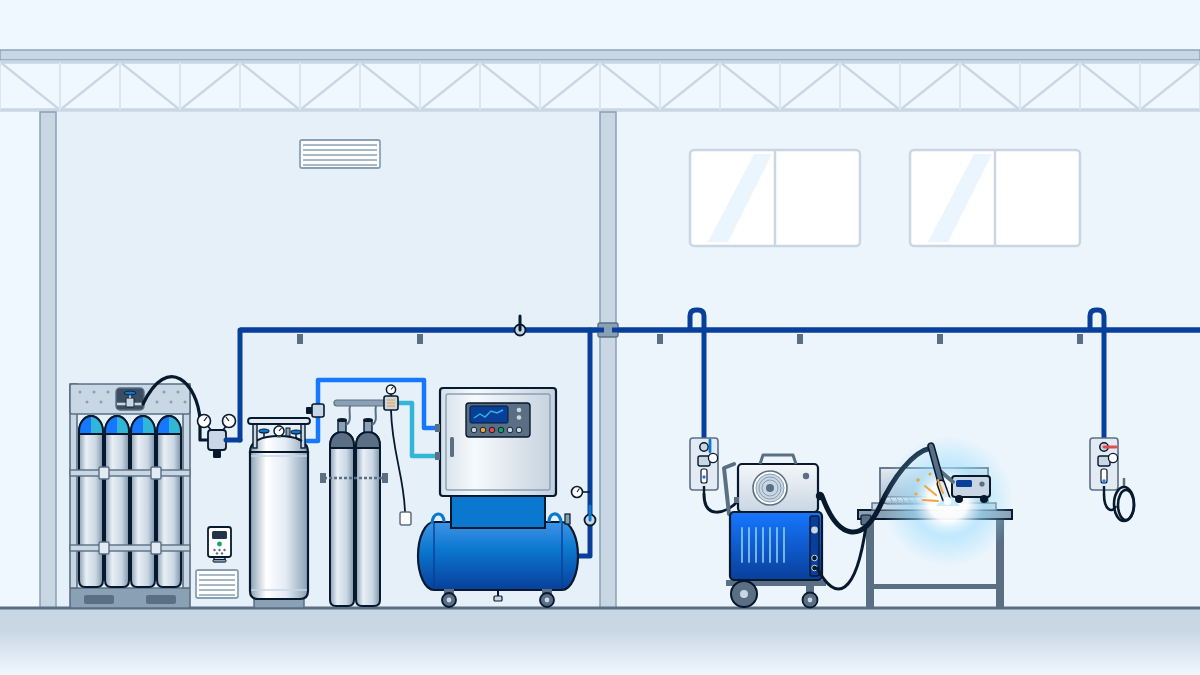
The weld is decided at the torch, not at the gas company. In MIG and MAG welding, a shielding gas streams out around the arc and blankets the molten pool, holding back the oxygen and nitrogen in ordinary air while the metal solidifies. Let that air reach the weld and you get porosity, spatter and a weak, ragged bead. Change the blend feeding the torch and you change the arc itself — its stability, its penetration, its spatter and the shape of the finished bead. So two questions sit underneath every welding-intensive shop: which blend, and where does that blend come from?
What the shielding gas actually does
The gas has one core job: keep the atmosphere off the arc and the pool. Beyond that shield, the mix also tunes how the arc behaves. Argon is inert and gives a smooth, stable, controllable arc with little spatter, but on steel a pure-argon arc tends to run narrow and can lack penetration. Carbon dioxide is reactive and cheap; it drives a hotter, deeper, more penetrating arc, at the cost of more spatter and a rougher bead. Most steel welding therefore uses a blend that borrows from both — enough argon for arc stability and appearance, enough CO2 for penetration and price.
Common blends
These families cover most of what a fabrication shop runs, and are worth citing as examples rather than prescriptions — the right mix depends on the base metal, wire, transfer mode and the code you weld to:
- Pure argon — common for aluminium and other non-ferrous metals, and for the TIG process.
- Argon/CO2 — the workhorse for carbon and low-alloy steel. The 75/25 and 80/20 families (roughly three-quarters to four-fifths argon) are among the most widely used for general MIG work.
- Higher-CO2 or pure CO2 — cheaper, with deep penetration, at the cost of a harsher arc and more spatter; still popular where cost and penetration outweigh finish.
- Argon/oxygen and tri-mixes — small oxygen additions or three-gas blends (for example argon, CO2 and a little oxygen or helium) are used to fine-tune stainless and specialised steel work.
Pre-mixed cylinders or on-site blending?
This is the decision the whole supply choice turns on. Pre-mixed cylinders arrive ready-blended from a gas company. They are simple: no mixing hardware, no calibration, just connect and weld. The trade-off is that you pay a blending premium on every single cylinder, and you are locked to the ratios your supplier offers.
On-site blending flips that. You buy argon and CO2 separately — in bulk or in cylinders — and blend them to the ratio you need with a gas mixer at the point of use. At volume the raw gas costs markedly less than the same gas pre-blended, and you can dial the ratio to the job instead of accepting a catalogue mix. In exchange you own the mixing equipment and take responsibility for its calibration. For a shop running a handful of cylinders a week, pre-mixed usually wins. For a welding-intensive plant, or a distributor filling mixed-gas cylinders to sell, on-site blending typically pays for itself and then keeps paying.
The mixer itself is the heart of that setup. A unit such as our gas mixer with receiver meters two (or more) gas streams to a set proportion; where the blending station lives on a wall or in a supply room, the same function comes in the panel form of a gas mixing cabinet. The gas sources feed in from bulk liquid argon equipment and liquid CO2 equipment, or from banks of high-pressure cylinders.
Where the argon or CO2 comes from liquid cylinders, each cylinder’s reserve can be followed remotely rather than on rounds. On cylinders with a compatible capacitive level probe, a CryoFor TM2 module takes the place of the stock electronic level gauge and reports the level to CryoFor Telemetry on a set schedule; consumption analytics show use by gas, and a low-reserve alert arrives while there is still time to plan the refill.
Why a receiver keeps the ratio on-spec
Here is the single most useful technical point, and the one most often missed. A mixer blends accurately only within a flow range. It meters two streams in proportion, and that works cleanly only while the draw downstream is steady. In a real shop it never is: torches trigger and release, stations come on and off, and the flow swings from moment to moment. Chasing those swings, the mixer lets both pressure and ratio drift — exactly when you least want it.
The fix is to put a buffer downstream of the mixer. A gas mixture receiver stores already-blended gas and releases it when demand spikes, so pressure and ratio stay in a tight band instead of reacting to every trigger pull. It decouples the mixer from the demand swings, letting the mixer run steadily while the tank absorbs the peaks — and the gas arriving at each torch stays on-spec. We cover the underlying principle, and how such a buffer is sized to a process, in our article on the gas mixing system buffer tank.
Filling your own mixed-gas cylinders
A distributor or large plant can go one step further and fill its own mixed-gas cylinders. Here the mixer feeds a filling loop rather than a weld station. One practical detail matters: where CO2 is present as a liquid it is dosed by weight, so CO2-containing cylinders are filled on scales, while the gas phase blends by pressure and partial pressure. Get the sequence and the weights right and every filled cylinder leaves on-ratio; the receiver again smooths the loop so filling does not starve the blend.
Safety: colourless, odourless, heavier than air
Both argon and carbon dioxide are colourless, odourless asphyxiants, and both are heavier than air. That combination is the hazard: a leak gives no warning and the gas pools low — in pits, trenches and the bottom of confined welding bays — where it can displace breathable air before anyone notices. Wherever large volumes are stored or blended, that means real ventilation and fixed gas monitoring, not just a cracked door. Welding inside tanks, vessels and other confined spaces brings its own rules, and they exist precisely because the gas you cannot see is the one that settles around your feet.
How Cryofortune configures the chain
Cryofortune is an international sourcing and engineering supplier, not a factory. We configure the full blending-and-supply chain — mixer, receiver, argon and CO2 sources, and the filling loop where you fill your own — from a network of vetted Chinese manufacturers, matched to the codes, markings and documents your destination requires. Tell us the blend or blends you run, the number of welding stations you feed or cylinders you fill per day, and whether you draw from bulk or cylinders, and we will size the chain to it. Start at our contact page with those details.
Availability and applicability of any standard, certificate, marking or registration procedure are confirmed for the specific manufacturer, model and order before production.