TR CU 032, the EAEU pressure-equipment regulation, does not end at a certificate. It expects a defined Russian-language dossier — equipment passport, calculations, safety justification — to travel with the vessel. That dossier, not the conformity mark itself, is usually the harder half of sourcing cryogenic equipment from China into Russia, Belarus, Kazakhstan, Kyrgyzstan or Armenia. The mark itself is comparatively well understood: one EAC document, once issued, is cited in all five states without national re-certification. The documentation behind it is where sourcing from a Chinese factory succeeds or stalls.
EAC certification under TR CU 032
Product conformity for cryogenic tanks, cylinders and vessels generally runs under TR CU 032/2013, the EAEU pressure-equipment regulation. Depending on the hazard category of the specific vessel, the procedure is a registered declaration or certification by an accredited body. Both routes end in the same place: an entry in the EAEU unified register and the EAC mark on the equipment. That one document is then cited at import in any member state, without national re-certification. Pumps, pelletizers and other machinery may instead fall under the machinery, low-voltage and EMC regulations, alone or in combination.
The regime itself — scope, categories, schemes, applicant requirements — is described on our EAC and TR CU 032 standard page. This page covers the market view: what the regime means for choosing a factory and structuring an order. One distinction carries through everything below: the EAC mark proves that conformity was assessed; it says nothing about whether the passport, the calculations or the safety justification exist in Russian.
A structural point matters early. A Chinese manufacturer cannot hold an EAC document itself; the applicant must be an entity resident in an EAEU state. For batch schemes that can be the importer of the specific consignment. For serial supply it is an authorized representative, and a production audit at the factory may be required. Which route fits depends on whether one tank is being bought or a supply line is being built, and is confirmed per order.
The documentation package in Russian
The practical filter in EAEU sourcing is rarely the certificate. It is the documentation the certificate rests on. TR CU 032 expects a defined dossier: an equipment passport in the regulation’s format, an operation manual, a safety justification (обоснование безопасности), strength calculations and safety-valve capacity calculations. Copies of the core documents are expected to accompany the delivered vessel, in Russian.
Most Chinese factories design competent equipment to GB or EN pressure-vessel codes. Few produce this dossier natively. A design standard is not a documentation package, and a test report is not a safety justification. Where a factory’s file falls short, preparing, translating and aligning the package with the regulation can be scoped into the order, subject to the agreed scheme and manufacturer — not assumed as a standard inclusion.
Equipment for EAEU configurations
The product range maps closely onto how EAEU buyers already specify equipment — by medium, by gasifier duty, by cylinder format.
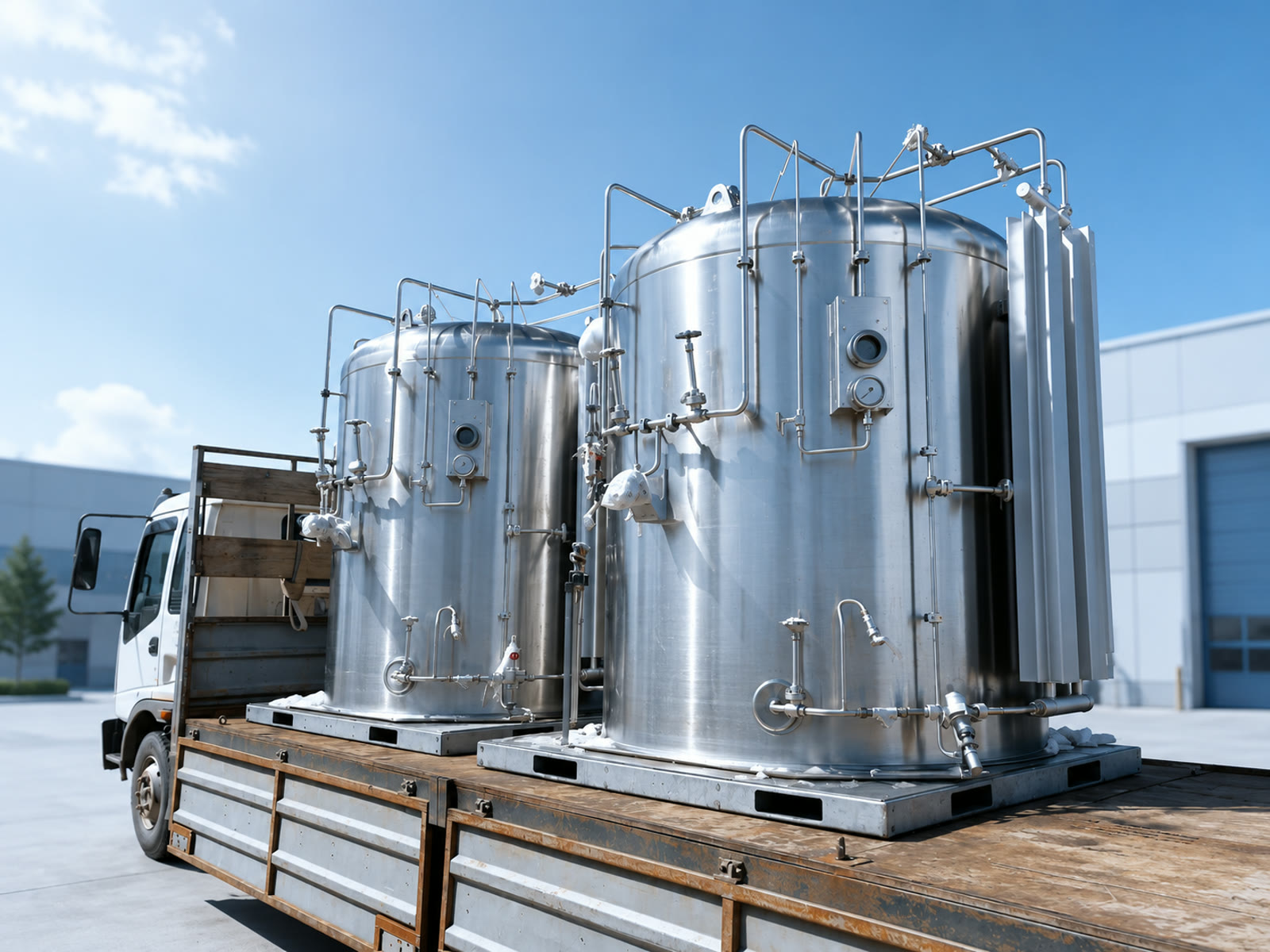
- Vertical cryogenic storage tanks for bulk liquid oxygen, nitrogen, argon and CO2 at consumer sites.
- Vertical and horizontal cryogenic cylinders for microbulk and workshop-scale supply; the microbulk versus cylinders question is covered separately.
- Ambient vaporizers for liquid-to-gas duty — Russian buyers often call the paired tank-and-vaporizer setup a ГХК — and CO2 heaters.
- Cylinder filling pumps and complete gas filling systems for filling-station duty.
- 20 ft tank containers and cryogenic ISO tanks for transport and rail-borne distribution.
- Liquid nitrogen dewars, high-pressure gas cylinders and dry-ice pelletizers.
Configuration is defined per order: medium, working pressure, vaporization capacity, climate rating and the documentation set the operator will need on site.
EAEU applications by industry and gas
EAEU demand is segmented by medium more than by product name, and each segment carries its own configuration logic.
- Metallurgy and fabrication. Oxygen and nitrogen remain the largest industrial draw; typical briefs pair storage tanks with ambient vaporizers, sized against furnace or cutting-line consumption. See liquid oxygen equipment.
- Healthcare. Hospital sites typically specify reserve and standby capacity against their own facility norms; duty-plus-standby tank configurations are a common request.
- Laser cutting. Nitrogen assist gas via cryocylinders or tank-and-gasifier configurations, weighed against on-site generation on capacity and purity, not on habit.
- Food and beverage. Liquid CO2 storage, heaters and dry-ice pelletizers, configured to food-contact requirements specified by the buyer. See liquid CO2 equipment.
- Small-scale LNG. LNG equipment can be supplied; the segment moves at policy speed rather than market speed, and configurations are reviewed case by case.
Selecting a factory with EAC and Russian-documentation experience
Cryofortune sources from a network of Chinese manufacturers, not from one plant. For EAEU destinations, four filters come before price.
- EAC history. A factory holding a live TR CU 032 document, or with prior EAEU shipments, can shorten the conformity path materially. A factory without one implies building the route from scratch, which is workable but must be priced into the lead time.
- Documentation capability. Whether the passport, calculations and safety justification already exist in usable form, or must be prepared and translated.
- Scheme fit. Serial-scheme relationships suit ongoing supply programmes; batch schemes may suit single tanks or one-off projects.
- Duty match. Medium, pressure, capacity and climate rating for the destination site, checked against the factory’s actual production record.
Our general approach to vetting Chinese manufacturers applies here, with the EAC and documentation filters added on top.
What ships with an EAEU order
Subject to the agreed scheme and the selected manufacturer, the delivery set can include: the EAC certificate or registered declaration; a TR CU 032-format equipment passport; an operation manual in Russian; the safety justification; strength and relief-valve capacity calculations; material certificates and test protocols; and the commercial and shipping documents needed for customs clearance. The scope of the set is fixed in the contract, not assumed. Background on export documentation in general is in our export certification guide.
Customs, Rostechnadzor and the national layer
Conformity ends at the border. Operation begins there, and operation is national. The following actions sit with the importer and operator, not with the supplier, and may apply depending on the equipment and the member state.
- At import, the EAC document is cited in the customs declaration and verified against the EAEU unified register.
- In Russia, sites operating pressure equipment may constitute a hazardous production facility; vessels above exemption thresholds are put on record with Rostechnadzor and undergo periodic technical examination. The manufacturer’s stated design life in the passport matters here, which is one reason the passport matters commercially.
- In Kazakhstan, vessel registration is mirrored at national level, and a separate permit for use of the technical device may be required.
- In Belarus, vessels subject to registration are recorded with Gospromnadzor before being put into service.
- Road carriage of filled cylinders follows dangerous-goods rules — a logistics and documentation layer, separate from product conformity.
We do not perform these statutory actions. What we can do is ensure the documents they rest on arrive complete, legible and in the right format.
Logistics: land routes, not ocean legs
Geography favours the EAEU buyer. China and the Union share land borders and established rail corridors, so tanks, cylinders and containers can move by rail or road without an ocean transhipment. ISO tanks and 20 ft frames travel as standard intermodal units. Route, transit time and delivery terms are confirmed per order.
Confirmed before production
Availability and applicability of any standard, certificate, marking or registration procedure are confirmed for the specific manufacturer, model and order before production.
Send the medium, daily consumption, destination country and any operator-side requirements you already know. We will return manufacturer options, a conformity route and a documentation plan — before anything is built.