
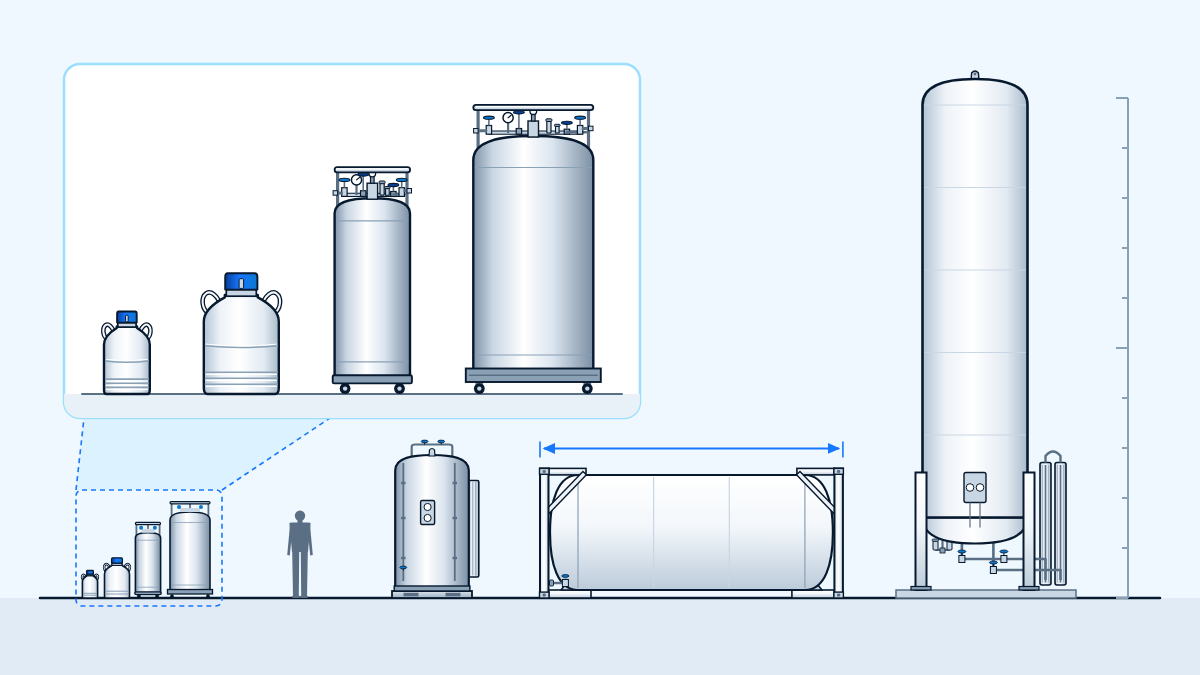
Liquid nitrogen equipment comes in a size ladder that spans four orders of magnitude, and choosing the wrong rung costs money at both ends: too small means constant refills and losses, too big means paying to boil off nitrogen you never use. This guide walks the ladder from hand-carried dewars to bulk tanks and ISO containers, with the consumption ranges where each size actually belongs.
10–50 L: laboratory dewars
Open-neck vacuum dewars (10, 20, 30, 50 liters) serve labs, clinics and small workshops: manual dispensing, sample transport, daily losses of a few percent. They are non-pressurized — nitrogen leaves by pouring or ladle, not through a valve. For sample storage itself, dedicated storage dewars like the YDS series hold canisters and racks in vapor or liquid phase; the storage discipline is covered in our biobank storage guide.
175–500 L: cryocylinders
Pressurized vertical cryogenic cylinders (typically 175, 195, 210, 450 and 499 liters) are the workhorses of distributed supply: palletized, forkliftable, self-pressurizing, dispensing liquid or gas through valves. One cryocylinder replaces dozens of high-pressure bottles, and a two-cylinder changeover keeps a line running through swaps. Daily evaporation runs around 1.5–3% depending on size and duty.
3–20 m³: microbulk and small bulk
Where weekly consumption outgrows cylinder logistics, a stationary vacuum-perlite tank takes over: filled by truck on site, feeding process lines through a vaporizer. Vertical formats save footprint. The crossover from cylinders usually comes when you swap more than a handful of them per week — or when the process cannot tolerate interruptions at all.
20–60+ m³: bulk storage
Vertical and horizontal bulk tanks serve plants with continuous demand — food freezing lines, gas plants, heat treatment. Sizing follows one rule: tank volume ≈ 1.5–2 weeks of consumption, so deliveries stay economic and the tank never runs the process dry. The full walk-through is in our tank specification and selection guide.
Transportable: 20-ft T75 ISO containers
When nitrogen itself must travel — depot supply, export, temporary sites — the 20-foot T75 ISO container (roughly 18,000–21,000 liters) moves it by road, rail and sea. Specs, hold time and approvals are covered in our ISO tank container guide.
Picking a size from consumption
Convert demand to liters of liquid per week (1 m³ of gas ≈ 1.44 L of liquid), then read the ladder: under ~100 L/week — dewars; 100–1,000 L/week — cryocylinders with changeover; 1,000–10,000 L/week — microbulk 3–10 m³; above that — bulk storage with a vaporizer sized to peak flow (see the vaporizer sizing guide). Then correct for purity, pressure class and peak profile — the same fields as any tank specification.
What Cryofortune supplies
Cryofortune sources the whole ladder — dewars, YDS storage vessels and YDZ supply containers, cryocylinders, vertical and horizontal bulk tanks, vaporizers and ISO containers — from vetted Chinese manufacturers, configured to media, pressure and destination code, with export documentation handled per order.
LN2 tank sizes: common questions
What sizes do liquid nitrogen tanks come in?
Lab dewars 10–50 L; pressurized cryocylinders 175–500 L; microbulk and bulk stationary tanks from about 3 to 60+ m³; and 20-ft T75 ISO containers around 18,000–21,000 L for transport.
How do I size a liquid nitrogen tank?
Convert consumption to liters of liquid per week and hold 1.5–2 weeks of it. Under 100 L/week dewars suffice; 100–1,000 L/week suits cryocylinders; beyond that move to microbulk and bulk with a vaporizer sized for peak flow.
How much liquid nitrogen evaporates per day?
Roughly 1.5–3% per day in cryocylinders and small dewars, and well under 1% per day in larger bulk tanks — bigger vessels lose proportionally less, which is why both oversizing small and undersizing large waste money.
What is the difference between a dewar and a cryocylinder?
A dewar is non-pressurized and dispenses by pouring; a cryocylinder is a pressure vessel that self-pressurizes and dispenses liquid or gas through valves, making it suitable for feeding equipment directly.