
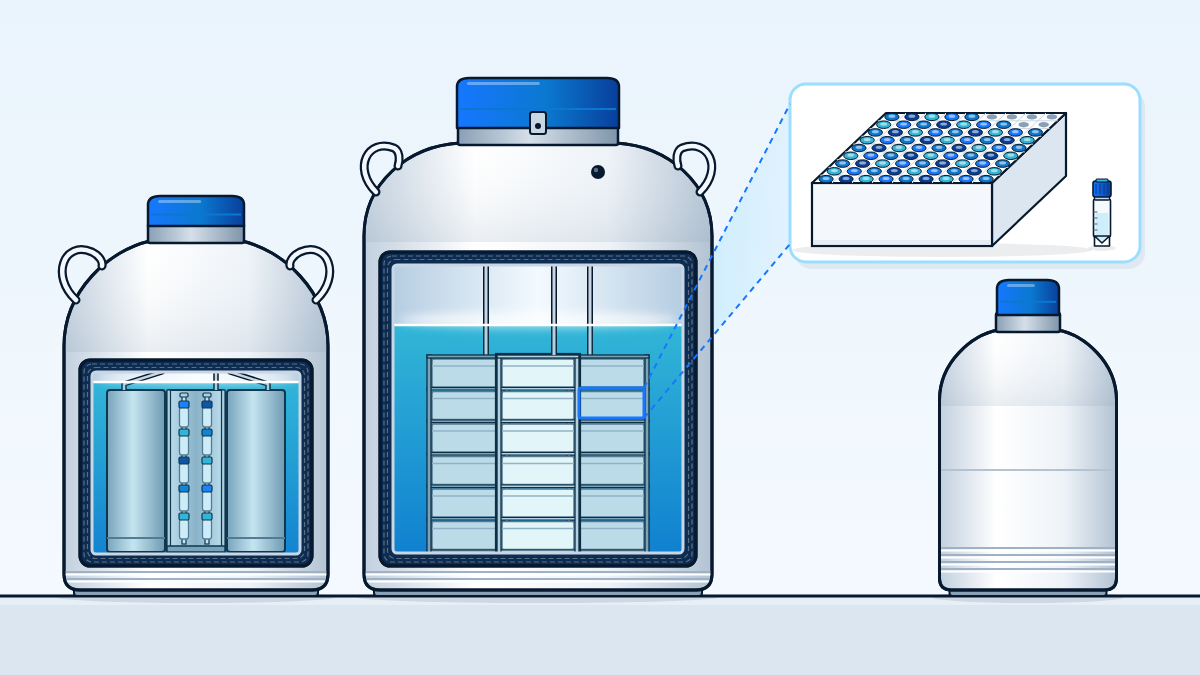
A cell line that took three years to establish, a patient’s embryos, a batch of donor blood, a reference strain a laboratory cannot replace — all of them survive the same way: held so cold that biology effectively stops. At −196 °C, the temperature of boiling liquid nitrogen, the reactions that cause cells to age and decay slow almost to nothing, and living material can wait years or decades for the day it is needed again.
That is why liquid nitrogen sits at the centre of every serious biobank, IVF clinic, university lab and cell-therapy facility. It is not the sample and it is not a chemical preservative — it is the working coolant. Samples either sit directly in the liquid or in the cold nitrogen vapour just above it, and the entire storage system exists to keep that cold stable, topped up and safe. This guide walks through the equipment that does it, from a hand-carried flask to a bulk tank feeding a whole building.
What the cold actually does
Below roughly −130 °C, water no longer forms damaging ice crystals and molecular movement is too slow to support the enzyme activity that degrades tissue. Cells, embryos, sperm and eggs, tissue biopsies, blood products, vaccines and microbial cultures can all be held in this state and remain viable more or less indefinitely. Liquid nitrogen is the practical way to reach and hold that temperature: it is abundant, relatively cheap, chemically inert, and it boils at −196 °C, giving a comfortable margin below the danger zone.
The equipment ladder, smallest to largest
Most facilities do not buy a single product — they assemble a chain sized to how much nitrogen they use and how many samples they hold. From smallest to largest, it usually looks like this:
- Transport and handling dewars — open-neck vacuum flasks for moving and dispensing LN2 around the building, typically in the single-digit to roughly 100-litre range. These are the everyday workhorses.
- Sample storage containers — the wide-neck “biological” vessels that hold canisters, racks and boxes of vials rather than bulk liquid. A canister dewar from our YDS liquid nitrogen dewar vessel range (roughly 3–100 L, necks from 50 to 210 mm) is a typical lab or clinic store for frozen samples.
- Self-pressurizing cryogenic cylinders — larger vessels that both store LN2 and dispense it under low pressure, so staff can top up the smaller dewars without lifting and pouring. Cryofortune offers both a vertical cryogenic cylinder and a horizontal 500 L cylinder, commonly in the 50–500 L class. For smaller rooms, the 50-litre YDZ-50 liquid nitrogen container does the same job: a self-pressurizing supply container for topping up smaller dewars.
- Bulk supply — for a whole department or campus, a fixed cryogenic storage tank paired with a cryogenic vaporizer, refilled periodically by road tanker. This is the cheapest nitrogen per litre once refill frequency starts to dominate cost.
A fuller overview of these categories sits on our liquid nitrogen equipment page.
Liquid phase or vapour phase?
Sample storage vessels can be run two ways, and the choice is a genuine design decision rather than a matter of better or worse.
- Liquid phase — samples are submerged in the LN2 itself. This is the coldest and simplest option, with the most forgiving temperature stability, but it carries a real risk of cross-contamination: pathogens can survive in the shared liquid and migrate between poorly sealed vials.
- Vapour phase — samples sit in the cold nitrogen gas above a shallow pool of liquid. Contamination risk is much lower, which is why it is common for clinical and regulated material, but temperature varies with height in the vessel and the liquid level must be controlled carefully so the top racks never warm up.
The number that governs everything: evaporation and hold time
No vacuum flask is perfectly insulated. Heat always leaks in, so liquid nitrogen boils off continuously — this is the static evaporation rate, and it is the single specification that governs how a store is run. Every vessel therefore has a hold time: the period it can stand unattended before the liquid falls to a level that puts samples at risk. A 50-litre sample container, for example, may lose on the order of a litre of nitrogen a day when left undisturbed, and every lid-opening to add or remove samples speeds that up.
This is why storage is never a single vessel in isolation. Labs run a topping-up schedule, and larger or critical installations add automatic fill systems and low-level alarms, because samples that took years to accumulate die within hours if the liquid runs dry. It is also why a facility keeps a self-pressurizing cylinder or a bulk tank on site: it is the refill source that keeps every smaller dewar above its safe level between tanker deliveries.
The supply vessel itself can be watched remotely. On self-pressurizing liquid cylinders with a compatible capacitive level probe, a CryoFor TM2 module reports the level to CryoFor Telemetry on a set schedule, so the refill source is topped up before it runs low. This applies to the supplying cylinders, not to sample storage dewars.
Safety: nitrogen is an asphyxiant
This part of the industry has caused real deaths, and it deserves plain treatment rather than alarm. Nitrogen already makes up most of the air and is not toxic — the danger is purely physical. When liquid nitrogen boils it expands roughly 1:700 into gas, so a small spill or a leaking vessel can flood a room with nitrogen and push the oxygen concentration down without any smell, colour or warning. Because the cold gas is dense, it pools in low, enclosed, poorly ventilated spaces — precisely the basements and small store-rooms where dewars are often kept.
The mitigations are well established and non-negotiable:
- Ventilate the room, and never store large dewars in a small sealed space.
- Fit fixed oxygen-deficiency monitors at the right height — an oxygen alarm, not a CO2 detector, because the hazard here is nitrogen displacing oxygen.
- Never ride in a lift or elevator with a large dewar; if it vents in a stuck car, there is nowhere for the gas to go. Send the vessel alone and meet it on the other floor.
- Wear cryogenic gloves and a face shield when handling: −196 °C liquid or cold metal causes a severe burn on contact in an instant.
- Never seal a cryogenic container. Boil-off must be able to escape, or pressure will build to the point of rupture.
Configuring the right storage-and-supply chain
Getting this right is less about any single vessel than about matching the whole chain — handling dewars, sample containers, self-pressurizing cylinders, and where justified a bulk tank with a vaporizer — to how much nitrogen a site actually uses and how many samples it must protect. Cryofortune is a sourcing and engineering supplier: we configure that chain from a network of vetted Chinese manufacturers and match each item to the destination’s requirements, rather than pushing a single catalogue product.
Tell us your LN2 usage, sample volume and site layout through our contact page, and we will propose a storage-and-supply configuration built around them.
Availability and applicability of any standard, certificate, marking or registration procedure are confirmed for the specific manufacturer, model and order before production.
Liquid nitrogen sample storage: common questions
Is vapor-phase or liquid-phase storage better for samples?
Vapor phase (samples above the liquid) avoids cross-contamination risk and still holds below −150 °C; liquid phase gives the most thermal reserve. Modern biobanks default to vapor phase for most collections.
What is the difference between a dewar and an LN2 storage freezer?
A dewar is a passive vacuum vessel refilled manually; a storage freezer adds racks, inventory and level control on the same principle. Both depend on the liquid nitrogen reserve, not electricity, to hold temperature.
How long does a storage dewar hold temperature?
Static hold time runs from weeks on small dewars to months on large storage vessels, set by volume and evaporation rate. The working rule: refill on schedule at half depletion, never on an alarm.
What supply does a biobank need behind the dewars?
A refill chain sized to total evaporation plus usage: cryocylinders or a small bulk tank, transfer lines, and level monitoring — the same supply logic as any liquid nitrogen consumer.