
Ask a supplier “what is the safety factor on this tank?” and the technically correct reply is a question: under which code, and which edition? In the ASME Boiler and Pressure Vessel Code, Section VIII, the safety factor is not a number a supplier bolts on. It is the design margin the code builds into every allowable-stress value, and its size depends on the division, the edition in force, and which material property governs. For a cryogenic vessel it is also only half of what keeps the vessel intact. This article explains what the margin is, what it is not, and what to confirm when you import an ASME-stamped cryogenic tank.
What “safety factor” means in ASME Section VIII
In Section VIII the safety factor is a design margin applied to a material’s measured strength to set its maximum allowable stress. The code does not let a designer work a vessel up to the point where the steel yields or tears; instead it derives an allowable stress by dividing tabulated material properties by a margin, and the vessel wall is then sized so that calculated stresses stay at or below that allowable value. The margin therefore lives in the allowable-stress tables of Section II, Part D, not in a line item on a datasheet. Two properties usually set the limit: ultimate tensile strength and yield strength, and whichever gives the lower allowable stress at temperature governs.
Division 1: historically 4:1, 3.5:1 in current editions
Division 1 is the design-by-rules route that covers most cryogenic storage vessels. Historically its margin on ultimate tensile strength was 4:1 — allowable stress equal to UTS divided by four. With the 1999 Addenda, carried into the 2001 Edition, that tensile margin was reduced to 3.5:1 for most materials, so allowable stress on tensile in current Division 1 editions is UTS/3.5. Yield strength is a separate ceiling, commonly two-thirds of the specified minimum yield. The exact figure for any given vessel depends on the edition invoked and on which property governs for that material and temperature, so it is safer to specify the edition than to quote a single ratio from memory.
Division 2 and the trade-off
Division 2, the alternative rules, permits a lower margin — on the order of 2.4:1 on tensile — but only in exchange for far more rigorous design-by-analysis, tighter material control, and more extensive examination and testing. It exists for higher-pressure or thicker vessels where the added engineering pays for itself in wall thickness and weight. A thinner Division 2 wall is not a weaker vessel; the reduced margin is offset by analysis a Division 1 formula never performs. For most cryogenic tanks, Division 1 remains the practical route.
Why the margin matters differently for cryogenic vessels
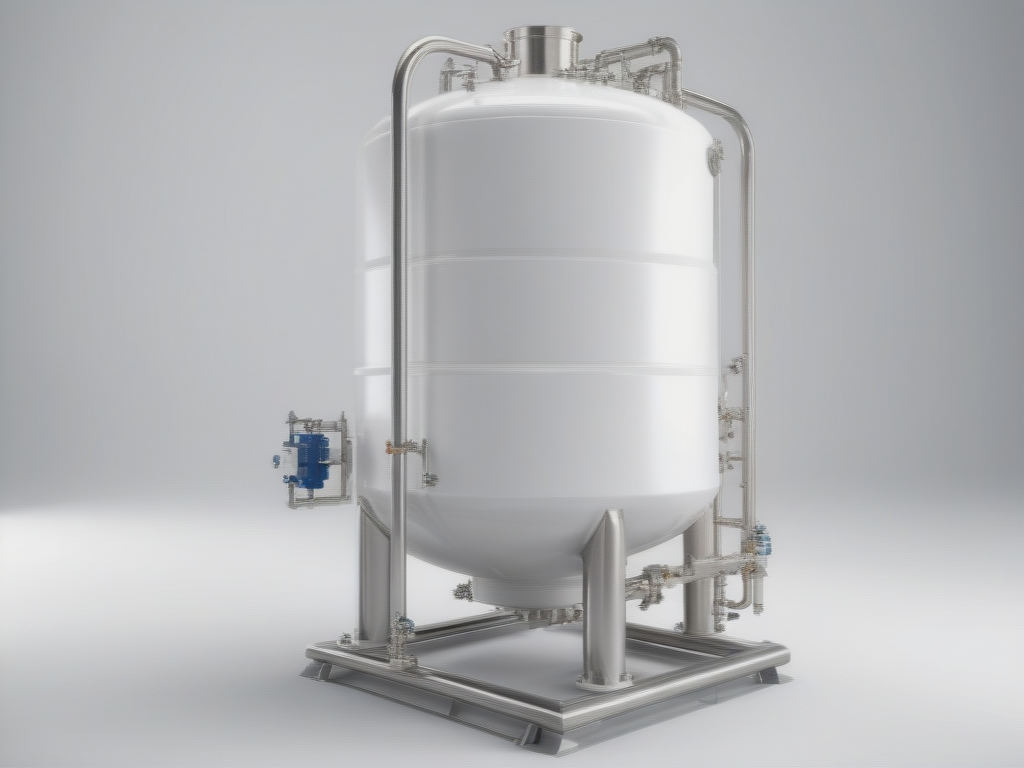
A cryogenic storage tank is a double-walled, vacuum-insulated vessel. The inner vessel holds the cold liquid under pressure and is the ASME pressure vessel proper, built to Section VIII with the tensile and yield margins above. But the internal-pressure margin protects against overpressure, not against the cold itself, and those are two different failure modes.
- Toughness at low temperature. At −196 °C, the boiling point of liquid nitrogen, ordinary carbon steel loses ductility and can fail by brittle fracture. Inner vessels are therefore built from austenitic stainless steels (304, 304L, 316) or 9% nickel steel, which stay ductile at cryogenic temperature. Section VIII requires low-temperature impact (Charpy) testing under the applicable UG and UHA rules unless the material and conditions qualify for a specific exemption.
- The safety factor and material choice are separate requirements. The margin keeps stresses below the allowable value; the material and its impact testing keep the steel from cracking in the cold. A correct margin on the wrong steel is still a brittle-fracture risk.
- The outer jacket is a different calculation. The jacket sees external pressure, because the annular space is evacuated, and is designed against buckling and collapse under that vacuum — different rules than the inner vessel’s internal-pressure margin.
Relief devices and MAWP: the margin is the last line
The design margin protects the vessel if it is ever pushed to its limit, but a code-built vessel is not meant to reach that limit in service. Every ASME Section VIII vessel carries pressure-relief valves or devices sized so that pressure is discharged before the vessel is overpressured. The rated ceiling is the maximum allowable working pressure (MAWP), and relief is set so operating excursions never climb past it. The safety factor is the reserve behind that protection, not the thing you rely on day to day.
The margin comes from the code, not the supplier
Because the margin is written into the code, it is a property of what the vessel is built and stamped to — not a feature a supplier can add or improve. A tank carrying the ASME “U” stamp with a National Board registration was, by definition, designed to these margins under an accredited quality program with an Authorized Inspector present during fabrication. When you import one, the checks are practical:
- Confirm the vessel is genuinely built to the ASME edition your jurisdiction accepts, since acceptance and registration rules vary by destination — see cryogenic equipment export certification.
- Check that the Manufacturer’s Data Report (Form U-1) and the nameplate match the order, the material, and the MAWP.
- Remember that the ability to apply an ASME stamp at all depends on the specific manufacturer holding a valid Certificate of Authorization — a property of that factory and that order, not of a brand.
This is where sourcing due diligence does the real work. Across our pressure vessels and cryogenic storage tanks, the code route is selected for the destination, and the supporting documentation is matched to it.
Cryofortune sources ASME Section VIII cryogenic tanks and pressure vessels from a network of vetted Chinese manufacturers, matched to the code route your destination accepts; ASME stamp availability and the certificate scope are confirmed for the specific manufacturer, model and order before production. Tell us the medium, working pressure, volume and destination country on our contact page and we will scope the code route and manufacturer to suit.
Availability and applicability of any standard, certificate, marking or registration procedure are confirmed for the specific manufacturer, model and order before production.
ASME safety factor: quick answers
What is the ASME safety factor for cryogenic pressure vessels?
Vessels built to ASME Section VIII Division 1 use a design margin of 3.5:1 on ultimate tensile strength in current editions (4:1 in editions before 1999). Division 2 designs use a lower margin of about 2.4:1 in exchange for stricter analysis, materials control and inspection.
Is the safety factor different at cryogenic temperatures?
The code margin itself does not change with temperature. What changes is the material side: cryogenic vessels must use materials that stay tough at −196 °C (austenitic stainless steels, 9% nickel steel), verified by impact testing, so the margin keeps meaning at operating temperature.
Division 1 or Division 2 — which is used for cryogenic storage tanks?
Most standard cryogenic storage tanks are Division 1 vessels. Division 2 appears on large or cost-critical projects where thinner walls justify the heavier engineering and inspection burden.
How does the ASME margin compare with PED or GB designs?
PED (EN 13458 / EN 13445) and Chinese GB designs use allowable-stress logic with different coefficients rather than one headline ratio, so a direct number-to-number comparison is misleading. What matters for a buyer is that the vessel is designed, tested and certified to the code accepted in the destination market.