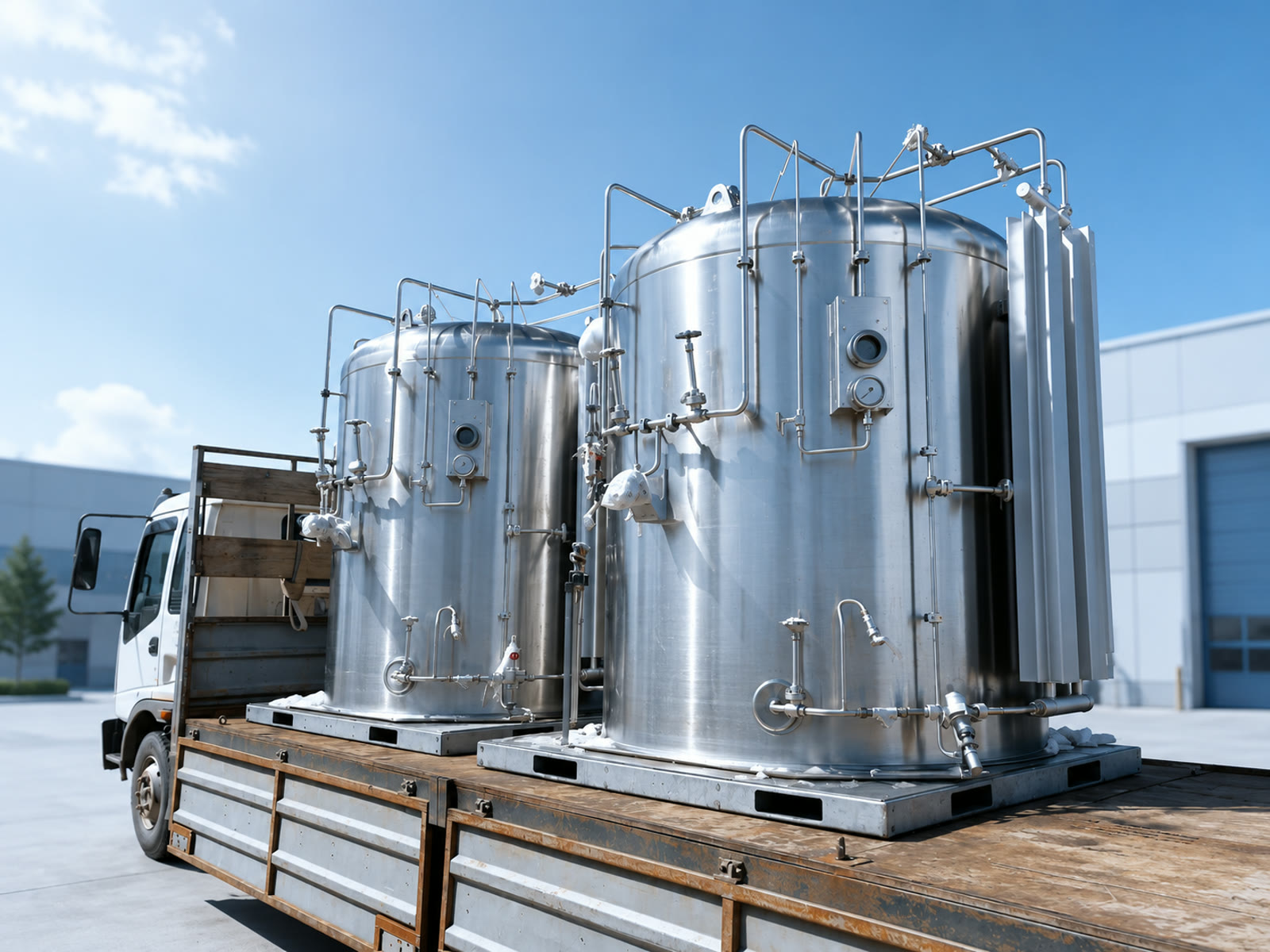
Microbulk is the supply band between cylinder packs and full bulk installations. A microbulk tank is a vacuum-insulated vessel that stays on site and is refilled in place, so liquid supply continues without cylinder handling. For plants drawing steady volumes of nitrogen, oxygen, argon or CO2, this class removes most of the logistics that cylinder fleets impose.
Where microbulk sits in the supply chain
A cylinder pack ties gas supply to a swap cycle of full cylinders in and empty cylinders back, with manifold changeovers between deliveries. A bulk tank ties supply to a civil foundation, a road-tanker schedule and a larger vaporization system. Microbulk keeps cryogenic liquid on site in a compact vessel, typically with its own pressure build-up circuit, topped up from a delivery vehicle. The article microbulk vs cylinders: when to upgrade sets out the consumption patterns where the change usually starts to pay.
Catalog configurations in the microbulk band
Two catalog families cover this band. Both are vacuum-insulated and configured for LN2, LOX or LAr service; the vertical family also covers CO2.
- Vertical Cryogenic Cylinder — 21 configuration variants from 50 to 700 L gross volume and working pressures of 2–10 MPa, with built-in pressure build-up and economizer circuits. The vertical format keeps the floor footprint small and suits most indoor and yard positions.
- Horizontal Cryogenic Cylinder 500 L — 499 L gross volume, 474 L usable, in nine working-pressure variants from 1.59 to 3.45 MPa. It holds 541 kg of LOX, 383 kg of LN2 or 660 kg of LAr within 2,100 × 820 × 1,010 mm, for positions where vertical clearance is limited.
The cryogenic liquid cylinders page covers this vessel class in its delivery and exchange context. This page treats the same configurations as stationary microbulk assets, connected once and refilled in place.
Selecting a configuration by duty
Selection follows the duty in a fairly stable order, and each step narrows the variant list.
- Draw and reserve. Consumption between refills fixes the usable volume, with a margin for delivery intervals and demand peaks.
- Working pressure. Downstream equipment defines the pressure band; catalog variants run from 1.59 MPa on the horizontal family to 10 MPa on vertical models.
- Pressure build-up and gas draw. Where the vessel feeds gas rather than liquid, the vertical family’s built-in pressure build-up and economizer circuits hold outlet pressure and flow during draw. Higher or continuous gas draws are usually paired with an external cryogenic vaporizer.
- Orientation and footprint. Vertical models save floor area; the horizontal 500 L format suits low rooms and height-restricted installations.
- Medium. Nitrogen, oxygen, argon and CO2 each place their own requirements on trim, cleaning and safety devices, confirmed per configuration; CO2 duty is covered by the vertical family.
Filling logistics: refill in place or swap
Microbulk tanks are normally refilled on site from a small cryogenic delivery vehicle through a fill connection, without moving the vessel or interrupting supply. Some distributors run a swap model instead, exchanging a full vessel for an empty one, and the 500 L formats remain compact enough for that. The refill model is what separates microbulk economics from cylinder economics: no returnable cylinder fleet, fewer deliveries, no changeover losses. Where remote level monitoring is required, telemetry provisions are agreed with the selected manufacturer for the specific model and site.
When the duty outgrows microbulk
Past a certain steady demand, refill frequency and per-liter delivery cost start to favor a fixed bulk installation. The vertical cryogenic storage tank line covers that next step, with gross volumes of 7,990–25,000 L and working pressures of 0.8–2.2 MPa. The cryogenic storage tanks page maps the bulk range, and the storage tank price guide outlines the cost structure of that class.
Microbulk supply by gas: nitrogen, oxygen, argon and CO2
Microbulk-scale vessels are configured per medium, and each media page organizes the wider equipment line by application.
The article cryogenic equipment by gas compares how the four media shape equipment selection.
Standards and destination markets
Cryofortune sources from a network of Chinese manufacturers and selects the factory per destination country, design standard, documentation and duty. Pressure-equipment rules and design codes that may apply to microbulk vessels are selected per destination; the standards hub summarizes the main regimes, and the export certification guide covers the documentation sequence. Country pages describe sourcing for Australia and New Zealand.
Configurations and documentation are confirmed for the specific manufacturer, model and order before production. Send a rough duty description — medium, daily draw, working pressure and site constraints — and we will return matching microbulk configurations from the relevant factories.