Why the CRN sets the schedule, not the factory
In most Canadian jurisdictions, a stationary cryogenic tank generally cannot be placed in service without a Canadian Registration Number (CRN). The CRN is issued for the design, not for the individual vessel, and it is typically granted province by province, following an engineering review against CSA B51 and the applicable construction code. Design review takes time, and that time sits on the critical path, not at the end of it.
This inverts the usual procurement sequence. The destination province is confirmed first, the configuration second, production third. A tank ordered before the registration path is mapped can arrive faster than its own paperwork, and then wait. We plan Canadian supply around the CRN as the item that sets the timeline, not as a closing formality.
CSA B51 and the provincial patchwork
Canada regulates stationary pressure equipment largely at the provincial level, not federally. Ontario works through TSSA, Alberta through ABSA, British Columbia through Technical Safety BC, and provinces generally enforce their own boiler and pressure vessel legislation built on CSA B51. Designs operating above 15 psig generally fall within scope.
Several points shape an import plan:
- Per-province registration. A CRN issued in one province does not automatically cover another. Mutual recognition of design reviews, in place since 2020 among most participating provinces and territories — Alberta is a current exception — and TSSA’s multi-province service can shorten this, where applicable.
- Fittings register separately. Valves, relief devices and gauges may each require their own CRN by CSA B51 category, typically supported by a statutory declaration and quality-system evidence from the manufacturer.
- One province differs. Saskatchewan can accept National Board-registered ASME vessels on a per-vessel basis as an alternative to design registration, subject to exclusions.
Which filings apply, and in which sequence, depends on the province of use and is mapped before the order is placed, not after the tank lands.
Winter duty is an engineering input, not a footnote
Ambient air vaporizers extract heat from the surrounding air. Their capacity falls as air temperature falls, and Canadian winter design temperatures sit far below the annual averages used in generic sizing. A vaporizer selected for the coldest expected week, not the annual mean, avoids ice-bound capacity loss at peak demand — and this sits alongside the CRN as a second variable that has to be settled before configuration, not after.
Configurations for cold climates can include duplexed vaporizer banks with switchover, trim heating, and defrost allowances in the duty cycle. These are sizing decisions made against the site’s climate data during configuration, and they are confirmed per project rather than assumed.
Transport Canada governs the road, not the storage tank
Transportable equipment sits under a separate federal system from the one that registers a stationary tank. Transport Canada’s TDG Regulations govern cryogenic highway tanks and portable tanks through CSA B620 and B622, with TC 338 and TC 341 specifications and registration of designs and facilities. Gas cylinders are TC-specification receptacles under CSA B339 and B340, produced by Transport Canada-registered manufacturers. UN T75 portable tanks are generally accepted for refrigerated liquefied gases, which is typically the route for an imported cryogenic ISO tank, subject to the applicable marking, periodic inspection and portable-tank instructions.
The two systems do not substitute for each other. A CRN does not authorize road transport, and a TC specification does not register a stationary vessel. A project involving both a storage tank and transport equipment is therefore planned as two compliance tracks, not one.
ASME and the National Board: a basis shared with the US
The practical construction basis for Canadian imports is ASME Section VIII, built in a code-certified shop under an Authorized Inspector, with the Manufacturer’s Data Report registered with the National Board. National Board registration complements the CRN; in most provinces it does not replace it.
This gives Canada and the United States a common engineering foundation with different legal overlays. A vessel configured for the US market can share its design basis with a Canadian unit, while the registration and inspection paths diverge. Buyers operating on both sides of the border can use this overlap deliberately.
Equipment we can source for a Canadian order
We are a sourcing supplier working with a network of Chinese manufacturers, with the factory selected per destination and code basis. For Canada the range includes:
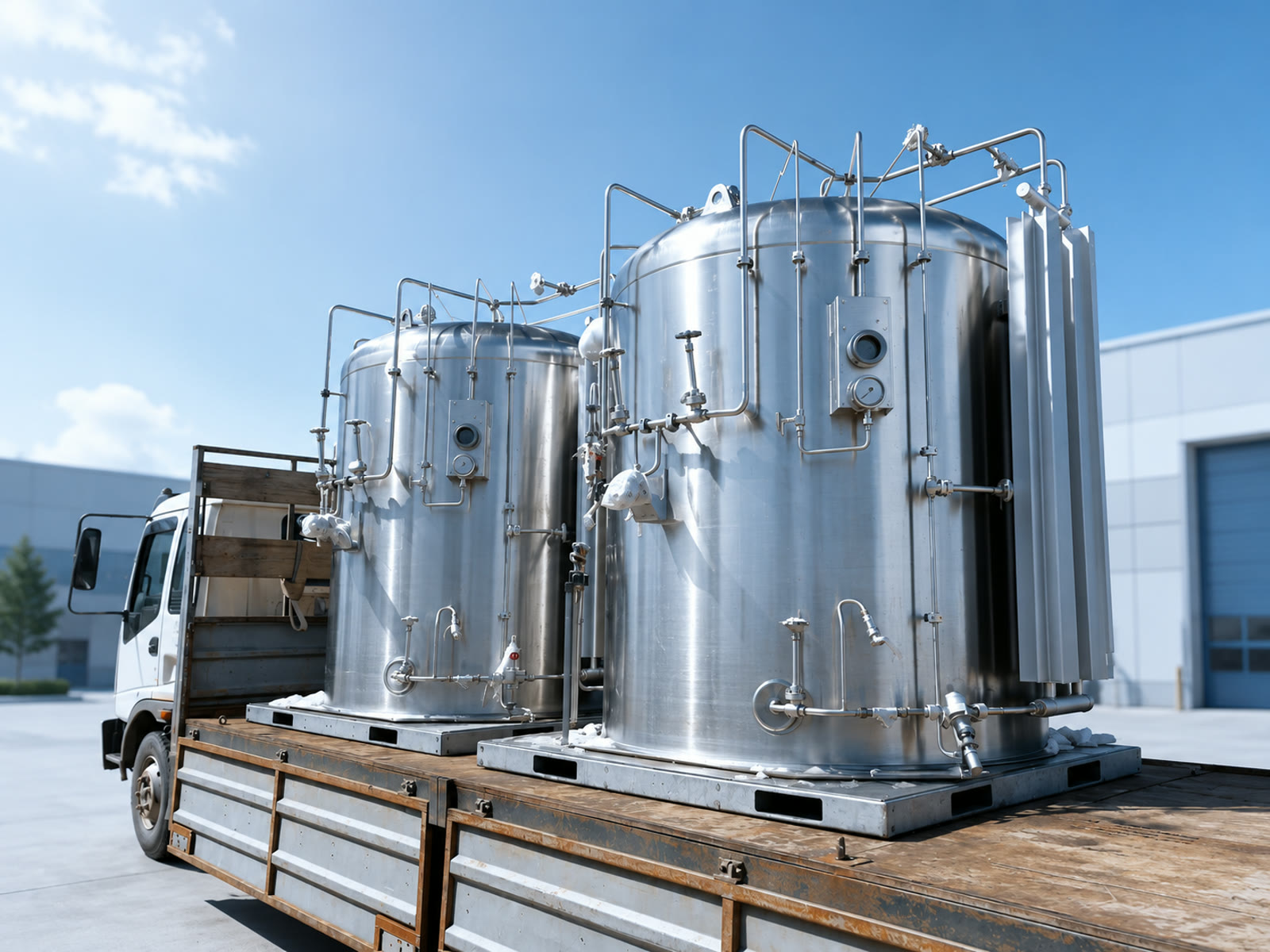
- Vertical cryogenic storage tanks for LOX, LIN, LAr and CO₂, from the storage tank line
- Vertical and horizontal liquid cylinders for micro-bulk and distribution duty
- Ambient vaporizers and CO₂ heaters, sized against site climate
- Cylinder filling pumps and filling system configurations
- 20 ft tank containers and ISO tanks for liquid logistics
- Liquid nitrogen dewars and high-pressure cylinders
- Dry ice pelletizers for CO₂ users
Owning the tank, rather than leasing it from a gas major, changes the economics of gas supply. Whether purchase suits a given site is a commercial question; the micro-bulk versus cylinders comparison is a starting point.
Where the equipment works
Canadian demand is concentrated and regional. Liquid nitrogen serves ground freezing in mining and shaft work, and well services and pipeline work in Alberta. Hospitals, biobanks and IVF laboratories draw on the same medium for cryopreservation. CO₂ and nitrogen micro-bulk serves breweries and food processors, and aerospace and research facilities draw specialty and bulk gases.
Siting obligations at the customer’s premises are local. Oxygen storage setbacks are commonly engineered to NFPA 55 or CGA guidance as industry practice, and checked against the applicable provincial fire code, which may incorporate specific standards by reference. LNG storage or handling may fall under CSA Z276 where provinces have adopted it. These site-level requirements belong to the owner and the local authority, and are checked against the installation, not the tank alone. The LNG equipment and liquid oxygen pages cover the media in more depth.
Matching a factory to the CRN filing
For Canada, CRN experience is a hard filter, not a preference. From the network we shortlist factories that hold current ASME certification for the shop in question, can evidence National Board registration of data reports for that shop, and have supported CRN registrations for comparable vessel designs or can back a new filing with complete drawings and calculations — capabilities confirmed per factory and per order, not assumed from the network at large. A factory that builds a sound vessel but cannot support a Canadian design review is not offered for Canadian orders. Our vetting method describes the general screen; the Canadian screen adds the registration test.
The paper trail behind a Canadian order
Depending on manufacturer and order, the documentation package can include the ASME Manufacturer’s Data Report with National Board registration, design drawings and calculations prepared for CRN submission, material certificates, pressure test records, fitting declarations with supporting quality-system evidence, and packing and shipping documents. The export certification guide explains how these pieces relate.
What the Canadian owner or importer still has to file
Statutory acts in Canada belong to the owner, the importer or their Canadian agent, not to the supplier. These may include CRN filings before shipment, installation or operating permits and compliance declarations in provinces such as BC, periodic inspection certificates required by the province of use, insurer inspections where boiler and machinery cover applies, and fire-code siting review. We align the documentation package to these steps; we do not perform them.
Availability and applicability of any standard, certificate, marking or registration procedure are confirmed for the specific manufacturer, model and order before production.
Start with the province
Send the destination province, the medium and the expected draw. We return a proposed configuration, the applicable code basis, and a document plan sequenced around the registration path. Budget context is in the storage tank price guide; the standards index maps the wider framework.
Choosing a supplier for Canada: the CRN checklist
For Canada the deciding requirement is the CRN — the Canadian Registration Number issued for a pressure-vessel design under CSA B51, registered with the authority of each province where the vessel will operate (TSSA in Ontario, Technical Safety BC, and their counterparts). A cryogenic tank without a CRN for your province cannot legally go into service, whatever other approvals it carries. Before ordering, Canadian buyers should confirm four things: that the design has, or will obtain, a CRN for the destination province; the design code behind it (ASME Section VIII with a U Stamp is the usual basis); the delivery document pack — material certificates to EN 10204 3.1 or mill equivalents, weld qualifications, NDE reports, the pressure-test certificate; and who files the CRN registration — an experienced manufacturer or sourcing partner handles it as part of the order, not as the buyer’s problem afterwards.
Sourcing for Canada: common questions
What is a CRN and does my tank need one?
The Canadian Registration Number is the design registration required under CSA B51 for pressure vessels operating in Canada, issued per province. Any cryogenic storage tank or cylinder put into service in Canada needs a CRN valid for that province.
Can a Chinese-made cryogenic tank get a CRN?
Yes. CRN registration depends on the design meeting the accepted code (typically ASME Section VIII) and the documentation passing provincial review — not on where the vessel is built. Manufacturers with CRN experience register designs for Canada routinely.
Is a U.S. ASME U Stamp enough for Canada?
No — the U Stamp covers the ASME side, but Canada additionally requires the CRN registration under CSA B51 in each province of operation. The two work together: ASME design plus CRN registration.