Catalog English sales support

Content

How to Choose a Cryogenic Cylinder Filling Pump: Flow, Pressure, Media and Skid vs Standalone

How to Choose a Cryogenic Cylinder Filling Pump: Flow, Pressure, Media and Skid vs Standalone

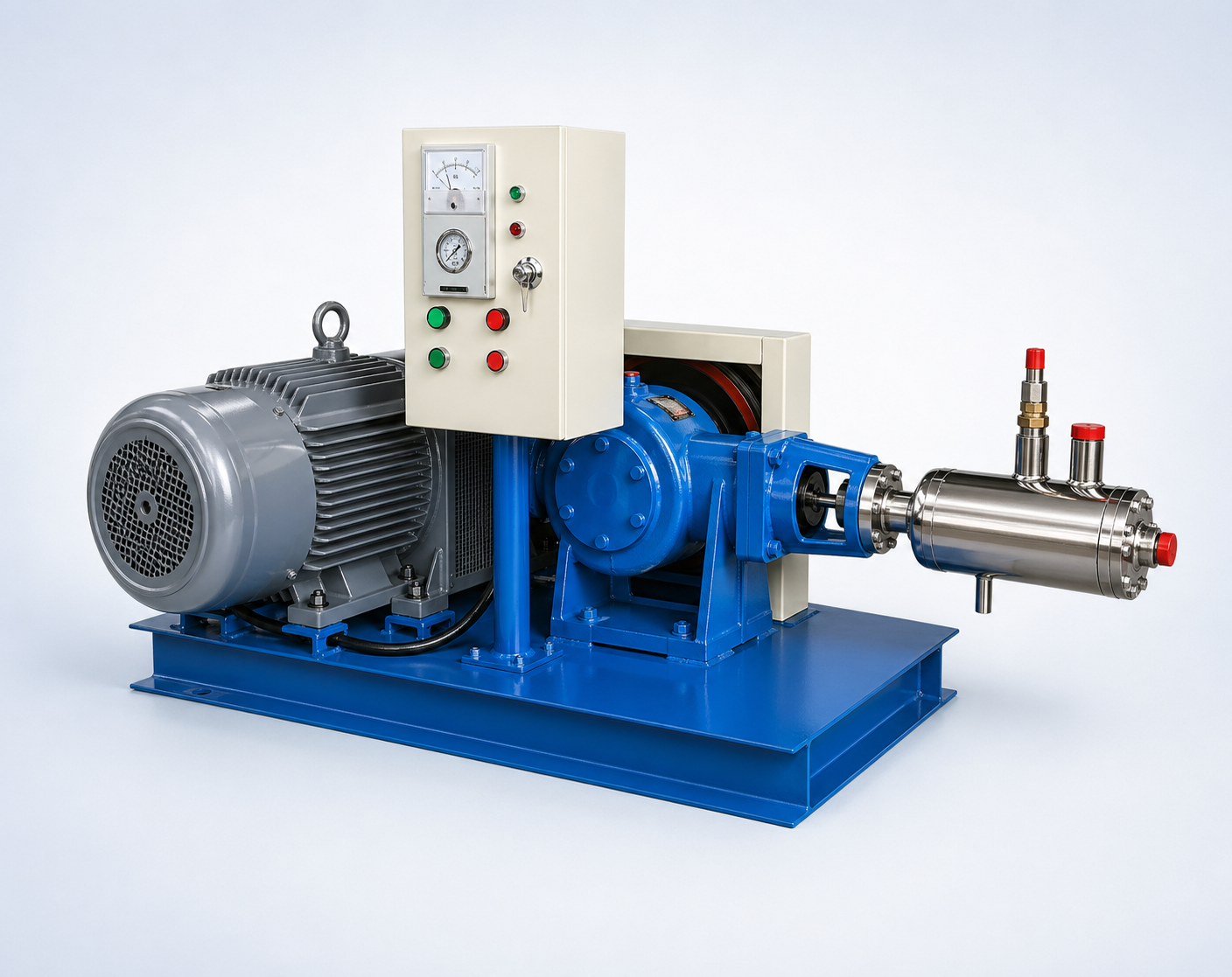
Specifying a cryogenic cylinder filling pump is one of those procurement decisions where the wrong call is expensive in ways that only surface months later: a pump that cannot reach your target cylinder pressure, a flow rate that bottlenecks the whole filling station, or a unit configured for the wrong liquid. Because these are reciprocating cryogenic machines moving liquids at temperatures down to roughly -196 °C and discharging at pressures up to 25 MPa, small mismatches between the duty and the equipment translate directly into downtime, cavitation, and rework.

This guide walks through the parameters that actually decide the selection — flow, discharge pressure, media, and installation format — so an engineer or buyer can shortlist sensibly before sending a single enquiry. The aim is to help you arrive at a specification you can defend, not to push a particular model.

Start With the Duty, Not the Pump

Before comparing any cryogenic cylinder filling pump on a datasheet, write down the duty in concrete terms. Three numbers anchor everything that follows:

  • What you are pumping — liquid nitrogen (LN2), liquid oxygen (LOX), liquid argon (LAr), or carbon dioxide (CO2). Each has different density, vapour pressure, and, critically for LOX, different cleanliness and material requirements.
  • How fast you need to fill — expressed as litres per hour of liquid throughput, derived from your cylinder size, fill cycle time, and how many cylinders you turn around per shift.
  • The pressure you must reach — the discharge pressure required to fill your cylinders to working pressure with margin, not just the nominal cylinder rating.

A pump is only as useful as its fit to these three figures. Everything else — motor power, skid layout, instrumentation — follows from getting them right.

Match Flow Rate to Your Filling Throughput

Flow rate is where most undersizing happens. It is tempting to specify for average demand, but a filling station is sized for its busy periods. If a bay must turn around a full rack of cylinders before the next shift, the pump has to deliver that volume within the available window, including the dead time for connecting, purging, and disconnecting.

As a reference point, the DYB200 reciprocating family is offered at 800 L/h and 1000 L/h of liquid throughput, paired with 7.5 kW and 11 kW drives respectively. That step from 800 to 1000 L/h is not cosmetic: it is the difference between comfortably clearing a queue and watching cylinders back up. Calculate your peak hourly liquid demand, add a realistic contingency for connection overhead, and select the flow band above it rather than at it. Motor speed also matters here — reciprocating cryogenic pumps typically run in the 600–1250 rpm range, and the operating speed affects both delivered flow and wear life.

Get Discharge Pressure and Inlet Conditions Right

Discharge pressure is the second hard constraint, and it is media- and cylinder-dependent. The same DYB200 platform is built for two distinct pressure classes: a 16 MPa discharge version and a 22–25 MPa version. High-pressure industrial cylinders generally need the higher class; lower-pressure service is well covered by the 16 MPa build. Specifying 25 MPa capability when you only ever fill to 16 MPa adds cost and stress for no benefit, while doing the reverse leaves you unable to fill at all.

Inlet conditions are just as important and frequently overlooked. These pumps expect a stable supply of subcooled liquid — typically 0.3–0.8 MPa at the inlet from the storage tank. Insufficient inlet pressure or warm liquid causes cavitation, which destroys pump performance and shortens component life. Confirm that your storage tank’s pressure-build circuit can reliably deliver the inlet conditions the pump requires across your full operating range, not just on a cold morning.

CO2 duties sit slightly apart. A dedicated automatic CO2 filling station configuration runs at a 1.38–2.5 MPa inlet and around 10 MPa discharge with an 11 kW drive, reflecting CO2’s different phase behaviour. Do not assume an LN2/LOX/LAr pump can simply be repurposed for CO2.

Confirm Media Compatibility — Especially for LOX

Media compatibility is not a single yes/no answer; it is a configuration. The cryogenic cylinder filling pump range is offered for LN2, LOX, LAr, and CO2 by configuration, with availability varying by model. This matters for two reasons.

First, oxygen service is a safety discipline, not a parts swap. LOX demands oxygen-compatible materials, rigorous degreasing, and cleanliness controls throughout the wetted path. A pump built and cleaned for nitrogen is not automatically fit for oxygen.

Second, argon and nitrogen behave similarly but are not interchangeable in every detail when it comes to sealing and tolerances at the required pressures. Always state the exact gas — and whether the duty might change in future — so the unit is configured correctly from the outset. Retrofitting media compatibility after delivery is rarely clean.

Skid-Mounted vs Standalone: Decide Early

The choice between a standalone pump and a packaged pump skid shapes installation cost, commissioning time, and footprint, so make it deliberately rather than by default.

A standalone pump suits projects where an existing station already has the surrounding pipework, valving, controls, and a suitable foundation, or where a system integrator is assembling everything to a site-specific design. It gives maximum flexibility and a lower line-item cost, at the price of more integration work on your side.

A packaged pump skid arrives with the pump, drive, inlet and discharge piping, instrumentation, and controls pre-assembled and pre-tested on a single frame. For a new filling station, a remote site, or a fast project schedule, a skid compresses commissioning from weeks to days and reduces the risk of field assembly errors. It is also far easier to relocate later.

A useful rule: if you have in-house cryogenic engineering and existing infrastructure, a standalone unit is often the economical path; if you are building from scratch or want a turnkey, repeatable installation, specify the skid.

A Practical Selection Checklist

Before requesting a quotation, confirm you can answer each of these:

  • Media: Exact liquid (LN2 / LOX / LAr / CO2), with LOX cleanliness flagged explicitly.
  • Flow: Peak liquid throughput in L/h, including connection overhead — then select the band above it.
  • Discharge pressure: Required fill pressure with margin, mapped to the 16 MPa or 22–25 MPa class (or ~10 MPa for CO2).
  • Inlet conditions: Confirmed available inlet pressure (e.g. 0.3–0.8 MPa) and subcooled supply.
  • Power and speed: Available drive (7.5 / 11 kW) and acceptable operating rpm.
  • Format: Standalone vs packaged skid, based on existing infrastructure and schedule.
  • Documentation: Export paperwork, test certificates, and material certs needed for your jurisdiction.

That last point is easy to forget until a shipment is held at customs. Cryofortune, based in Foshan, Guangdong, supplies this equipment for export-oriented projects worldwide, matching each order to a manufacturer selected from a vetted network in China, with the documentation support that cross-border industrial-gas installations require — worth confirming up front alongside the technical specification.

Get the duty defined, match it to the right flow and pressure class, lock in media compatibility, and choose your installation format deliberately, and the rest of the selection becomes straightforward. If you would like to review the available configurations, drive options, and skid arrangements against your own duty figures, see the full cryogenic cylinder filling pump range and use it as a reference point for your specification.
Content

Cryogenic Storage Tank Price Guide: What Actually Drives the Cost

Cryogenic Storage Tank Price Guide: What Actually Drives the Cost

If you are scoping a bulk liquid installation, the first question is almost always the same: what is a fair cryogenic storage tank price for what we actually need? It is a reasonable question and a frustrating one, because a single headline figure rarely means much. Two tanks of identical volume can differ substantially in cost once you account for design pressure, insulation, the gas being stored, the documentation required to import and operate the vessel, and the cost of getting several tonnes of steel to your site. This guide breaks down the variables that genuinely move the number, so you can compare quotations on equivalent terms before you send an enquiry.

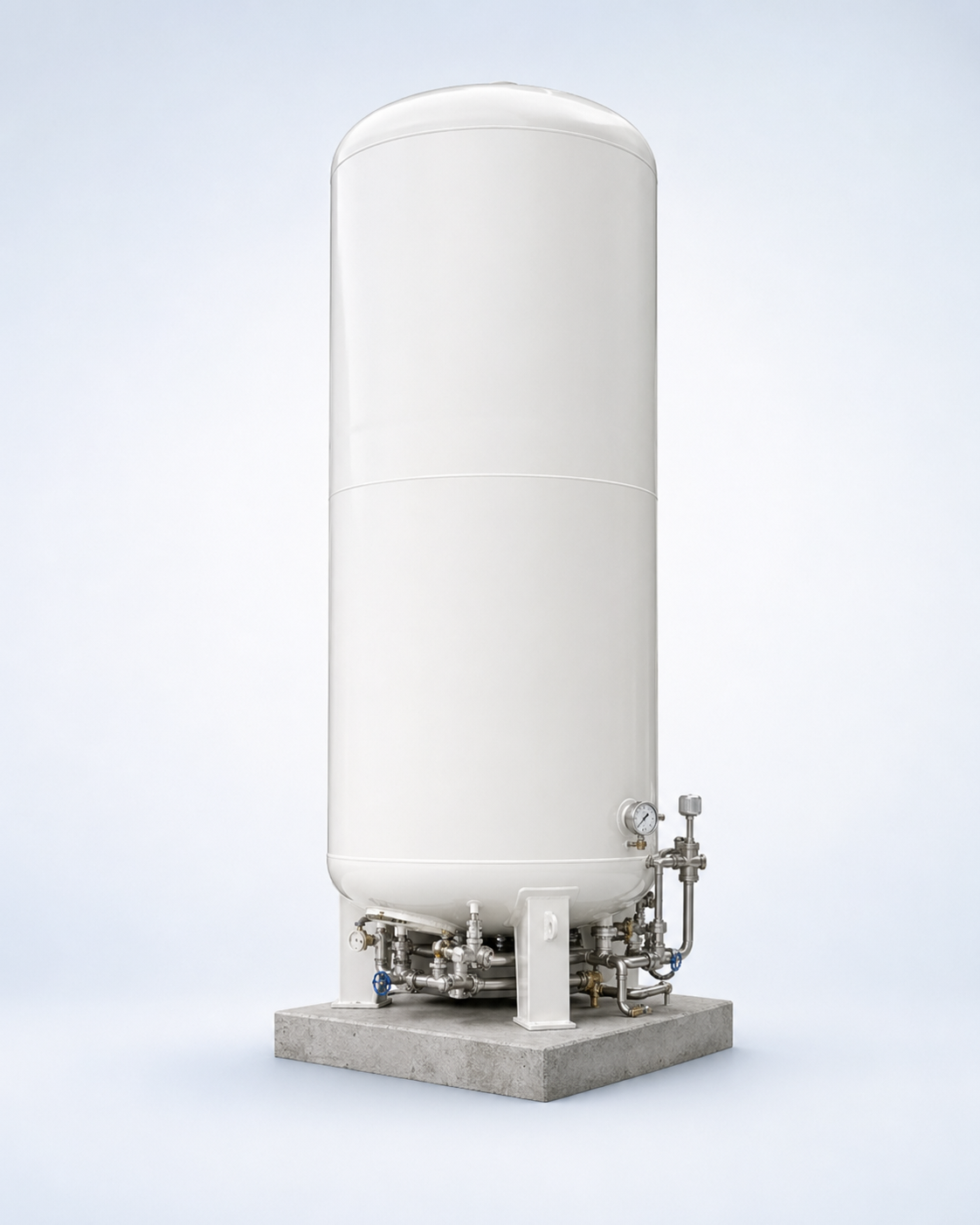
The reference point throughout is a typical vertical vacuum-insulated bulk tank: capacities from 8,000 L up to 25,000 L gross, working pressures of 0.8, 1.45, 1.6 and 2.2 MPa, and media including liquid oxygen (LO2), nitrogen (LN2), argon (LAr) and CO2 depending on configuration. Those parameters are not marketing options; they are the cost drivers themselves.

Capacity is the obvious driver, but usable volume and footprint matter more

Gross volume sets the baseline. More litres means more inner and outer shell material, more weld length, more insulation and a larger vacuum space to evacuate, so cost rises with size. But raw litres are a blunt instrument for comparison. Usable volume is typically around 95 percent of gross, because you cannot draw a tank completely empty and still maintain stable supply pressure, so always compare quotations on usable capacity rather than the nameplate figure.

Footprint and height matter as well. A 25,000 L vertical tank stands over 11 metres tall and weighs close to 10 tonnes empty; a 20,000 L unit is around 10 metres. Those dimensions feed straight into foundation design, crane requirements and, frequently, local planning or height constraints. The cheapest tank on a spec sheet can become the most expensive installation if your site cannot accommodate its height or bearing loads. Size the vessel to consumption and refill frequency, not to the largest unit your budget appears to allow.

Design pressure changes the cryogenic storage tank price more than buyers expect

Working pressure is the variable most often underestimated. The same nominal volume can be built for 0.8 MPa or for 2.2 MPa, and the higher rating is materially more expensive. A higher design pressure means thicker shells, more conservative weld and head design, and more demanding testing, all of which add material and labour.

Match the rating to the duty. A low-pressure tank around 0.8 MPa suits high-throughput sites with their own pumps and vaporisers, where the tank is essentially bulk reserve. Higher ratings such as 1.6 or 2.2 MPa earn their cost where you need to push gas through a pipeline network or maintain delivery pressure without additional pumping. Note also that media availability is tied to pressure class in real product ranges: some higher-pressure configurations are offered for LO2 only, while multi-service LO2/LN2/LAr tanks cluster at the lower and mid ratings. Specifying more pressure than the application requires is one of the most common and avoidable ways to inflate a cryogenic storage tank price.

Insulation and the gas you store

Bulk cryogenic tanks are double-walled with an insulated vacuum space. The common, cost-effective approach for static bulk storage is a vacuum-perlite jacket, which keeps the liquid cold with low evaporation. Insulation quality is not a line item you see on a quotation, but it is where long-term operating cost is decided: every litre lost to boil-off is product you paid for, evaporating into the atmosphere. A modestly cheaper tank with a poorer vacuum or weaker insulation can erase its saving within a couple of years through higher losses.

The stored medium also shapes specification. Liquid oxygen is an oxidiser and demands rigorous cleanliness and oxygen-compatible construction throughout, which legitimately adds cost compared with an inert-service nitrogen or argon tank. CO2 service has its own pressure and temperature profile. When you compare prices, confirm each quotation is for the same medium and the same service conditions, because an LO2-rated, oxygen-clean vessel and a basic LN2 tank are not interchangeable even at identical volume and pressure.

Certification, documentation and compliance

This is where a low quotation most often hides its true cost. A cryogenic vessel is pressure equipment, and the certification regime that applies in your country governs whether you can legally install and operate it. Different markets recognise different pressure-vessel codes, and a tank built and certified to one regime may need additional assessment, documentation or a recognised third-party route before it can be commissioned elsewhere.

Treat the documentation package as part of the deliverable, not an afterthought. Material certificates, weld and pressure-test records, the data report, the declaration of conformity and a complete export file all have real cost behind them, and a price that omits them is not comparable to one that includes them. Cryofortune, based in Foshan, Guangdong, supplies these tanks for export-oriented industrial projects and can arrange accessories, documentation and export packing, which is precisely the paperwork that determines whether a vessel clears customs and passes commissioning rather than sitting on a quay. Always ask explicitly which standard a tank is certified to and which documents are supplied.

Logistics: the line item that surprises first-time buyers

A bulk tank is heavy, tall and classified as out-of-gauge cargo. Freight, specialised handling, export packing, insurance and inland transport to site can represent a significant share of the delivered cost, especially for the larger 20,000 L and 25,000 L units. Two factors dominate: distance and dimensions. Because these vessels exceed standard container envelopes, shipping is rarely a simple per-unit rate.

Get a delivered, all-in figure rather than an ex-works price you then have to build on. Confirm Incoterms explicitly, clarify who handles customs clearance and inland haulage, and budget for offloading at site, which a standard yard crane may not cover for a unit approaching 10 tonnes. As a global exporter, Cryofortune ships this equipment worldwide with the export documentation that keeps that logistics chain moving.

A practical selection checklist

Before you request a quotation, settle these points so every supplier prices the same thing:

  • Medium and service conditions — LO2, LN2, LAr or CO2, with cleanliness requirements stated for oxygen service.
  • Usable capacity — sized to consumption and refill interval, compared on usable not gross volume.
  • Working pressure — matched to your distribution method, not over-specified.
  • Insulation and boil-off — vacuum-perlite quality and expected evaporation, weighed as an operating cost.
  • Site constraints — height, footprint, foundation loads, crane access.
  • Certification and documents — the exact code and the full documentation package.
  • Delivered cost and Incoterms — freight, packing, clearance and offloading included.

Specifying these clearly turns a vague price comparison into a like-for-like decision, and usually reveals that the lowest headline number is not the lowest total cost of ownership.

If you want to see how capacity, pressure and configuration map to a real product range, review the vertical cryogenic storage tank specifications and use the eight configuration options as a starting point for your own requirement before reaching out.

Content

Cryogenic Vaporizer Sizing: How to Estimate Flow Rate and Choose Ambient vs Heated

Cryogenic Vaporizer Sizing: How to Estimate Flow Rate and Choose Ambient vs Heated

A cryogenic vaporizer converts stored liquid, LN2, LOX, LAr, or CO2, into gas at the temperature, pressure, and flow your process needs. Get the sizing right and the unit disappears into the background, delivering steady gas for years. Get it wrong and you face frosting, pressure droop, frozen pipework, or a vaporizer that simply cannot keep up at peak demand. Cryogenic vaporizer sizing is not guesswork: it follows from a handful of numbers you can establish before you ever send an enquiry. This guide walks through how to estimate the flow rate you actually need, how to decide between ambient-air and heated designs, and the common mistakes that lead to a wrongly specified unit.

Start with the four numbers that drive cryogenic vaporizer sizing

On the Cryofortune product page, selection is described as being built around four things: media, peak and average flow, inlet and outlet pressure, and site climate. Those are the right place to begin.

Media. Liquid nitrogen, oxygen, argon, and carbon dioxide each behave differently. Oxygen service demands cleanliness and material compatibility; CO2 has a much higher boiling point and triple-point behaviour that changes the thermal duty. Fix the gas first, because it constrains every downstream choice.

Peak and average flow. This is the heart of the exercise. A vaporizer must be sized for the *peak* instantaneous demand, not the daily average. A plant drawing 200 Nm³/h on average but spiking to 500 Nm³/h when several lines call at once needs a unit rated for the spike. Note the catalogue figures such as 500 m³/h and 350 m³/h are nominal capacity references; your duty case has to map onto them honestly.

Inlet and outlet pressure. The pressure your liquid source delivers and the pressure your process requires together set the operating envelope. The listed models illustrate the range, with working pressures around 200 bar (test pressure 300 bar) on the high-pressure TGV units and 3.0 MPa on the TGN unit. Specify the pressure you need at the *point of use*, after line losses, not at the tank.

Site climate. Ambient temperature and humidity are not background details; they directly determine whether an ambient-air design can carry your load. We return to this below.

How to estimate required flow rate

Convert everything to a single, consistent unit, normal cubic metres per hour (Nm³/h) is the usual reference, then build up your demand profile:

1. List every consumer. Each machine, burner, blanketing line, or filling point that draws gas, with its individual flow. 2. Find the realistic peak. Add the flows that can run simultaneously. Apply a diversity factor only where you are confident loads never coincide; when in doubt, assume they do. 3. Add a margin. A sensible safety margin (commonly in the 15-25% range) covers future growth, measurement uncertainty, and gradual fouling. Undersizing is far more expensive to fix than a modest overspecification. 4. Define the duty cycle. Continuous 24/7 supply, intermittent batch draw-off, and short high peaks are three different problems. A vaporizer that recovers easily between intermittent draws may frost solid under continuous load. 5. State average flow too. Average flow governs operating economics and, for ambient units, the recovery time the heat exchanger gets between peaks.

Carry these five figures, peak flow, average flow, duty pattern, outlet pressure, and gas, into every conversation with a supplier. They are what a competent engineer needs to confirm a model.

Ambient-air vs heated vaporizers: how to choose

Cryofortune supplies ambient-air, water-bath, and steam or electric heated configurations, matched to duty and climate. Each has a clear home.

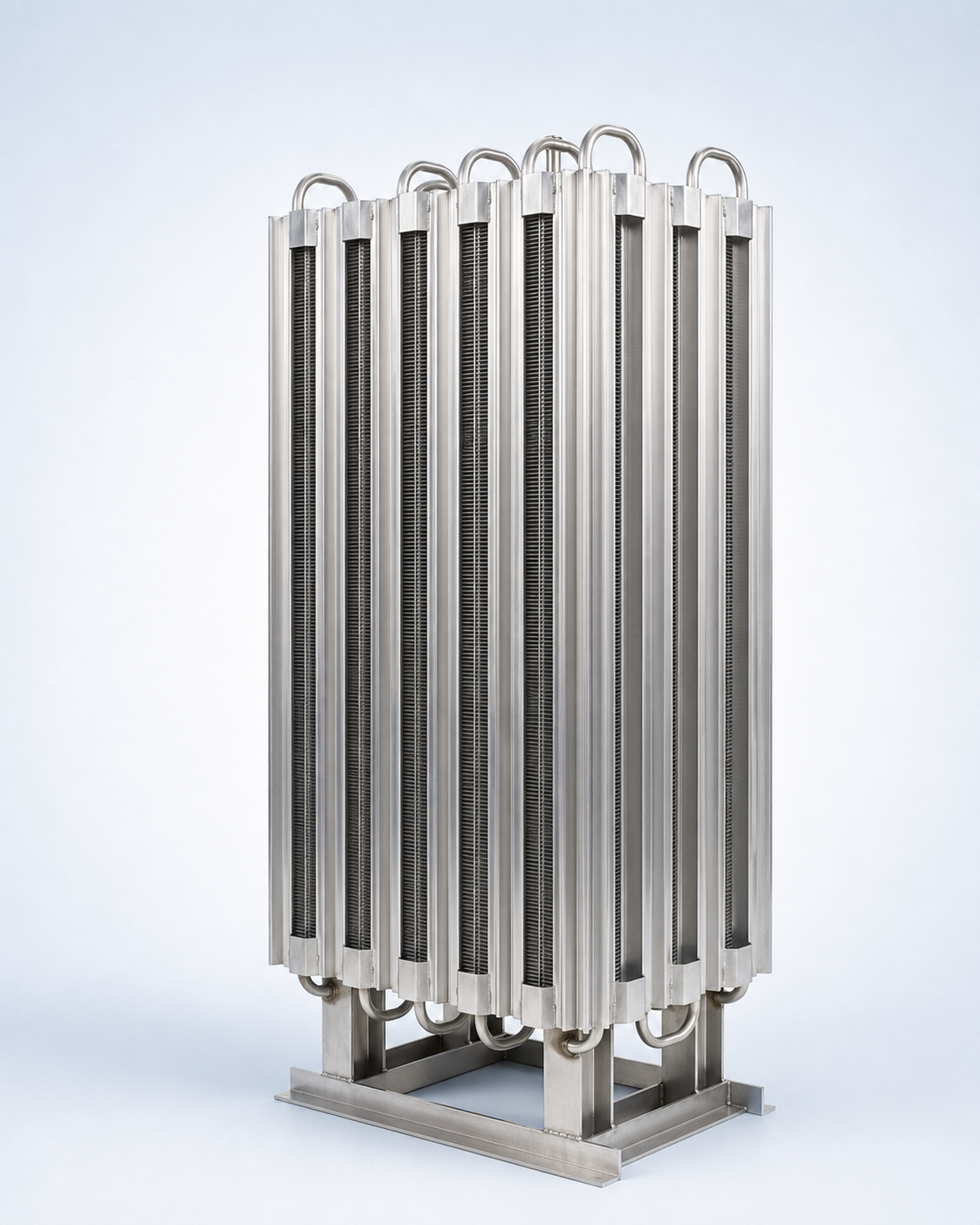
Ambient-air vaporizers draw heat from the surrounding air across finned tubes. They consume no fuel or electricity for vaporization, which makes them the economical default for low-to-moderate, intermittent duty in temperate climates. Their weakness is the flip side of their strength: as the fins extract heat, they cool and accumulate frost, which insulates the surface and steadily reduces capacity. That is why ambient units are often installed in multiple banks that alternate, one running while another defrosts.

Heated vaporizers, water-bath, steam, or electric, supply an external, controllable heat source. Choose them when you need genuinely continuous high flow, when the climate is cold or humid enough to defeat ambient defrost cycles, or when outlet temperature must stay within a tight band regardless of weather. Steam-heated units suit sites with existing steam; electric suits sites without it. The trade-off is operating cost and utility infrastructure.

A useful rule of thumb: if your demand is steady, high, and around the clock, or you are in a cold or very humid location, lean heated. If your demand is intermittent and your climate is mild, ambient is usually the lower-cost answer, provided you allow space and bank capacity for defrost.

Don’t underestimate climate, frosting, and duty cycle

The most common sizing error is treating an ambient-air vaporizer’s nameplate capacity as a continuous figure. It rarely is. Capacity quoted under favourable conditions degrades as ambient temperature drops, humidity rises, and frost builds. A unit that comfortably meets your peak in summer at 30°C can fall short on a damp winter morning.

Three practical safeguards:

  • Size ambient units for your worst-case climate, not the annual average. Use the coldest, most humid realistic operating condition.
  • Plan for defrost. Either accept duty cycling with multiple banks, or move to a heated design if you cannot tolerate the capacity dip.
  • Watch outlet temperature. Gas delivered too cold can damage downstream equipment and embrittle piping. Where this matters, trim heaters and multiple banks are added to hold a steady outlet temperature when continuous high flow or cold climates require it.

A practical cryogenic vaporizer sizing checklist

Before you request a quotation, confirm you can answer each of these:

  • Gas / media: LN2, LOX, LAr, or CO2, with any purity or cleanliness requirements.
  • Peak flow (Nm³/h): the simultaneous maximum, with margin added.
  • Average flow (Nm³/h): for economics and recovery assessment.
  • Duty cycle: continuous, intermittent, or short-peak.
  • Inlet pressure: what the liquid source delivers.
  • Outlet pressure at point of use: after line losses.
  • Required outlet temperature: and the tolerance on it.
  • Site climate: worst-case ambient temperature and humidity.
  • Installation context: indoor or outdoor, available utilities (steam, power), footprint, and the application, whether industrial gas supply, food and beverage, electronics, medical oxygen, laboratory, or welding.
  • Standards and documentation: the destination market’s requirements, since available certificates depend on product type, market, and the agreed supply standard.

Working through this list usually reveals the ambient-versus-heated decision on its own, and it gives the supplier everything needed to confirm a model rather than guess.

Closing thoughts

Sound cryogenic vaporizer sizing comes down to defining your real peak flow, being honest about duty cycle and climate, and matching those to the right ambient or heated configuration, with trim heaters or multiple banks where continuous high flow or cold conditions demand them. The numbers are not difficult to assemble, and assembling them before you enquire saves weeks of back-and-forth and protects you from the costly mistake of an undersized unit.

Cryofortune sources and supplies cryogenic vaporizers in ambient-air, water-bath, steam, and electric heated configurations for LN2, LOX, LAr, and CO2 service, shipping to export-oriented projects worldwide with the export documentation each destination market requires. If you have your flow, pressure, and climate figures in hand, you can review configurations and specifications on the cryogenic vaporizer product page and use them as the basis for a properly grounded enquiry.

Content

Vertical vs Horizontal Cryogenic Tank: How to Choose the Right Storage Format

Vertical vs Horizontal Cryogenic Tank: How to Choose the Right Storage Format

Choosing between a vertical and a horizontal cryogenic vessel is one of the first specification decisions an engineer or procurement lead makes when planning bulk liquid gas storage, and it is easy to get wrong. The two formats store the same products, use comparable construction, and often quote similar capacities, so the deciding factors are rarely the tank itself. The real question in a vertical vs horizontal cryogenic tank comparison is how the vessel fits your site, your throughput, and your installation constraints. This guide walks through what actually matters before you send an inquiry, so you arrive at the conversation with the right requirements already defined.

What both formats have in common

Before comparing orientations, it helps to anchor on what does not change. A modern bulk cryogenic storage tank is a double-walled, vacuum-insulated pressure vessel. On the Cryofortune vertical range, the annular space uses vacuum-perlite insulation to keep evaporation low and hold the liquid cold, and the same insulation principle applies whether the vessel stands upright or lies horizontal.

Both formats are configured for the common industrial cryogens: liquid nitrogen (LN2), liquid oxygen (LOX), liquid argon (LAr), and carbon dioxide (CO2), selected by configuration rather than being interchangeable in one tank. Both are designed around a defined working pressure, and on the vertical range these are offered at 0.8, 1.45, 1.6, and 2.2 MPa. Both quote a gross volume alongside a usable volume of around 95%, the rest being ullage the system needs to operate safely. And both are normally supplied as part of a system, matched with vaporizers, pumps, and safety valves rather than as a standalone shell.

Because construction, gases, pressure classes, and insulation are shared, orientation is mostly a question of geometry and logistics, not thermal performance. That reframing is the most useful thing to carry into the decision.

Vertical vs horizontal cryogenic tank: the core trade-off

The defining difference is the relationship between footprint and height.

A vertical tank concentrates its capacity over a small ground area. It keeps the foundation footprint small where floor space is limited, which makes it the natural choice for filling stations, distributor depots, production sites, and plant rooms where land is constrained or expensive. The trade-off is height: a tall vessel needs adequate vertical clearance, may attract more wind loading, and can complicate maintenance access at the top.

A horizontal vessel spreads the same capacity along the ground. It trades floor area for a low overall profile. The Cryofortune range illustrates this with the Horizontal Cryogenic Cylinder 500 L, described as a compact unit for liquid storage with a low installation height. Low profile is valuable where there are height restrictions such as roofed areas, indoor bays, height-limited yards, or where keeping the centre of gravity low matters for stability or transport.

In short: choose vertical when ground area is your constraint, and horizontal when height or clearance is your constraint. Most sites have one binding limit, and identifying it early settles much of the debate.

Sizing, pressure, and throughput considerations

Orientation should follow your operating profile, not the other way around. Three numbers drive sizing.

First, working pressure. Match the pressure class to what your downstream system and end use actually require, rather than over-specifying. The vertical range spans 0.8 to 2.2 MPa, and a higher class is not automatically better; it affects vessel cost and the safety relief arrangement.

Second, usable capacity. Always size against usable volume, not gross. With roughly 95% usable, a tank quoted at a given gross figure delivers slightly less in practice, and across a refill cycle that margin matters for continuity of supply. The vertical range, for example, spans gross volumes from 7,990 L up to 25,000 L across eight variants, so there is room to match a real consumption curve rather than rounding up blindly.

Third, refill frequency. Estimate average and peak draw, then size so refills land at a manageable interval. Undersizing forces frequent deliveries and risks running dry; oversizing ties up capital and increases standing boil-off relative to what you use.

Insulation, boil-off, and total cost of ownership

The purchase price is a fraction of lifetime cost. The vacuum-perlite insulation system is what keeps a cryogenic tank economical day to day, because every unit of product lost to evaporation is product you paid for and cannot sell or use. When comparing options, ask for the static evaporation (boil-off) rate for the specific gas and capacity you intend to store, since it varies by product and vessel size and is the single largest recurring cost driver after the gas itself.

Orientation has only a second-order effect on thermal loss compared with insulation quality and vacuum integrity, so do not choose a format expecting it to fix boil-off. Instead, weigh insulation performance, the relief and venting arrangement, and how the vessel will be maintained over a multi-year service life. A tank that is slightly cheaper but harder to service, or that loses more product annually, is usually the more expensive choice.

Installation, foundation, and site logistics

Site reality decides more cryogenic tank choices than the datasheet does. Vertical vessels sit on an outdoor foundation or a prepared industrial pad, and the small footprint is an advantage only if you have the height and clearance to use it. Before committing, confirm vertical clearance and any overhead obstructions, wind exposure for a tall vessel, crane or delivery access for installation, and serviceability of valves and instruments at working height.

For horizontal vessels, confirm instead that you have the ground run available and that the low profile genuinely solves a height limit you actually have. Also plan the supporting equipment footprint early: vaporizers, pumps, and safety valves need their own space and access, and that layout often tips a borderline decision one way or the other.

Two common mistakes recur. The first is choosing orientation on price or habit before checking the binding site constraint, then discovering a clearance or access problem during installation. The second is sizing on gross volume and ignoring the usable figure and refill interval, which quietly undermines supply continuity.

A practical selection checklist

Work through these before you inquire:

  • Which gas and at what working pressure class (0.8 to 2.2 MPa on the vertical range)?
  • What is your binding site constraint, ground area or height clearance?
  • What usable capacity do you need at peak draw, sized on 95% usable, not gross?
  • What refill interval is operationally acceptable?
  • What static boil-off rate applies to your gas and capacity?
  • Is there room and access for vaporizers, pumps, and safety valves?
  • What certification and export documentation does your destination market require?

That last point matters for international projects. Cryofortune supplies this cryogenic storage equipment worldwide, and certificates and export documentation are arranged according to product type, destination market, and the agreed supply standard, so confirming requirements early avoids customs and compliance delays later.

Once your constraints, capacity, and pressure class are defined, the vertical-versus-horizontal question usually answers itself. To review configurations, capacity variants, and working pressures for vertical bulk storage, see the vertical cryogenic storage tank range and use it to validate the specification you have just scoped.

Content

Types of Cryogenic Vaporizers: Ambient Air vs Water Bath vs Electric Compared

Types of Cryogenic Vaporizers: Ambient Air vs Water Bath vs Electric Compared

A cryogenic vaporizer is the link between your storage tank and the downstream line. It converts liquefied gas back into usable gas before it reaches the process, and the way it adds that heat determines your energy bill, your footprint, your reliability in winter, and how much your system can flow on a peak day. Choosing among the main types of cryogenic vaporizers is therefore one of the more consequential decisions in a bulk gas installation, yet it is often made on price alone.

This guide compares the three heating approaches that dominate industrial practice: ambient air, water bath, and steam or electric. It is written for the engineer or buyer doing the homework before sending an inquiry. The goal is to give you a clear framework for matching equipment to duty, media, pressure, and site climate, so you specify the right unit the first time rather than discovering its limits after commissioning.

How the main types of cryogenic vaporizers differ

All cryogenic vaporizers do the same job, but they source the heat of vaporization differently, and that single difference drives almost every trade-off you will weigh.

Ambient air vaporizers draw heat from the surrounding atmosphere. Cold liquid flows through finned tubes, usually aluminum, and the air around those fins gives up its heat to vaporize the gas. There are no burners, no electrical heaters, and no consumables, which makes this the lowest-operating-cost design. The catch is that performance is tied to the weather. As the fins run, they accumulate frost, which insulates them and gradually reduces capacity, so ambient units are typically run in banks that switch and defrost on a cycle.

Water bath vaporizers pass the cryogenic liquid through a coil submerged in a heated water bath. The bath holds a stable temperature regardless of outdoor conditions, so output is consistent and high. This makes water bath designs well suited to continuous, high-flow service where an ambient unit would frost out. They require an energy source to maintain the bath and more plant space, but they decouple your gas supply from the climate.

Electric and steam heated vaporizers use an electric element or a steam jacket to add heat directly and controllably. They deliver steady, repeatable output in a relatively compact footprint and are a strong fit where ambient air is unreliable, where plant steam is already available, or where precise outlet temperature control matters. Operating cost is higher because you are paying for energy on every cubic meter vaporized.

On the Cryofortune cryogenic vaporizer line, these heating methods are offered as configurations matched to the application rather than as fixed catalog items, so the same media can be handled by different heat sources depending on the site.

Match the type to your gas, flow, and pressure

The page that grounds this article states the selection logic plainly: it is built around media, peak and average flow, inlet and outlet pressure, and site climate. Work through those in order.

Media. Cryofortune vaporizers are configured for LN2, LOX, LAr, and CO2. Oxygen service in particular demands oxygen-clean construction and careful material selection, so the gas you are vaporizing constrains the design before anything else.

Flow. Distinguish your average flow from your peak. A facility with a modest baseline but sharp demand spikes is a different problem from one running flat out around the clock. Ambient air handles intermittent and moderate continuous duty economically; sustained high flow usually points toward a water bath or a heated design, or toward multiple ambient banks.

Pressure. This is where the published specifications matter. The high-pressure models, TGV-20,0/500 and TGV-20,0/350, are rated for a working pressure of 200 bar with a test pressure of 300 bar, and offer 500 m³ and 350 m³ capacity respectively. The low-pressure model, TGN-3,0/500, runs at 3.0 MPa with a 500 m³/h flow. High-pressure cylinder-filling and pumping systems and lower-pressure pipeline supply are genuinely different duties; confirm both your inlet and your required outlet pressure against the rated envelope.

Climate is a specification, not an afterthought

Outdoor conditions belong in the data sheet, not in the assumptions. Ambient air vaporizers are the most climate-sensitive of the types of cryogenic vaporizers because the air itself is the heat source. In a cold, humid, or low-wind location, frost builds faster and clears slower, and a unit sized for a temperate average can fall short on the coldest, highest-demand days, which often coincide.

This is exactly why trim heaters and multiple banks are added where continuous high flow or cold climates require it. A trim heater polishes the outlet temperature so gas never enters the line too cold; multiple banks let one set of fins defrost while another carries the load. In harsh climates, a water bath or electric design may simply be the more honest choice. The practical rule: size for your worst-case combination of low temperature and peak draw, not for the annual mean.

Common mistakes when comparing vaporizer types

A few errors recur often enough to call out:

  • Sizing to average flow. A vaporizer that meets average demand can starve the line during peaks. Specify against peak flow at the worst ambient condition.
  • Ignoring outlet temperature. Gas delivered too cold can damage downstream equipment and embrittle piping. If ambient air cannot reliably warm the gas in your climate, plan for trim heating from the start.
  • Treating ambient air as free and consequence-free. Operating cost is low, but frost cycling, the need for switching banks, and footprint for that redundancy are real. The economics still usually favor ambient air for suitable duties, but go in with eyes open.
  • Overlooking the gas. Pressure and flow get the attention; oxygen cleanliness, material compatibility, and code requirements for the specific media get forgotten until late.
  • Forgetting the downstream context. The vaporizer is one link in a chain from tank to point of use. Pressure drop, control, and the storage and regulation around it all shape what the vaporizer actually needs to deliver.

A selection checklist before you inquire

Have these answers ready and the conversation with any supplier becomes far more productive:

1. Gas and purity. Which media (LN2, LOX, LAr, CO2), and any oxygen-clean or purity requirements. 2. Flow. Average and peak flow in normal m³/h, with how long peaks last. 3. Pressure. Inlet pressure from the source and required outlet pressure to the line, mapped against the rated working pressure. 4. Climate. Site location, design minimum temperature, humidity, and prevailing wind. 5. Duty pattern. Continuous, intermittent, or peaking, and acceptable downtime for defrost. 6. Heating utilities. Whether plant steam or electrical capacity is available to support a heated design. 7. Space and layout. Footprint, orientation (atmospheric or vertical formats are available), and access for maintenance. 8. Redundancy. Whether the process can tolerate a single bank or needs switching for uninterrupted supply. 9. Codes and documentation. Applicable pressure-vessel codes and the certification and export paperwork your project requires.

Cryofortune supplies ambient-air and heated cryogenic vaporizers worldwide, sized to flow and climate, with export documentation, and accessories and export packing can be arranged with the selected equipment, which matters when the unit has to clear customs and satisfy inspection on arrival.

Closing: choose by duty, not by default

There is no universally best vaporizer, only the right one for your media, flow, pressure, and climate. Ambient air wins on operating cost for suitable duties; water bath delivers steady high flow independent of weather; electric and steam offer controllable output in tight or climate-challenged sites. Define the worst-case operating point, hold each option against it, and the choice usually makes itself.

When you are ready to translate these requirements into a sized unit, review the full specifications and configurations on the Cryofortune cryogenic vaporizer page or share your duty data for a configuration matched to your site.

Content

Cryogenic Equipment for LOX and LN2 Service: Choosing by Gas (LN2, LOX, LAr, CO2)

Cryogenic Equipment for LOX and LN2 Service: Choosing by Gas (LN2, LOX, LAr, CO2)

Engineers and procurement teams often treat cryogenic gas supply as a single category, then discover at commissioning that a tank or vaporizer specified for one gas is unsuitable for another. The reality is that liquid nitrogen, liquid oxygen, liquid argon and carbon dioxide each impose distinct demands on materials, cleanliness, insulation and pressure design. Selecting cryogenic equipment for LOX and LN2 service — and for LAr and CO2 alongside them — starts with the gas, not the hardware. This guide walks through what actually changes between gases, how to compare options before you inquire, the mistakes that cause the most rework, and a checklist you can apply to any storage, vaporization or transfer package.

Why the gas, not the vessel, drives the specification

A vacuum-insulated cryogenic tank may look identical whether it holds LN2, LOX or LAr, but the internal requirements diverge sharply. Liquid nitrogen at roughly -196 C is chemically inert and forgiving, which is why it dominates lab, medical and small-volume field use. Liquid oxygen is the demanding case: it is a strong oxidizer, and any hydrocarbon contamination — oil, grease, certain gasket materials — on a wetted surface can become an ignition hazard. That is why LOX equipment must be specified and built oxygen-clean, with compatible materials throughout the wetted path, even when the vessel geometry matches an LN2 unit.

Liquid argon sits between the two: inert like nitrogen, but stored about ten degrees warmer (−185.8 °C against −195.8 °C) and markedly denser, with a higher liquid density that affects tank weight, pressure build-up behavior and economics. Carbon dioxide is the outlier. It is stored at far higher pressure and warmer temperature than the air gases, behaves as a liquefied gas rather than a deep cryogen, and sublimes rather than simply boiling off. Equipment configured for LCO2 — including the 20 ft cryogenic tank container, which Cryofortune lists as handling LCO2, LOX, LN2 and LAr by configuration — is set up differently from the same platform configured for an air gas. The phrase “by configuration” that appears across these product lines is the key signal: the base equipment is shared, but the gas determines the build.

Storage: matching the vessel to the gas and the duty

Storage selection is a function of three things: which gas, how much, and how stable the on-site supply needs to be. Cryofortune’s range maps cleanly onto these duty points and is a useful reference frame for any comparison:

  • Lab and small-volume field use: the YDZ-50 liquid nitrogen container and open-neck Dewar vessels are LN2-only, built for safe handling and decanting where portability matters more than throughput.
  • Local storage with pressure build-up: vertical cryogenic cylinders are vacuum-insulated and support LN2, LOX, LAr and CO2 — the broadest gas coverage in the cylinder class.
  • Horizontal duty: the horizontal cryogenic cylinder 500 L is rated for LN2, LOX and LAr, suited to installations where headroom is limited.
  • Bulk on-site supply: vertical cryogenic storage tanks deliver stable bulk supply for LN2, LOX, LAr or CO2 by configuration.
  • Transportable bulk: the 20 ft cryogenic tank container offers ISO-style handling for LCO2, LOX, LN2 and LAr.

When comparing storage options, look past nominal capacity. Vacuum insulation quality governs static evaporation loss, which is an ongoing operating cost, not a one-time spec. For LOX, confirm oxygen-clean construction explicitly. For CO2, confirm the vessel is configured for the higher working pressure that liquid carbon dioxide demands rather than assuming an air-gas tank will serve.

Vaporization and heating: where flow rate and gas meet

A storage vessel is only as useful as its ability to deliver gas at the right rate, pressure and temperature. This is where many specifications fall short, because vaporizer sizing depends on both the gas and the worst-case ambient conditions at the site. Cryofortune offers ambient-air and water-bath vaporizers, configurable for LN2, LOX, LAr or CO2. Ambient-air units are economical and maintenance-light but lose capacity in cold or humid climates and during sustained high draw, when icing reduces heat transfer. Water-bath and heated designs hold output through those conditions.

CO2 deserves particular attention. Because it is drawn from a higher-pressure, warmer liquid and tends toward dry-ice formation if expanded without enough heat, it commonly needs dedicated heating. Cryofortune’s gas heater and CO2 heater line provides electric and water-assisted temperature support after vaporization specifically to stabilize delivery temperature. Specifying a vaporizer without confirming the downstream heating duty is one of the more frequent causes of flow interruptions in the field.

Transfer, filling and gas mixing

If your operation fills cylinders or feeds a distribution station, the cryogenic cylinder filling pump and pump skids cover liquid transfer, cylinder filling, pressure build-up and station-side distribution for LN2, LOX, LAr and CO2. The right unit is selected by flow rate and by inlet and discharge pressure — so define those duty parameters before comparing pumps, because a skid sized for one filling regime will underperform in another.

For welding and process applications, the question shifts from a single gas to a prepared mixture. Cryofortune’s gas mixer with buffer tank, gas mixing cabinet with PLC control, and gas mixture buffer tank handle two-component blends such as Ar/CO2, Ar/O2, Ar/He and N2/CO2. The mixer prepares the blend, the buffer tank stabilizes line pressure and flow downstream, and the PLC cabinet adds controlled dosing and operator monitoring. If consistent blend ratio under variable demand matters to your process, the buffer tank is not an optional extra — it is what smooths delivery when draw fluctuates.

Common mistakes to avoid

  • Treating LOX like LN2. Reusing an LN2-cleaned vessel or non-oxygen-compatible fittings on liquid oxygen service is the single most consequential error. Specify oxygen-clean from the start.
  • Sizing the vaporizer for average, not peak, draw in best-case weather. Ambient-air units in particular must be sized for the coldest, highest-demand scenario the site will see.
  • Forgetting downstream heating on CO2. Vaporization alone often will not deliver CO2 at a usable temperature; plan the heater into the package.
  • Ignoring static evaporation in the comparison. Two tanks of equal capacity can differ materially in boil-off and therefore in running cost.
  • Specifying a pump by capacity alone. Inlet and discharge pressure and required flow rate determine fit; nominal size does not.
  • Leaving documentation to the end. For cross-border projects, conformity and shipping paperwork should be scoped at the inquiry stage, not after award.

A practical selection checklist

Before you send an inquiry, confirm you can answer the following:

1. Gas and phase — LN2, LOX, LAr or CO2/LCO2, and the cleanliness class required (oxygen-clean for LOX). 2. Volume and duty — portable, local with pressure build-up, or bulk on-site; horizontal or vertical footprint. 3. Delivery requirements — peak flow rate, required pressure, and minimum acceptable delivery temperature. 4. Vaporizer type — ambient-air for mild climates and intermittent draw, water-bath or heated for sustained or cold-weather duty; dedicated heating for CO2. 5. Transfer and filling — flow rate plus inlet and discharge pressure for any pump skid. 6. Mixing needs — blend type (Ar/CO2, Ar/O2, Ar/He, N2/CO2) and whether PLC dosing and buffering are needed. 7. Site and transport — fixed installation versus transportable ISO-style tank container. 8. Documentation route — which standards and export papers your project requires.

That last point is where international buyers benefit from a supply partner set up for export. Cryofortune supplies this equipment worldwide and notes that documentation can be prepared around China standard and international routes such as ISO, ASME, PED, DOT and TPED where applicable, with English communication available for export inquiries. Confirming the documentation path early keeps customs and conformity from becoming a late-stage surprise.

Closing

Choosing cryogenic equipment well is mostly a matter of starting from the gas and working outward to materials, insulation, vaporization, heating and transfer — then confirming the paperwork your destination requires. Define the gas, the duty and the delivery conditions before you compare hardware, and most of the difficult decisions resolve themselves. If you want to see how specific storage tanks, vaporizers, pumps, dry ice equipment and mixing systems are configured per gas, browse the full range at Cryofortune’s products page as a reference for your own specification.

Content

Microbulk vs Cylinders: When to Upgrade from Cylinder Gas to Bulk Cryogenic Supply

Microbulk vs Cylinders: When to Upgrade from Cylinder Gas to Bulk Cryogenic Supply

Choosing how to receive your industrial gas is a quiet but consequential decision. For a welding shop, a laboratory, or an electronics line running on LN2, LOX, LAr, or CO2, the supply mode shapes your floor space, your labour hours, your safety exposure, and your cost per cubic metre delivered to the point of use. The microbulk vs cylinders question becomes pressing as soon as your consumption outgrows the format you started with. This guide walks through how to compare the two honestly, what an engineer should measure before inquiring, and where the typical mistakes hide.

The point here is not to declare one format universally better. It is to give procurement and engineering a shared, fact-based framework for deciding when staying on cylinders still makes sense and when consolidating into bulk cryogenic supply will pay back.

What “Cylinders” and “Bulk” Actually Mean Here

When people say cylinders in a cryogenic context, they usually mean vacuum-insulated liquid cylinders rather than high-pressure compressed-gas bottles. These are also called DPL or DPW cylinders, or simply liquid dewars. A vertical vacuum-insulated cryogenic cylinder holds cryogenic liquid such as LN2, LOX, LAr, or CO2 and delivers it as liquid or gas at a controlled working pressure, typically in the 2 to 10 bar range depending on the variant.

These cylinders are portable, self-pressurising vessels in the small-to-medium range. Gross volumes commonly run from 50 L to 500 L, with models spanning the DPL450 series (for example DPL450-50, DPL450-100, DPL450-175, DPL450-195, DPL450-210) up to the DPL700-500 at 500 L. Stored volumes sit lower than gross, in the region of 95 L to 185 L on the mid-range units. Empty weights range from roughly 65 kg on the smallest to about 425 kg on the largest, which matters for handling and for how many you can realistically rotate through a site.

Bulk cryogenic supply, by contrast, means a larger fixed storage tank fed by tanker deliveries, with vaporisers converting liquid to gas for the pipeline. Microbulk is the bridge between the two: small permanent or semi-permanent vessels, larger than a single cylinder but smaller than a full bulk tank, refilled on site by a delivery truck rather than swapped out. The microbulk vs cylinders comparison is really a question of where on this continuum your demand sits.

How to Compare Total Cost, Not Sticker Price

The most common error in the microbulk vs cylinders analysis is comparing the gas price per unit and stopping there. Cylinders look cheap per vessel, but the real cost is the system around them.

Build a total-cost-of-supply picture that includes:

  • Cylinder rental or demurrage charged per vessel per day, which scales with how many you hold to cover peak demand and buffer stock.
  • Labour for changeovers — every empty swapped for a full one is handling time, paperwork, and a potential line stoppage.
  • Product loss. Vacuum-insulated cylinders do evaporate. Published evaporation rates on these units fall in the range of under 2.1% to under 4.0% per day depending on the model and gas. Across a large fleet of part-used cylinders, that boil-off compounds.
  • Delivery frequency and minimum-order effects that come from ordering many small vessels rather than fewer large fills.
  • Floor space and logistics for staging full and empty stock.

Bulk and microbulk shift the economics toward fewer deliveries, less handling, and lower boil-off per unit of gas stored, at the cost of a fixed asset and a tanker-access requirement. The crossover point is specific to your volumes — which is exactly why you measure before you commit.

Reading the Signals That You Have Outgrown Cylinders

Certain patterns reliably indicate that cylinder supply has reached its ceiling:

  • Changeover frequency. If staff are swapping cylinders multiple times a shift, you are paying skilled-labour rates to move vessels.
  • Cylinder count creeping upward. A site that has quietly accumulated dozens of liquid cylinders to keep up with demand is usually past the point where consolidation pays.
  • Run-out incidents. Unplanned empties that stall a welding bay, a laboratory run, or an electronics process are a direct production cost and a strong upgrade signal.
  • Pressure or flow limits. If your process needs steadier delivery pressure or higher continuous flow than a self-pressurising cylinder comfortably sustains, larger storage with dedicated vaporisation is the cleaner answer.
  • Boil-off on idle stock. Cylinders sitting part-used between shifts lose product; the more buffer you carry, the more you waste.

If two or more of these describe your operation, microbulk or bulk deserves a serious look. If none do — for example a low-throughput lab drawing modest LN2 — well-chosen cylinders remain the rational, lower-commitment choice.

Matching the Format to the Application and the Gas

Different applications stress the supply system differently, and the gas itself constrains the decision. Welding and cutting shops, laboratories, electronics, food processing, and medical or industrial gas points each have distinct duty cycles. A laboratory with intermittent LN2 draw is well served by a few cylinders. A continuous electronics or food-processing line drawing steadily is a stronger candidate for microbulk or bulk.

Gas choice matters too. LN2, LOX, LAr, and CO2 each have their own handling and material considerations. LOX in particular demands oxygen-clean components and disciplined handling regardless of format, so the upgrade decision should never compromise on the safety and cleanliness specification of valves, connections, and instrumentation. Whatever the gas, vacuum insulation is what keeps these vessels efficient, and the level indication — electronic or float-type — is what lets you manage stock without guesswork.

A practical middle path many sites use: standardise on vertical vacuum-insulated cylinders for flexible and backup supply while sizing a microbulk vessel for the steady base load. This keeps the resilience of swappable cylinders without paying the full handling penalty for your continuous demand.

Common Mistakes Engineers and Buyers Make

A few recurring errors distort the microbulk vs cylinders decision:

  • Sizing to the average, not the peak. Supply has to cover your busiest shift, not your monthly mean. Under-sizing forces emergency cylinder top-ups that erase the savings.
  • Ignoring boil-off in the model. Treating evaporation as negligible understates the true cost of holding many part-used cylinders.
  • Overlooking site access. Bulk and microbulk need reliable tanker access and a compliant standing area. Confirm this before specifying the vessel, not after.
  • Forgetting documentation and compliance. Cross-border projects need correct export documentation, pressure-vessel paperwork, and connection standards that match the destination. Cryofortune supplies vertical cryogenic cylinders for LN2, LOX, LAr, and CO2 service worldwide with export documentation, which removes a common source of customs and commissioning delay.
  • Neglecting instrumentation and connections. The right level indicator, valve package, and connection set determine how easy the system is to run day to day. These are configurable, so specify them deliberately rather than accepting a default.

A Practical Selection Checklist

Before you inquire, gather the following so any supplier conversation is grounded in numbers:

1. Daily and peak consumption per gas (LN2, LOX, LAr, CO2), in litres or cubic metres. 2. Required delivery pressure and flow at the point of use, checked against the 2 to 10 bar working-pressure range of cylinder options. 3. Duty cycle — continuous, batch, or intermittent — and the number of shifts. 4. Current cylinder count, rental, and changeover labour, to establish your real baseline cost. 5. Acceptable boil-off, compared with the published evaporation rates of candidate vessels. 6. Site logistics — floor space, handling equipment, and tanker access for any microbulk option. 7. Capacity headroom — choose a gross volume (from the 50 L to 500 L range, up to the DPL700-500) that covers growth without over-committing. 8. Documentation needs — export paperwork, standards, and connection packages for the destination.

Work through this list and the crossover between cylinders, microbulk, and bulk usually reveals itself without guesswork.

Closing Thoughts

There is no single right answer to microbulk vs cylinders — only the answer that fits your consumption, your duty cycle, your site, and your gas. Cylinders win on flexibility and low commitment; microbulk and bulk win on labour, boil-off, and cost per cubic metre once your volume is high enough. Measure your peaks, model the full cost, and check site access before you decide.

If you are sizing or comparing options, the vertical vacuum-insulated cryogenic cylinder range is a useful reference point for capacities, working pressures, and configuration choices. Cryofortune supplies this equipment worldwide with export documentation and configurable instrumentation, connection, and packaging sets, so the specification you settle on can be matched to your site and your destination.

Content

20 ft Cryogenic ISO Tank Container: Specifications, Capacity and Shipping Explained

20 ft Cryogenic ISO Tank Container: Specifications, Capacity and Shipping Explained

A 20 ft cryogenic ISO tank container is one of the most practical ways to move and hold liquefied cryogenic media, but it is also one of the easiest pieces of equipment to specify incorrectly. The same external footprint can hide very different working pressures, usable volumes and payloads, and those differences decide whether the unit fits your route, your gas and your filling regime. This guide explains what actually varies between configurations of a cryogenic ISO tank container, how to read the capacity and pressure figures, and which questions to settle before you send an inquiry.

The reference point throughout is a real 20 ft product line built around a vacuum-insulated inner vessel inside a standard ISO-style frame, offered in several pressure and volume variants. Use it to sanity-check whatever quotation lands on your desk.

What a 20 ft cryogenic ISO tank container actually is

A cryogenic ISO tank container is a double-walled pressure vessel mounted in a 20 ft ISO container frame so it can be handled, stacked and transported like any standard intermodal box. The inner vessel holds the liquefied gas; the space between the inner and outer shells is held under vacuum with multilayer insulation to slow heat ingress and keep the contents cold. You will also see the same equipment described as an ISO cryogenic tank container, a T75 tank container, or a 20 ft LIN/LOX/LNG container, depending on the market and the gas it carries.

The external dimensions stay close to the ISO standard across variants. On this product line the box measures roughly 6058 mm long and 2438 mm wide, with height between about 2519 mm and 2591 mm depending on configuration. That consistency is the whole point: it lets the unit travel by road, rail and sea and integrate with existing container handling without special arrangements.

Reading the specifications: pressure, volume and payload

Three numbers drive the decision, and they trade off against each other.

Working pressure. Across the available configurations, working pressure ranges from about 0.75 MPa to 2.3 MPa (roughly 7.5 to 23 bar). A higher-pressure tank holds gas more readily and supports pressure-driven discharge and longer holding before venting, but it tends to carry a heavier vessel and slightly less usable volume. A lower-pressure variant maximizes volume and is often suited to high-throughput logistics where the tank is filled and emptied quickly. Match the pressure rating to how the tank will be used downstream, not just to the gas.

Gross versus usable volume. Quotations list both, and the gap matters. On this line gross volume sits around 20.35 to 21.13 m3, while usable volume is roughly 19.33 to 20.4 m3. Usable volume is the figure that determines how much product you actually move, because a cryogenic vessel is never filled to 100 percent — ullage is reserved for thermal expansion and safe pressure management. Always compare suppliers on usable volume, not gross.

Payload by gas. The same tank carries very different masses depending on the liquid, because each cryogenic liquid has its own density. For the higher-pressure 2.3 MPa variant, for example, the stated payloads are approximately 22,845 kg of liquid oxygen, 23,100 kg of liquid argon, and 16,232 kg of liquid nitrogen. Argon and oxygen are dense and weight-limiting; nitrogen is lighter. This is where buyers most often go wrong — sizing on volume alone and then discovering the loaded unit exceeds a road weight limit. Net tank weights here run from roughly 7,380 kg to 10,945 kg, so confirm the combined tare-plus-payload figure against the legal gross weight for every leg of your route.

Matching the cryogenic ISO tank container to your gas and route

Start from the medium. This cryogenic ISO tank container family is configured for LCO2, LOX, LIN and LAR by variant, and the gas you carry should drive the pressure and volume choice rather than the other way around. A dedicated oxygen service unit, for instance, has cleanliness and compatibility requirements that you do not want to compromise by sharing across incompatible media.

Then layer in the route. Because the unit conforms to the ISO frame, it moves multimodally — but the binding constraint is usually the strictest weight or height limit along the journey, not the tank itself. A dense liquid like argon may force you toward a lower fill or a different variant to stay road-legal in a given country, even though the vessel could physically hold more. Map the full door-to-door path first, then pick the configuration that survives every leg.

Finally, consider duty cycle. Fast-turnaround distribution favors larger usable volume and lower pressure; intermittent use or longer site holds favors higher pressure and the pressure-building and discharge hardware that goes with it.

Instrumentation, valves and the connection package

A bare vessel is not an operating asset. Beyond the tank itself, a usable unit needs valves, gauges, fittings, relief devices and connection hardware, typically supplied as a connection package, plus instrumentation such as level indication, pressure monitoring and a control panel or operating accessories specified to the configuration. These determine how you fill, monitor and discharge in practice.

Treat the instrumentation list as part of the specification, not an afterthought. Two tanks with identical volume and pressure can behave very differently in service depending on their relief arrangement, level gauging and the fittings on the operating panel. Confirm that the connection package matches your filling station and receiving equipment — thread standards, connection types and relief settings — so the unit is ready to work on arrival rather than after a round of retrofits.

Common mistakes and a selection checklist

The recurring errors are predictable: buyers compare gross instead of usable volume; they size on volume and overlook payload mass for dense gases; they ignore the heaviest leg of the route; and they treat the connection package and instrumentation as a generic add-on rather than something that must match their site. Specifications such as static evaporation rate, inner and outer vessel materials, and exact certification scope are not universal across markets and should be requested in writing on a datasheet for the specific variant rather than assumed.

Use this checklist before you inquire:

  • Gas and service — exact medium (LOX, LIN, LAR, LCO2) and whether dedicated service is required.
  • Working pressure — matched to discharge method and holding needs (0.75 to 2.3 MPa range here).
  • Usable volume — the real working capacity, not gross.
  • Payload mass for your gas — checked against road, rail and port weight limits on every leg.
  • Connection package and instrumentation — valves, relief devices, level and pressure monitoring matched to your filling and receiving setup.
  • Documentation — datasheet, general arrangement drawing and operation documents for the specific variant.
  • Certificates — confirmed for your destination market, since available certificates depend on product type, destination and the agreed supply standard.

Sourcing and export documentation

For international projects, the equipment is only half the order — the paperwork that lets it cross borders and pass acceptance is the other half. Cryofortune (cryofor.com/), an international sourcing and engineering supplier based in Foshan, Guangdong, supplies this 20 ft equipment for export-oriented projects worldwide, matching each order to a manufacturer selected from a vetted network in China, with the available certificates determined by product type, destination market and the agreed supply standard. Because requirements differ by country, confirm the exact certification and documentation scope for your destination early, while the configuration is still open.

A 20 ft cryogenic ISO tank container is a long-life asset, so the time spent matching pressure, usable volume and payload to your gas and route pays back over years of service. If you have your gas, route and duty cycle defined, you can review the full configuration table — pressures, volumes and per-gas payloads — and request a datasheet for your case on the 20 ft cryogenic tank container product page.

Content

CO2 Cylinder Filling Station: The Equipment List and Workflow

CO2 Cylinder Filling Station: The Equipment List and Workflow

Setting up a CO2 cylinder filling station is a systems problem, not a shopping list. Carbon dioxide moves through the station as a cold liquid, a chilled high-pressure stream, and finally a stabilised gas inside a cylinder, and each phase change introduces its own pressure, temperature, and safety constraints. If you specify components in isolation, you will end up with mismatched pressure ratings, undersized heating, or a vaporisation stage that frosts over under real demand. This guide walks through the equipment list and the workflow for a CO2 cylinder filling station so that an engineer or buyer can compare options sensibly before issuing an inquiry.

The aim here is decision support, not promotion. We will keep the technical claims grounded in equipment that is actually deployed in this role, including the gas heaters Cryofortune supplies for CO2 service, and flag the mistakes that most often surface during commissioning.

What a CO2 cylinder filling station actually does

A CO2 cylinder filling station takes carbon dioxide from bulk storage and transfers a measured charge into individual cylinders at the correct pressure and temperature. Carbon dioxide is normally stored as a refrigerated liquid in an insulated tank, typically held in the region of 2.0 MPa. From there the liquid is pressurised, vaporised, brought up to a workable temperature, and dispensed.

The reason temperature control matters so much is the physics of CO2 itself. Liquid CO2 is cold, and pulling it through a pump and into a cylinder drops the temperature further through expansion. Without heat input at the right stage, you get frost, sluggish flow, and cylinders that read low once they warm to ambient. A well-designed station therefore treats heating not as an accessory but as a core process step wherever gas is drawn or tank pressure is built.

The same station footprint is often expected to serve more than one gas over its life. Equipment configured for CO2 frequently shares a design lineage with units handling O2, N2, and Ar, so it is worth confirming early whether your supplier can configure the line by gas rather than forcing a single-purpose build.

The core equipment list for a CO2 cylinder filling station

A practical CO2 cylinder filling station is built from a handful of interdependent subsystems. The exact selection depends on throughput, but the backbone is consistent:

  • Bulk CO2 storage tank — an insulated vessel holding refrigerated liquid CO2, commonly around the 2.0 MPa working range, feeding the rest of the line.
  • Cryogenic liquid pump — raises pressure from storage level to above the pressure already sitting inside the cylinder, so that liquid transfers. CO2 cylinders are filled in the liquid phase, which is why a pump does this work rather than a compressor; confirm the rated envelope of the pump, manifold and hoses against the actual fill pressure of your cylinder type.
  • Vaporiser — converts liquid CO2 to gas for the duties that actually need gas: building and holding pressure in the storage tank, and any gas-phase draw the site takes off the line. It does not sit in the cylinder fill path. Ambient-air vaporisers are simple but lose capacity in cold weather and under sustained draw, which is exactly when a filling station is busiest.
  • Gas heater (CO2 heater) — provides temperature support after vaporisation or during CO2 service, holding the gas above the point where it would re-condense or freeze out. This is the step most often under-specified.
  • Filling manifold and connections — the dispensing point where cylinders are coupled, with valves, hoses, and fittings matched to the gas and pressure.
  • Pressure regulation, instrumentation, and safety devices — gauges, relief valves, and controls that keep each stage inside its rated envelope.
  • Weighing or metering — CO2 cylinders are typically filled by weight, so scales or load cells define accuracy and overfill protection.

Treat this as a connected chain. The pump outlet pressure, the heater power, and the manifold rating all have to agree, or the weakest link sets the real-world capacity of the whole station.

Sizing the gas heater for CO2 service

The gas heater deserves its own discussion because it is where buyers most often guess. The CO2 gas heater Cryofortune supplies is offered as an electric or water-bath unit and exists precisely to give temperature support after vaporisation or during CO2 service. Getting its rating right is what keeps a station running smoothly at peak demand.

Heater capacity should be matched to your flow rate and electrical supply rather than copied from another site. Published configurations for this class of equipment span flow capacities such as 100, 150, and 300 m³/h, with corresponding electric heating power options of 24 kW, 36 kW, 48 kW, and 96 kW on a 380V supply. Heating can be electric or steam-assisted, which matters if you already have a steam header available and want to reduce electrical load. Models in this family carry designations such as DYQ-150 and SYQ-300, and the same platform appears in oxygen variants like SYQ-300/25, underlining that gas selection is a configuration choice.

Two practical points when sizing. First, specify for worst-case ambient and continuous draw, not for a single cylinder on a mild day; an undersized heater shows up as frost and falling fill weights during a shift. Second, confirm the working pressure rating of the heater against the stage where it sits. These units are built around defined pressure classes: the 2.0 MPa range covers the CO2 liquid side, while the 25 MPa range belongs to the high-pressure O2, N2 and Ar variants of the same platform, and the heater has to match the pump and manifold it is bracketed between. Physical envelope matters too: a representative unit measures roughly 900×730×1350 mm and weighs in the 180 to 520 kg range depending on configuration, so plan floor space and lifting access before delivery.

The filling workflow, stage by stage

Mapping the workflow against the equipment list makes the dependencies obvious:

1. Storage — refrigerated liquid CO2 sits in the bulk tank at storage pressure. 2. Pressurisation — the cryogenic pump raises the liquid toward fill pressure for the cylinder size in use. 3. Vaporisation — the vaporiser converts liquid to gas, absorbing heat in the process and cooling itself in the act. 4. Temperature stabilisation — the gas heater adds controlled heat so the stream reaches the cylinder at a usable temperature, countering the chill from pumping and expansion. 5. Dispensing — liquid CO2 passes through the manifold into the connected cylinder, with pressure regulation holding the target. 6. Verification — the cylinder is filled to a target weight, then checked and disconnected.

The heating stage is what links the cold front end to a clean, repeatable fill at the back end. Skip or undersize it and the rest of the chain still runs, just badly: slow fills, frosted lines, and inconsistent cylinder contents.

Common mistakes and how to compare options

A few errors recur across CO2 cylinder filling station projects, and most are avoidable at the specification stage:

  • Pressure-class mismatch. Mixing a high-pressure pump with components rated only for low pressure is both a safety and a performance failure. Confirm every stage against the same pressure map, from the storage side up to the fill pressure your cylinders actually require.
  • Heater chosen on price, not duty. A heater sized for intermittent use will frost under continuous draw. Match kW to your m³/h and to ambient conditions, and check whether electric or steam-assisted heating fits your utilities.
  • Ignoring electrical supply. A 96 kW heater on 380V is a serious load. Verify your supply and distribution before committing to a flow rate.
  • Single-gas tunnel vision. If you may handle O2, N2, or Ar later, ask whether the platform configures by gas now, rather than rebuying.
  • Overlooking documentation and after-sales. Cross-border projects live or die on paperwork. Cryofortune supplies this equipment worldwide with export documentation, certificates, and manuals, which is worth confirming up front rather than discovering at customs.

When comparing suppliers, line up flow rate, heating power, heating method, pressure rating, gas configurability, footprint, and the documentation package side by side. A quote that omits any of these is incomplete.

Selection checklist

  • Required throughput in m³/h and matched heater power in kW
  • Pressure class confirmed across pump, heater, and manifold, matched to the gas actually being filled
  • Heating method chosen (electric or steam-assisted) against available utilities
  • Electrical supply verified for the heater load on 380V
  • Gas configuration confirmed (CO2 now, and O2 / N2 / Ar if needed later)
  • Footprint and weight planned for installation and access
  • Export documentation, certificates, and manuals included

Closing thoughts

A CO2 cylinder filling station works only when storage, pumping, vaporisation, heating, and dispensing are specified as one system. The gas heater is the quiet pivot in that chain, the stage that turns cold, freshly vaporised CO2 into a stable stream the cylinder can actually accept at rated capacity. Get its flow, power, heating method, and pressure class right, and the rest of the station performs as designed.

If you are scoping a station and want to ground your numbers in real equipment, review the Gas Heater / CO2 Heater specifications and configurations to see how flow rate, heating power, and pressure class map to a unit you can size against your own duty cycle.

Content

Cryogenic Tank ASME CE Certification: An Export Documentation Guide for Importers

Cryogenic Tank ASME CE Certification: An Export Documentation Guide for Importers

When you import cryogenic equipment, the hardware is only half the purchase. The other half is paperwork. A vacuum-insulated tank, a pump skid, or a vaporizer can be technically excellent and still sit in a bonded warehouse for weeks because the design code does not match your jurisdiction, or because a single certificate is missing. For engineers and procurement teams sourcing from overseas, getting the certification route for a cryogenic tank right before the inquiry stage is what separates a smooth commissioning from a costly standoff at the port.

This guide walks through what the major pressure-equipment regimes actually mean, how to compare documentation between suppliers, the mistakes that delay shipments, and a checklist you can use before you ever request a quotation.

Why ASME and CE certification decide where you can install a cryogenic tank

Cryogenic storage vessels, microbulk systems, and high-pressure monoblocks are pressure equipment. They are governed not by a single global standard but by regional regimes, and the certificate that travels with the tank determines where it can be legally installed and operated.

Three frameworks dominate international trade:

  • ASME (United States and many export markets). The ASME Boiler and Pressure Vessel Code governs design, fabrication, and inspection. A vessel built to it carries the ASME stamp and a Manufacturer’s Data Report. This is the reference point in North America and is widely accepted or expected across the Middle East, parts of Asia, and Latin America.
  • CE / PED (European Economic Area). In Europe, pressure equipment falls under the Pressure Equipment Directive. These are separate instruments and worth keeping apart. The directive is the legal regime: it sets safety objectives and sorts equipment into hazard categories. A harmonised design standard such as EN 13445 supplies the calculation rules. Conformity is then demonstrated through a defined assessment procedure — a module from Annex III, involving a notified body above the lowest categories. The CE marking is the mark applied once that procedure is complete, and the Declaration of Conformity is the document that declares it, backed by a technical file. One scope limit matters here: transportable equipment — cryogenic cylinders, dewars and tank containers — falls outside PED and under TPED 2010/35/EU instead, carrying the Pi marking rather than CE.
  • GB (China). GB and TSG standards govern pressure vessels manufactured in China. Because much cryogenic equipment is built in China, you will often see GB-compliant fabrication as the baseline, with ASME or CE/PED added as an export configuration.

Registration is a separate step again, and it is the one most often missed. Some markets require the specific vessel, or its design, to be entered in an official register before it can be installed: a CRN in the Canadian provinces, National Board registration in North America, design and item registration with a state regulator in Australia, an EAC declaration or certificate for the EAEU. A tank can be correctly built, correctly assessed and correctly marked, and still not be installable until that entry exists.

Who does what matters just as much. Construction, conformity assessment, marking and the technical file sit with the manufacturer. Registration, import notification and in-service inspection are statutory duties on the buyer, importer or owner in the destination country — they cannot be transferred to a supplier by agreement, however helpful that supplier is. What a supplier can do is arrange the manufacturer documentation those steps depend on, and confirm before production that the intended factory can actually produce it.

The practical takeaway: ASME and CE/PED certification are not interchangeable. A vessel stamped only for one regime is not automatically admissible in another. Decide your destination market first, then specify the code, not the other way around.

How to compare documentation between suppliers

Two quotations for the same vacuum-insulated tank can look identical on price and capacity yet differ sharply on what arrives in the document folder. When you compare suppliers, evaluate the paper trail as rigorously as the steel.

Ask each supplier to confirm, in writing, which of the following they provide:

  • Design code and certificate of conformity for your target market (ASME stamp and Data Report, or CE Declaration of Conformity with Notified Body number, or GB documentation).
  • Material certificates (mill test certificates / EN 10204 3.1 type records) for the pressure-retaining components.
  • Welding and NDT records — welder qualifications, procedure specifications, and non-destructive examination results for the welds.
  • Pressure test report confirming the vessel was tested at the specified pressure.
  • Vacuum and performance data for vacuum-insulated equipment, since insulation quality directly affects boil-off and holding time.
  • Nameplate and traceability data matching the certificates to the serial number physically on the tank.

A capable export-focused supplier treats this as routine. Cryofortune, for example, supplies cryogenic storage, vaporization, transfer, and filling equipment configured to the operating duty, with export documentation support, so the certification set is matched to the destination rather than assembled as an afterthought. That alignment between hardware specification and paperwork is exactly what you are testing for when you compare vendors.

Common documentation mistakes that delay shipments

Most customs and commissioning delays trace back to a handful of avoidable errors. Watch for these before money changes hands.

Specifying capacity but not code. Buyers frequently lock in volume, working pressure, and gas service while leaving the design code vague. The factory then builds to its default domestic standard, and the certificate does not match the import requirement.

Assuming one certificate covers a system. A cryogenic installation is rarely a single vessel. Pumps, pump skids, vaporizers and gas heaters, cryogenic cylinders, automatic filling systems, multi-ramp assemblies, valves, regulators, and gas analyzers may each carry their own conformity requirements. Confirm coverage component by component, not just for the headline tank.

Mismatched commercial and technical documents. The model, serial number, and specification on the certificate must agree with the commercial invoice, packing list, and the physical nameplate. A discrepancy as small as a transposed serial number can trigger an inspection hold.

Ignoring gas-service implications. Documentation for a vessel intended for oxygen service is not the same as for an inert-gas vessel; cleanliness and material declarations differ. State the intended gas service explicitly so the right records are issued.

Leaving telemetry and accessories undocumented. Modern systems often include add-ons such as Wi-Fi telemetry modules for real-time level and pressure data. These are easy to omit from the technical file even though they form part of the delivered scope.

What “export documentation support” should actually include

The phrase appears on many supplier websites, so press for specifics. Genuine export support means more than emailing a PDF after production. At minimum it should cover:

  • Selecting the correct design code for your destination at the configuration stage, not after fabrication.
  • Issuing the full conformity set — certificate, material and weld records, NDT and pressure-test reports — in a language your authorities accept, which for international trade usually means English.
  • Providing accurate commercial documents (invoice, packing list, and any certificate of origin) that reconcile cleanly with the technical file.
  • Confirming HS classification so the declared goods match what is shipped.

A supplier that handles English-language sales and structures configuration around the destination duty and code regime removes most of the friction that strands shipments at the border. This is the level of support a serious importer should expect, and the absence of it is a red flag regardless of unit price.

A pre-inquiry selection checklist

Run through this before you send your first message to a supplier. It forces the decisions that, made early, prevent the expensive surprises later.

1. Define the destination market and therefore the required code: ASME, CE/PED, GB, or a combination. 2. List every component, not just the main vessel, and note which need independent certification. 3. State the gas service for each item so material and cleanliness records are correct. 4. Specify capacity, working pressure, and performance (including boil-off or holding expectations for vacuum-insulated equipment). 5. Request a sample documentation package for a comparable unit so you can inspect format and completeness before ordering. 6. Confirm language and reconciliation — certificates and commercial documents in English, matching serial numbers and specifications. 7. Verify accessories are in scope, including telemetry, valves, regulators, and filling components. 8. Agree on responsibilities for inspection, classification, and any third-party witnessing up front.

Working through this list turns a vague request into a precise specification, and a precise specification is what allows a manufacturer to quote accurately and certify correctly the first time.

Closing

Certification is not a formality bolted on at the end; it is a design decision you make at the start. Choosing the destination market, the correct code, and a supplier who can produce a complete, reconciled documentation set is what makes the difference between equipment you can commission on schedule and equipment that becomes a customs problem. Treat the document folder as part of the deliverable, and most of the risk in importing cryogenic equipment disappears.

If you are scoping a project and want to understand how an export-focused supplier structures configuration and documentation for international delivery, learn more about Cryofortune and the cryogenic equipment it supplies worldwide.