Germany runs cryogenic equipment through two regimes at once. Market access is European: a cryogenic tank enters Germany under the Pressure Equipment Directive (PED) 2014/68/EU, CE-marked after conformity assessment with a notified body — one framework shared with the rest of the EU. Operation is German: once that tank stands on a site in Bavaria or Lower Saxony, its installation, commissioning and periodic in-service inspection are governed by national rules the EU layer does not touch. Importers who plan only for the first layer tend to meet the second at commissioning, when the schedule is hardest to change.
Cryofortune Engineer & Supply Co., Ltd. is an international sourcing and engineering supplier, not a factory. We source cryogenic and gas equipment from a network of vetted Chinese manufacturers and match each German order to a factory whose PED certification and documentation practice fit the destination. Every certificate on a German order belongs to a specific manufacturer, model and production run — never to a brand name. For buyers comparing cryogenic equipment suppliers for Germany, the sections below set out the equipment scope, the two regulatory layers, and the documents a German order can carry.
Equipment supplied to German buyers
German demand for imported cryogenic equipment concentrates where cryogenic media meet production: laser cutting and metal fabrication running on liquid oxygen and nitrogen, food and beverage lines freezing and inerting with nitrogen and CO2, breweries and water treatment plants drawing on liquid CO2, laboratories and biotech facilities holding samples in nitrogen, and hospitals storing medical oxygen in bulk. The hardware behind those applications comes from the sourcing range described on our products overview:
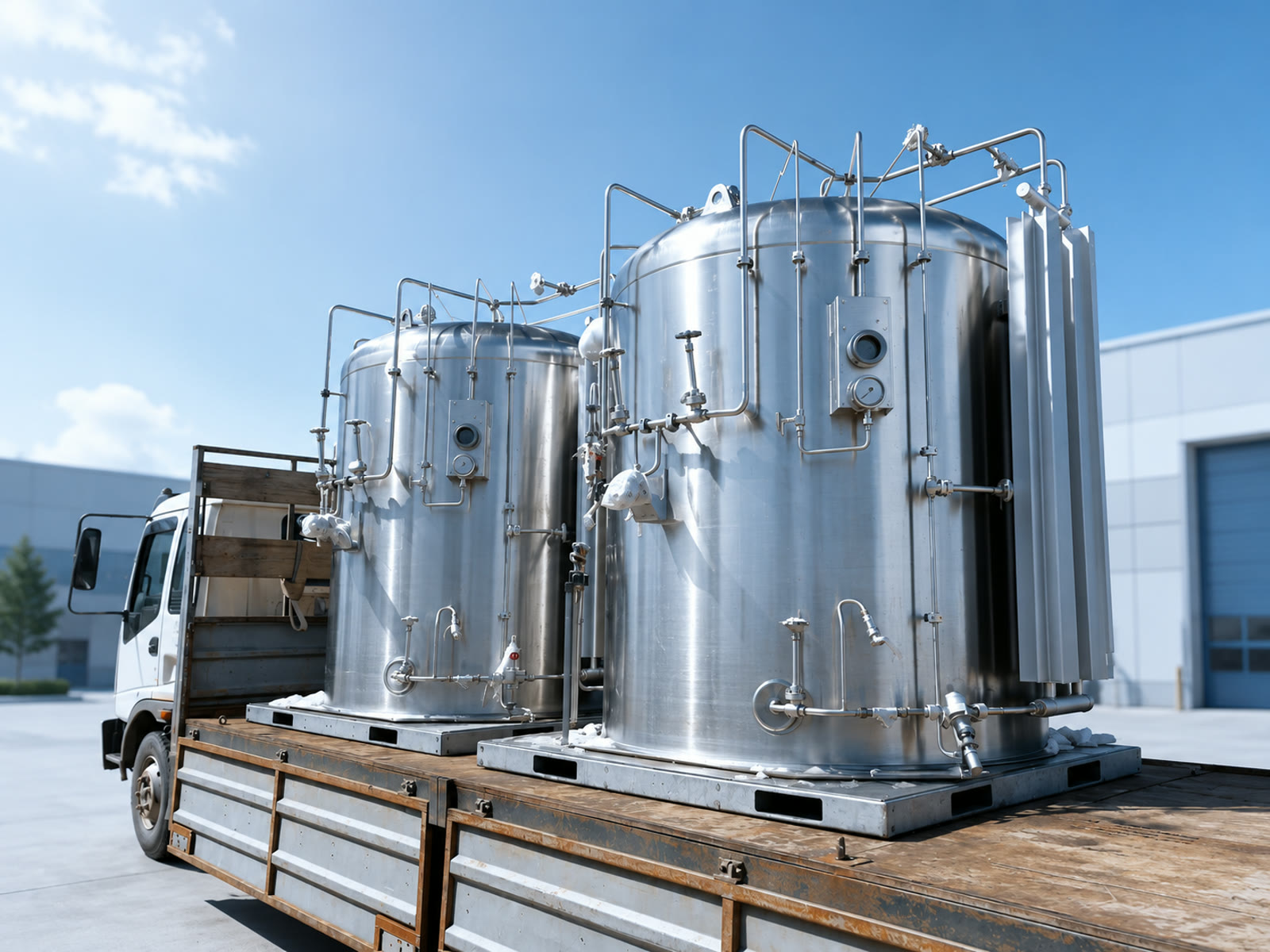
- Cryogenic storage tanks — vertical and horizontal vacuum-insulated vessels for LIN, LOX, LAR and LCO2 service, from compact site tanks to bulk storage;
- Cryogenic vaporizers — ambient-air units and skids that turn stored liquid into process gas at the required flow and pressure;
- Cryogenic liquid cylinders — palletized dewars for sites that need liquid supply without a fixed tank;
- Pressure vessels for compressed-gas buffering and process duty;
- Liquid CO2 equipment — storage tanks, pumps and supporting hardware for carbonation, inerting and dry ice production.
Layer one: PED conformity assessment and the CE marking
For market access, Germany applies the EU framework without national additions. Pressure equipment above the lowest category passes conformity assessment under PED 2014/68/EU, with a notified body involved to the degree the category requires, and leaves the factory CE-marked with an EU declaration of conformity. The assessment happens at the manufacturer, before shipment; a compliant CE-marked tank is not re-approved at the German border. How the directive classifies equipment and which modules apply is covered on our PED 2014/68/EU page, and the EU-wide picture — one conformity regime, many national operating regimes — on the Europe market page.
AD 2000: the German engineering expectation
PED states what pressure equipment must achieve; it leaves open which technical code demonstrates it. Harmonized European standards such as EN 13445 are one route to presuming conformity. The AD 2000 code — the AD 2000-Merkblätter maintained by the German pressure vessel associations — is another, and it is the route German industry grew up with. Formally the two stand equal under the directive. In practice, many German operators, their insurers and the inspection bodies that later examine the installation are used to AD 2000-based design documentation and may ask for it, or at least read it more fluently. This is an expectation of the market rather than an extra legal requirement, but it is worth settling at order stage: whether the design file for a German tank is built on EN 13445 or AD 2000 affects which factory is matched to the order and what the documentation package contains.
TPED: cylinders and bundles carry Pi, not CE
Transportable receptacles — high-pressure gas cylinders, cylinder bundles and, depending on service, cryogenic receptacles moved under transport rules — fall outside PED. They are assessed under the Transportable Pressure Equipment Directive 2010/35/EU and carry the Pi marking instead of CE. A German order that combines a stationary tank with cylinders therefore ships under two markings, each with its own certificate chain; the split is explained on our TPED page.
Layer two: BetrSichV, the ZÜS and the operator’s duties
The part of the German system that most often surprises importers is not conformity but operation. The Betriebssicherheitsverordnung (BetrSichV) — the Industrial Safety and Health Ordinance — governs how work equipment, including pressure installations, is installed, commissioned and inspected in service. For pressure installations in the higher categories, the inspections before commissioning and at intervals thereafter are carried out by a ZÜS (zugelassene Überwachungsstelle), an approved inspection body; the TÜV organizations are the familiar examples. Which inspections apply, when, and at what depth depends on the category and classification of the specific installation and is settled within the operator’s own assessment — we do not quote intervals here, because they attach to the installation, not to the product.
These duties sit with the operator of the equipment, not with the manufacturer and not with the supplier. What the manufacturer’s side owes the operator is documentation the German file can be built on: design and conformity records, and operating instructions the site can actually use. German-language operating instructions are the normal expectation for the operator’s file, and we arrange manufacturer documentation — including German-language manuals — to support it.
The importer’s position
When equipment moves from a Chinese factory to a German buyer, the buyer typically acts as the EU importer, with the duties EU law attaches to that role: verifying that conformity assessment was carried out and technical documentation drawn up, checking the CE or Pi marking and the instructions, placing the importer’s name and address on the equipment or its papers, and retaining the declaration of conformity for ten years. Where a notification, permit or registration step applies to a given installation under German rules, it is carried out by the operator or importer — or a German representative acting for them — in the destination; Cryofortune does not file on a buyer’s behalf, and arranges the manufacturer documentation those steps rely on.
Cryogenic storage services in Germany: renting a tank versus owning one
A large share of German searches for cryogenic storage are looking for a service: a gas company installs a tank at the customer’s site, keeps ownership of it, fills it under a liquid supply contract and charges rent. Cryofortune stands on the equipment side of that arrangement — we supply the tanks, vaporizers and cylinders that gas companies, plant builders and independent service providers operate, and we supply the same hardware to end users who prefer to own. For a buyer weighing the two paths, the economics deserve an honest run: a rented tank binds the site to one liquid supplier, while an owned, imported tank is paid for once and leaves gas supply open to competition. Over the life of the asset, ownership can beat rental economics by a wide margin — at the price of carrying the operator’s duties described above. Specifications and sizing are covered under cryogenic storage tanks, and the cost side in the storage tank price guide.
Selecting a factory for a German order
Not every factory in the network is a fit for Germany. A German order is matched to a manufacturer that holds valid PED certification under the appropriate module for the category being built, keeps its notified-body relationship in good standing, and can produce the design documentation the order requires — EN-based, or AD 2000-based where the buyer’s inspection environment expects it. Weld records, NDT reports and material traceability are checked during vetting, not assumed. How that matching works is described in how Cryofortune selects a manufacturer and in the guide to vetting Chinese equipment suppliers.
Documents that can accompany a German order
The typical documentation scope for a CE-marked cryogenic tank bound for Germany:
- EU declaration of conformity for the specific unit;
- CE marking on the nameplate, with the notified body number where the module requires it;
- Notified-body certificate references for the applicable conformity module;
- Material certificates to EN 10204 type 3.1 for main pressure-bearing parts;
- Weld documentation and NDT records;
- Pressure and leak test reports;
- Operating manual in German for the operator’s file.
This is the typical scope, not a promise attached to every product: the exact package follows the conformity route and category of the specific order and is confirmed before production.
Confirming a German configuration
A quotation for a cryogenic tank bound for Germany starts from five facts: the medium (oxygen, nitrogen, argon or CO2), the volume, the working pressure, the site — which federal state, since the inspecting environment is local — and whether the tank will be operator-owned or provided as part of a gas supply service. With those five, we match the order to a factory in the network, confirm the conformity route and the documentation package, and return a specification with pricing. Send them through the contact page.
Availability and applicability of any standard, certificate, marking or registration procedure are confirmed for the specific manufacturer, model and order before production.