A liquid nitrogen freezer runs at −196 °C. That is cold enough to take a fresh scallop from chilled to solidly frozen in a couple of minutes, before the flesh ever has a chance to form the coarse ice that ruins texture. Speed is the entire point of cryogenic freezing — and it is also why the process depends on one unglamorous thing: a steady supply of liquid nitrogen on site.
Cryofortune supplies that nitrogen side — the bulk storage tank, vaporizer, cryogenic cylinders and transfer hardware that feed the freezer. We do not build the freezer tunnels themselves; those are food-processing machines from specialist makers. What follows explains how cryogenic freezing works, why it consumes nitrogen the way it does, and how the supply behind it is sized.
A note on which freezer this article covers. Here, liquid nitrogen freezers are the industrial machines that freeze food product on a production line: immersion baths, tunnels and cabinets fed from a bulk LN2 tank. If instead you are looking for a liquid nitrogen freezer that holds biological samples at minus 190 degrees Celsius for storage, that is a different machine and it is covered in our guide to liquid nitrogen sample storage for labs and biobanks.
Why freeze food with liquid nitrogen
All freezing turns the water inside food into ice. What matters is how big the ice crystals grow. Slow mechanical freezing — a blast room at −30 °C or −40 °C — pulls heat out gradually, so water has time to form large crystals that puncture cell walls. On thawing, those ruptured cells leak: you get drip loss, a softened or mushy bite, and duller colour.
Liquid nitrogen removes heat so fast that the water freezes as a mass of tiny crystals instead of a few big ones. Cell structure stays largely intact, so the thawed product holds its texture, moisture and colour far closer to fresh. That quality gap is why premium seafood, soft berries, herbs, ready meals and other high-value proteins are frozen cryogenically rather than mechanically.
IQF: individually quick frozen
The other commercial draw is IQF, individually quick frozen. Because the surface of each piece freezes almost instantly, the pieces crust over before they can touch and fuse. Shrimp, berries, diced vegetables and meatballs come out of the freezer separate and free-flowing rather than welded into one solid block. The customer pours out a portion and reseals the bag instead of thawing the whole lot — a decisive selling point for retail and food service.
The three liquid nitrogen freezer formats: immersion, tunnel and cabinet
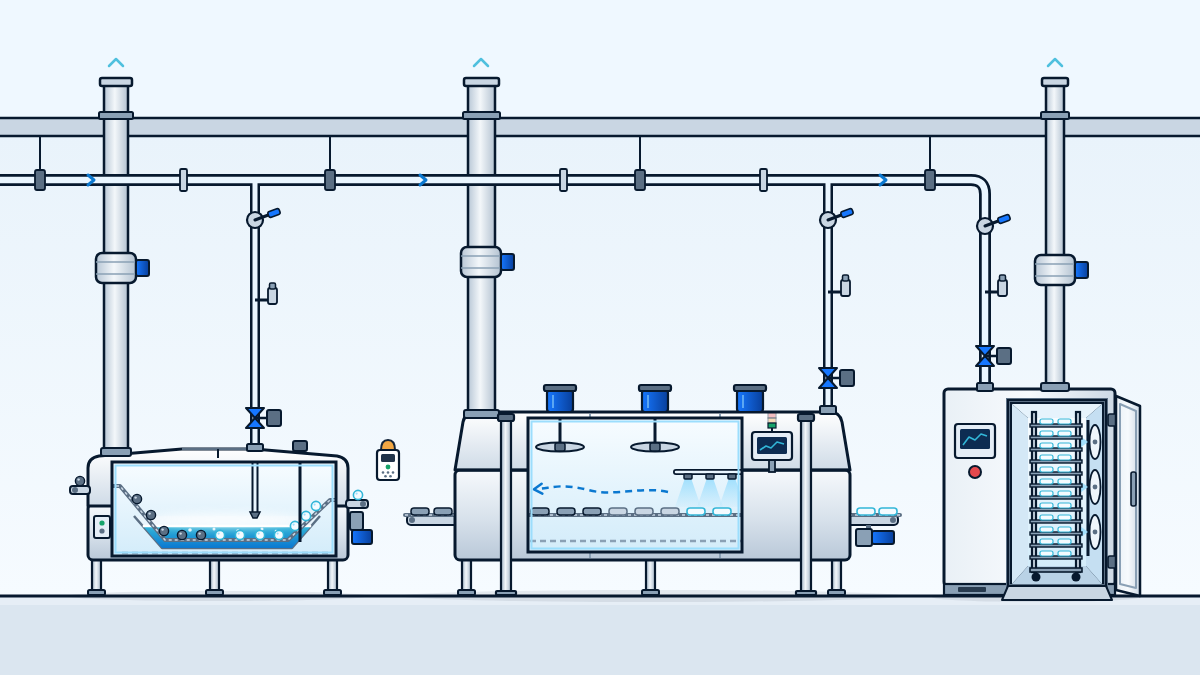
Cryogenic freezers are built by food-processing equipment makers, not by us, but it helps to know the formats because each one draws nitrogen differently:
- Immersion (dip) freezers plunge product straight into a bath of liquid nitrogen for an extremely fast crust — often a pre-freeze stage ahead of a tunnel.
- Spray/tunnel freezers carry product on a conveyor while liquid nitrogen is sprayed over it and the cold gas is drawn back along the belt. This is the workhorse for IQF lines.
- Cabinet (batch) freezers load trolleys or trays into an insulated cabinet where liquid nitrogen is sprayed and circulated by fans. They suit small batches, trials and seasonal peaks.
In every one of these, liquid nitrogen is sprayed or boiled onto the food and then vented away as gas. It is consumed, not recirculated. That single fact drives the whole supply design.
The consumption reality
Cryogenic freezing trades capital cost for nitrogen cost. A mechanical freezer is an expensive machine that then runs on cheap electricity. A cryogenic freezer is mechanically simpler, but you buy liquid nitrogen by the tonne for every shift it runs. Nitrogen is the real operating line item — which means the supply cannot be an afterthought of cylinders wheeled in by hand. A production line needs bulk liquid nitrogen stored on site and refilled by tanker.
Liquid nitrogen freezer formats compared
The three cryogenic formats and the mechanical blast freezer solve the same problem with a completely different cost shape, so the comparison below is the one buyers actually need before they ask for offers. Treat every figure as a typical range: real numbers depend on the product, its thickness, the entry temperature and the final core temperature you have to reach.
| Immersion | Tunnel | Cabinet or batch | Mechanical blast | |
|---|---|---|---|---|
| Typical throughput | 100 to 1,000 kg/h | 200 to 2,000 kg/h | 50 to 300 kg per batch | 500 kg/h and up |
| LN2 per kg of product | typically 1.0 to 1.8 kg | typically 0.9 to 1.5 kg | typically 1.2 to 2.0 kg | none, electricity instead |
| Freezing time | seconds to about 2 minutes | about 3 to 20 minutes | about 10 to 40 minutes | about 1.5 to 4 hours |
| Footprint | compact | long, roughly 6 to 15 m | small | large, a room or plant |
| Cost shape | low capex, high opex | low to medium capex, high opex | lowest capex, high opex | high capex, low opex |
| Best fit | crusting and surface set on delicate items, seafood | continuous IQF lines: berries, shrimp, patties, diced meat | small batches, seasonal peaks, trials and new products | steady high volume where the product tolerates slow freezing |
Two lines in that table decide most projects. The first is consumption: at roughly 0.9 to 2.0 kg of liquid nitrogen per kg of product (0.9 to 1.5 kg in a tunnel), the gas bill scales directly with tonnage, which is why cryogenic freezing wins on seasonal, high-value or delicate products and loses on commodity volume that runs every day of the year. The second is freezing time. Liquid nitrogen freezes in minutes rather than hours because the temperature difference is enormous, and that speed is what produces smaller ice crystals, less drip loss on thawing and genuine IQF separation rather than a frozen block.
A common answer is not one or the other. A cryogenic crusting unit at the head of a mechanical line sets the surface so pieces do not stick together, then the mechanical freezer takes the core down slowly at low running cost. That layout buys IQF quality at a fraction of the nitrogen consumption of full cryogenic freezing, and it is worth pricing alongside the single-technology options.
What Cryofortune supplies
We configure and source the nitrogen supply that sits behind the freezer:
- Bulk storage: a vertical or horizontal cryogenic storage tank sized to the plant’s per-shift nitrogen draw and topped up by tanker.
- Vaporizer: where gaseous nitrogen is also needed — for blanketing or modified-atmosphere work — a cryogenic vaporizer turns liquid into gas at a controlled flow.
- Cylinders: for small or pilot lines before a fixed tank is justified, cryogenic liquid cylinders bridge the gap.
- Atmosphere and MAP: where the process also needs a blended freezing or packaging atmosphere, see our gas mixing system and buffer tank and the wider liquid nitrogen equipment hub.
Sizing the supply
Sizing starts from the freezer, not the tank. Multiply the product throughput in kilograms per hour by the nitrogen-consumption figure in kilograms per kilogram of product to obtain hourly nitrogen consumption. Multiply by operating hours per day and convert kilograms to tonnes to obtain daily nitrogen tonnage. That number sizes the storage tank and sets how often a tanker has to call, with a reserve margin so a late delivery never stops the line. We size the supply once your freezer duty is known — not before, and never by guessing at the machine we do not sell.
Nitrogen safety is oxygen safety
Nitrogen already makes up most of the air, and it is not toxic — but that is exactly what makes it dangerous in bulk. It is colourless and odourless, so it gives no warning; concentrated, it is an asphyxiant that simply displaces the oxygen you breathe. Boiling liquid nitrogen expands roughly 1:700 into cold gas, and because it is cold it pools low and lingers in pits and floor-level spaces.
A freezer hall moving large nitrogen flows therefore needs mechanical ventilation, fixed oxygen-deficiency monitors with alarms, and interlocks that react to a falling oxygen level, plus cold-burn PPE — face shield and cryo gloves — for anyone handling liquid or hoses. Food-grade nitrogen, finally, is a property of the gas supply and the local food regulations, not of the tank: confirm the nitrogen specification with the supplier and against the destination market’s food rules.
Configuring the supply behind your line
Cryofortune configures the nitrogen supply chain behind a cryogenic freezing line — bulk tank, vaporizer, cylinders and piping — sourced from a network of vetted Chinese manufacturers and matched to the destination’s codes and documentation. We do not sell the freezer tunnels. Tell us your product throughput and the freezer maker’s nitrogen duty, and we will size and quote the supply that keeps it fed: contact us.
Availability and applicability of any standard, certificate, marking or registration procedure are confirmed for the specific manufacturer, model and order before production.
Liquid nitrogen freezers: common questions
What is a liquid nitrogen freezer?
A cryogenic freezer that sprays or immerses product in liquid nitrogen at −196 °C. It freezes far faster than a mechanical freezer and forms much smaller ice crystals, which protects texture. The common formats are immersion, tunnel and cabinet.
How is a nitrogen food freezer different from a mechanical freezer?
Speed. A nitrogen food freezer removes heat in seconds to minutes instead of hours, so ice crystals stay small and cell walls are not ruptured — the basis of true IQF quality.
How much liquid nitrogen does a freezer consume?
As a planning figure, typically 0.9–2.0 kg of liquid nitrogen per kg of product (tunnel 0.9–1.5 kg), depending on the format, entry temperature and target core temperature.
Do you supply liquid nitrogen freezers?
No. Cryofortune does not sell the freezers; we supply the bulk LN2 storage tank, vaporizer, cylinders and piping behind them, sized to the freezer maker’s nitrogen duty.
How does a liquid nitrogen freezer work?
Liquid nitrogen at minus 196 degrees Celsius is sprayed onto the product or the product is immersed in it. The nitrogen boils as it absorbs heat, and the cold gas is then circulated counter to the product flow so it gives up the rest of its cooling capacity before it is vented. Nothing is compressed and no refrigerant circuit is involved, so the machine is simple and the cold comes from the consumable.
How much liquid nitrogen does a food freezer use per kg?
Typically 0.9 to 2.0 kg of liquid nitrogen per kg of product, depending on the format, the product and how far down the core temperature has to go. Thin or small pieces in a well-tuned tunnel sit at the bottom of that range, thick pieces and batch cabinets at the top. Use the real figure from a trial run when sizing the bulk tank and the delivery schedule.