
Every plant that needs nitrogen eventually faces the same decision: install a nitrogen generator and make the gas on site, or buy liquid nitrogen and vaporize it on demand. Both models are mature, both are used by thousands of factories, and neither is universally cheaper. The right answer depends on purity, flow profile, power costs and how you expect demand to grow. This guide walks through the trade-offs honestly — including the cases where a generator is clearly the better buy.
The two supply models
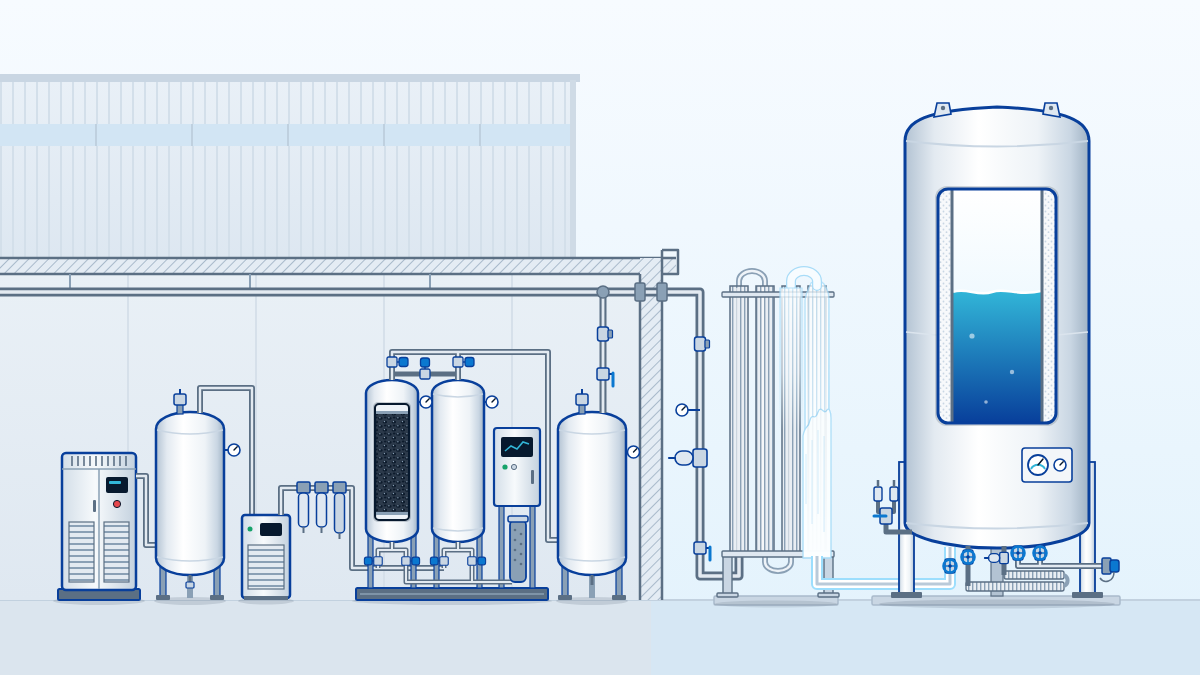
A nitrogen generator is a machine that separates nitrogen from compressed air, using either pressure swing adsorption (PSA) or membrane technology. You pay the capital cost up front, then feed the unit electricity, compressed air and scheduled maintenance for its working life. The gas is produced at your site, at the purity and flow the machine was sized for.
Liquid nitrogen supply works the other way round: a gas company delivers LN2 — nitrogen liquefied at about −196 °C — into a storage tank or cylinders at your site, and a vaporizer turns the liquid back into gas as you draw it. You pay per litre delivered, plus the cost of owning or renting the vessel. One litre of liquid holds roughly 0.68 m³ of gas at 15 °C — an expansion of about 1:680 — which is why a single tank can back a very large gas demand.
Purity: the first fork in the road
Generators typically deliver 95–99.5% nitrogen. Within that band they are efficient; pushing beyond it costs disproportionately more, because removing the last fractions of oxygen demands more adsorbent capacity, more compressed air and more energy per cubic metre. Liquid nitrogen, by contrast, is inherently high purity — typically 99.99%+ as delivered, a direct result of the cryogenic distillation that produced it.
That difference decides many cases on its own. Modified atmosphere packaging (MAP) for food is often satisfied at 99%+, so a generator is a legitimate candidate there — check your specification rather than assume. Laser cutting is the opposite: 99.99%+ is commonly specified to avoid edge oxidation, and reaching that level on site erodes most of a generator’s advantage. Laboratories, electronics and pharmaceutical duties also tend to sit at the high-purity end, where delivered liquid is the natural fit.
Flow profile: continuous output vs peaks
A generator is sized to a continuous output. If your demand is flat — keeping a storage tank blanketed around the clock, feeding a steady process line — that is exactly what the machine is built for. If demand spikes, you must either oversize the generator or add buffer storage, and both cost money that sits idle between peaks.
Liquid supply is indifferent to peaks. The stored liquid is the buffer, and the vaporizer is simply sized to the maximum instantaneous flow — our vaporizer sizing guide shows how. A tank that covers a modest average demand can serve a peak many times higher without any change to the supply contract.
One case is not a trade-off at all. If your process uses nitrogen as a liquid — food freezing, rapid cooling, cryopreservation of biological samples — a generator cannot serve it. Generators make gas, full stop. Cryogenic applications require delivered liquid.
The shape of the economics
We deliberately avoid quoting prices here, because they vary too much by country, power tariff and gas market for any general figure to be honest. What stays stable is the shape of each cost curve.
On-site generation is capital plus operating cost: the machine, the compressed air system behind it, electricity for every cubic metre produced, and maintenance. The more hours it runs near its design point, the cheaper each cubic metre becomes. If you need a steady, modest flow at 95–99% purity and your power is cheap and reliable, a generator is often the better buy — no honest liquid supplier should pretend otherwise.
Liquid supply is almost entirely operating cost: a per-litre price, tank rental or purchase, and evaporation losses. Every vacuum-insulated tank absorbs a little heat and boils off a small fraction of its contents each day — the mechanism is covered in our article on vacuum insulation and evaporation rate. Boil-off matters most when turnover is slow; a tank that is emptied and refilled frequently loses very little.
The break-even point depends on your volume, your electricity price and reliability, and the purity you actually need. A site with high-purity requirements, spiky demand or expensive power will usually land on liquid. There is no universal crossover figure, and any article that quotes one is guessing.
Hybrid setups and growth paths
The choice is not binary. Many plants run a generator for base load and keep liquid nitrogen as backup for peaks and outages — a small tank and vaporizer cost far less than the production stoppages they prevent. Others grow along the liquid route itself: starting with liquid cylinders, moving to a microbulk tank when cylinder handling becomes a burden, then to a full bulk storage tank when volumes justify it. Each step reuses the same vaporization principle at a larger scale.
Decision checklist
- Purity: what does your process specification actually require — 97%, 99.5% or 99.99%+?
- Phase: do you need gas only, or liquid for freezing, cooling or cryopreservation?
- Flow profile: how far apart are your peak and average demand?
- Power: is electricity at your site cheap and reliable enough to run a generator economically?
- Space: room for a compressor and generator, or for a tank with tanker access?
- Growth: will demand double? A tank scales by refilling more often; a generator scales by buying another generator.
Where Cryofortune fits
Cryofortune Engineer & Supply works on the liquid side of this decision. We are not a factory and we do not sell nitrogen generators; we configure the storage-to-gas chain — tanks, cylinders, microbulk vessels, vaporizers — from a network of vetted Chinese manufacturers, selecting the factory per destination country, design standard and documentation package. If your analysis points to liquid supply, or to a hybrid with liquid backup, use our conversion tables to translate gas demand into litres and tank size, then contact us with your flow figures — we will propose a configuration, and tell you plainly if a generator suits your case better.
Availability and applicability of any standard, certificate, marking or registration procedure are confirmed for the specific manufacturer, model and order before production.
Generator vs bulk liquid: common questions
What purity does a nitrogen generator deliver?
PSA units are economic at 95–99.5%; each additional nine raises energy cost sharply. Bulk liquid nitrogen is 99.999% as produced, which is why high-purity applications usually favor liquid supply.
Can a nitrogen generator replace liquid nitrogen for freezing?
No — freezing, cryotherapy and biobanking consume liquid nitrogen itself. Generators produce gas; adding liquefaction changes the economics entirely. Liquid-phase demand means bulk supply.
At what volume does a generator start to pay?
As a rule of thumb, above roughly 20–50 Nm³/h of flat, continuous gaseous demand at moderate purity. Peaky profiles and high purity push the threshold higher.
Why do plants with generators still keep a bulk tank?
Backup for outages and maintenance, peak coverage, and any liquid demand. The tank lets the generator be sized for average load instead of worst case.