When a vertical cryogenic storage tank is ordered, the vessel itself is rarely what delays first fill. Fabrication and sea freight follow reasonably predictable schedules; what slips is the site. A concrete pad poured too late, a crane that cannot reach it, a separation distance nobody verified, a registration file still sitting with the local authority — any one of these can leave a finished tank lying horizontal in a yard for weeks while production waits.
This guide covers what a buyer should have ready before the tank arrives. It is written around the vertical cryogenic storage tanks Cryofortune supplies — vessels from 7,990 to 25,000 litres gross at working pressures from 0.8 to 2.2 MPa, serving liquid nitrogen, oxygen and argon, with CO2 covered elsewhere in the storage tank range. One point of framing first: Cryofortune is an international sourcing and engineering supplier, not a factory. Tanks are sourced from a vetted network of manufacturers in China, and the factory selected for the order issues the general-arrangement and foundation drawings your civil engineer will build from. Site preparation should always follow those order-specific drawings; this article tells you what to expect in them.
Foundation and load: design for the full tank, not the empty one
The number that catches first-time buyers is the gap between shipping weight and operating weight. The largest vertical tank in the range, a 25,000 L unit, weighs just under 10 tonnes empty. Liquid oxygen is denser than water, so a full charge adds roughly 28 tonnes of liquid on top of that — the operating load is close to four times what the crane lifted off the truck, and liquid argon is heavier still. The foundation must be designed for the full condition, plus wind loading on a tall cylinder and seismic loads where the destination requires them.
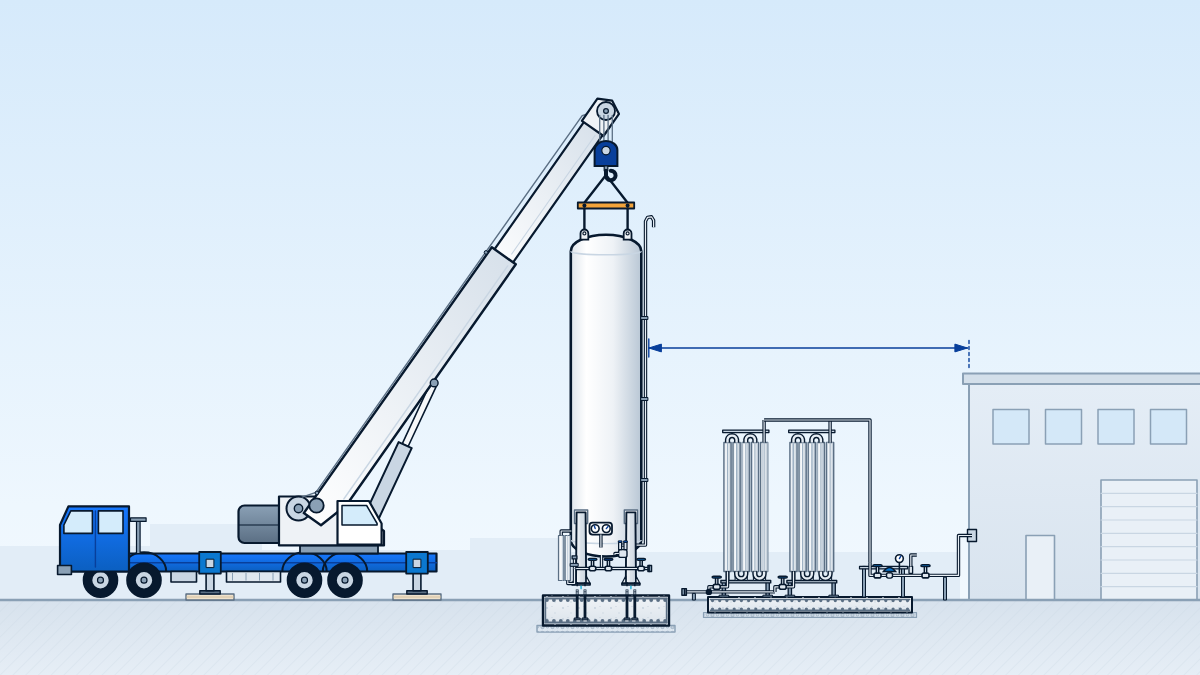
In typical practice that means a reinforced concrete pad on soil of verified bearing capacity, detailed to the factory’s foundation drawing, with anchor bolts cast in to the supplied template. Geometry matters as much as mass: the 25,000 L tank stands about 11.7 m tall on a footprint of roughly 2.5 m square, so overturning moment — not just vertical load — drives the anchor design. The pad should be flat and level to the tolerance on the drawing, and the concrete needs to reach strength before the lift; commonly 28 days of curing are allowed. Where soil bearing is uncertain, commission the geotechnical survey early — it is often the longest-lead site item.
Clearances and siting: check the distances before you pour
Cryogenic tanks are subject to separation distances — from occupied buildings, building openings, ignition sources, flammable stores, vehicle routes and property lines. These are regulated locally: national fire and pressure-equipment codes set typical separations, the distances grow with stored volume, and oxygen is treated more strictly than inert gases. Rules genuinely differ by country, which is why the layout should be confirmed for the specific destination before concrete is poured; the country-by-country equipment pages outline how requirements diverge between markets.
Beyond the coded distances, apply cold-gas common sense. Do not site the tank beneath overhead power lines or building eaves. Keep it away from pits, basements and drains where cold, oxygen-displacing vapour from nitrogen, argon or CO2 could pool. Leave working room on all sides for maintenance access, and think about where relief valves and vent lines discharge — never toward air intakes, windows or walkways.
Access: one crane day, then years of tanker deliveries
The tank arrives horizontal on a flatbed or transport frame. For the largest variants that is a load nearly 12 m long and up to about 10 tonnes, so delivery needs a mobile crane sized for the weight at the required reach, firm standing for its outriggers, and clear overhead space to upend the vessel onto the pad. Smaller units are easier — the 8,000 L tank weighs under 4 tonnes and stands about 5.1 m — but the access survey is the same: gate widths, turning radii, ground bearing along the route, obstructions overhead.
The crane comes once; the road tanker comes for the life of the installation. Plan a route a full-size semitrailer can drive, ideally without reversing blind or crossing public footways, with the parking position close to the tank’s fill point — transfer hoses are finite, and a fill connection the driver cannot reach comfortably becomes a permanent operational irritation.
Utilities: less than you might expect
A static cryogenic tank with ambient vaporizers is a remarkably self-sufficient installation. Ambient units warm the liquid with air alone — no power, no water. The tank’s standard accessory set of valves, gauges, fittings and relief devices works mechanically. Electrical supply becomes relevant only for options: telemetry for remote level monitoring, electrically heated vaporization where climate or duty demands it, and lighting for night deliveries. Confirm which options the order includes before trenching cable.
Liquid cylinders are different. A battery-powered telemetry module such as CryoFor TM2 reports through the site’s 2.4 GHz Wi-Fi router, so what it needs at the vessel is Wi-Fi coverage, not a power cable. See remote level and pressure monitoring for liquid cylinders.
The vaporizer and everything downstream
The tank stores liquid; the process needs gas. Between them sits a vaporizer bank, and its pad space, pipe run and switchover arrangement should be planned together with the tank foundation, not afterwards. Sizing is driven by peak flow rather than average demand, and by climate — ambient units lose capacity as frost builds — which is covered in detail in the cryogenic vaporizer sizing guide. Reserve room for the vaporizer bank plus a standby leg in humid climates, then the pressure-regulation skid, then the pipeline into the building.
Oxygen service: the extra rules
Liquid oxygen changes the site rules. Oxygen-wetted equipment leaves the factory cleaned for oxygen service, and the site must not undo that: no oil, no grease, no hydrocarbon contamination near the fill point, piping or fittings, and only oxygen-compatible lubricants and sealants during hookup. In typical practice the ground beneath the tank and the tanker stand is concrete rather than asphalt, because an oxygen-enriched atmosphere over a combustible surface is a genuine ignition hazard. The area becomes a no-smoking, no-hot-work zone, kept clear of parked vehicles and stored combustibles, with good natural ventilation so vented oxygen disperses. These practices, and the equipment they apply to, are covered further on the liquid oxygen equipment page.
Paperwork: who does what
Responsibility splits cleanly. Statutory steps at the destination — siting and planning approvals, fire-authority consent where required, registration of the vessel as pressure equipment, in-service inspection arrangements and operator training — rest with the buyer or site owner, because they attach to the site and the operating company, not to the supplier. These rules differ widely by country and are confirmed per order.
On the supply side, Cryofortune aligns the documentation package before production: the factory selected for the order provides the manufacturer’s data book — drawings, material certificates, test reports and the certificates agreed for the destination market. No tank is “pre-certified everywhere”; certificates belong to a specific factory, production site, model and order, which is why the design code and paperwork are fixed at contract stage. The standards overview explains how the common frameworks relate. Sort this before production starts, not when the vessel is at customs.
Commissioning day: a short checklist
When the tank is vertical and bolted down, first fill and commissioning typically run through a sequence like this:
- Pad cured to strength, level within drawing tolerance, anchor bolts torqued to the foundation drawing.
- Clearances re-verified against the approved site layout and local consents.
- Piping to the vaporizer complete, pressure-tested and — for oxygen — verified clean and grease-free.
- Relief devices and gauges checked against the manufacturer’s documentation.
- Lines purged and dried with nitrogen before any cryogenic liquid is introduced, as is typical practice.
- First-fill tanker booked with extra product allowed for cool-down — a warm inner vessel boils off far more than routine top-ups will.
- Operators briefed on venting behaviour, pressure building and emergency shutdown; the documentation pack kept on site.
The pattern across all of this: the tank is the predictable part, and the site is where schedules are won or lost. If you are planning an installation, send Cryofortune the gas, the daily and peak demand, and the destination country through the contact page — you will receive a proposed tank and vaporizer configuration with candidate factory options from the vetted manufacturing network, matched to your destination’s documentation requirements. Availability and applicability of any standard, certificate, marking or registration procedure are confirmed for the specific manufacturer, model and order before production.
Commissioning is where the vessel’s service life begins, not ends: the ongoing discipline — boil-off trends, relief devices, vacuum care — is covered in our guide to cryogenic storage vessel repair, refurbishment and maintenance.