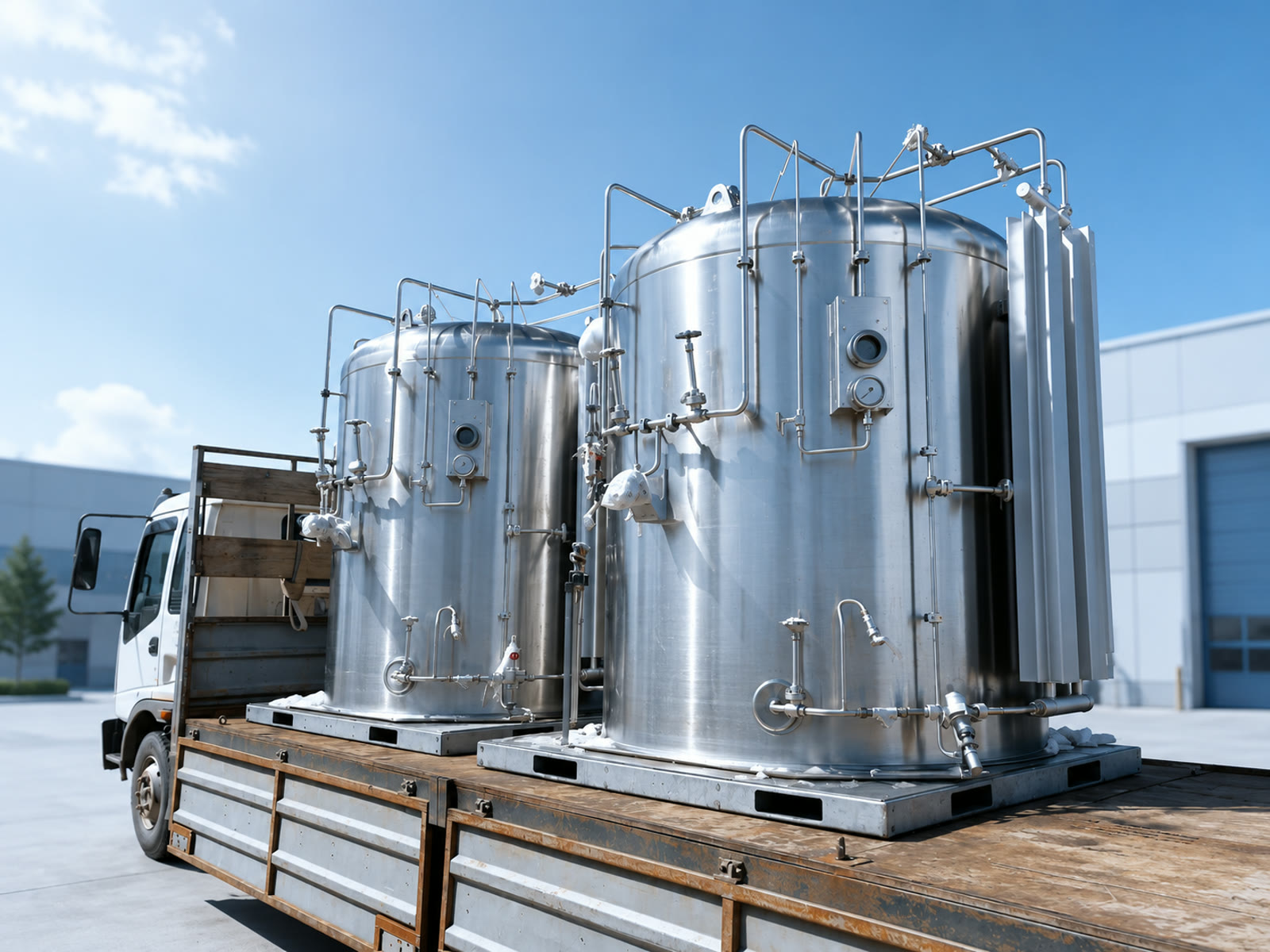
A cryogenic liquid cylinder is a vacuum-insulated vessel that stores liquefied gas and maintains its own working pressure. A pressure-building circuit vaporizes a small fraction of the stored liquid to keep head pressure at the set level. Product can therefore be withdrawn as liquid for transfer, or as gas through the built-in gasification circuit. This self-contained behavior places liquid cylinders between open dewars and fixed bulk vessels in most gas supply chains.
Cryofortune supplies liquid cylinders from a network of Chinese manufacturers rather than from a single factory. The manufacturer is selected per order against the destination country, the applicable design standard and the required documentation.
Vertical cryogenic cylinders: the default format
The Vertical Cryogenic Cylinder covers most stationary duties. The range spans 21 configuration variants from 50 to 500 L gross volume, with working pressures from 1.37 to 2.88 MPa. Each model carries its own gasification rate, which sets the continuous gas flow the internal circuit can support. Configurations are available for liquid nitrogen, liquid oxygen, liquid argon and CO2 service.
Horizontal cryogenic cylinders: where headroom is limited
The Horizontal Cryogenic Cylinder 500 L places the same vacuum insulation in a low envelope of 2100 × 820 × 1010 mm. Gross volume is 499 L, of which 474 L is usable, with working pressures from 1.59 to 3.45 MPa. Fill capacity is 541 kg of liquid oxygen, 383 kg of liquid nitrogen or 660 kg of liquid argon. Net weight runs from 353 to 485 kg depending on the variant. The format suits rooms and enclosures where a vertical shell of equivalent volume cannot be placed.
Liquid nitrogen dewars and the YDZ-50: laboratory and biological duty
Not every nitrogen duty calls for a pressurized cylinder. The Liquid Nitrogen Dewar Vessel range covers open-neck vacuum flasks from 3 to 100 L, with neck diameters from 50 to 210 mm. These are non-pressurized vessels for storage, transport and decanting in laboratories, clinics and field work. The YDZ-50 Liquid Nitrogen Container adds controlled dispensing at low pressure: 0.05 MPa working, 0.09 MPa maximum. It holds 50 L, weighs 46 kg empty and shows a static evaporation rate of 2.2% per day, about 1.10 L. Neck formats, sizing and handling practice are covered in the liquid nitrogen dewar buyer’s guide; the wider LN2 line is mapped on the liquid nitrogen equipment page.
How to select a cryogenic liquid cylinder: four figures
Most liquid-cylinder selections reduce to four parameters, read together against the duty.
- Capacity. Size the vessel to consumption between refills, with an allowance for standing losses on low-draw duties.
- Working pressure. Match the rating to downstream equipment; the catalogue spans 1.37 MPa (vertical) to 3.45 MPa (horizontal).
- Evaporation. Static evaporation sets the loss rate while the vessel stands idle, so compare it against the planned refill interval.
- Gas withdrawal rate. Each vertical model lists a gasification rate; sustained draw above it points to an external cryogenic vaporizer.
The stored medium also shapes the choice; working differences between LN2, LOX, LAr and CO2 service are summarized in cryogenic equipment by gas. Where refill frequency becomes the constraint rather than the cylinder itself, review microbulk tanks and the comparison in microbulk vs cylinders. Larger fixed reserves move into cryogenic storage tanks.
Cryogenic cylinder filling and refilling
Liquid cylinders are refilled by liquid transfer from bulk storage. The Cryogenic Cylinder Filling Pump family handles transfer and filling at 800 to 1,000 L/h, from inlet pressures of 0.3 to 0.8 MPa. The same skids fill high-pressure gas cylinders at discharge pressures of 16 to 25 MPa. Station-level scope, from storage through pumping and vaporization, is mapped on the gas filling systems page.
Remote level and pressure. A liquid cylinder can be fitted with a CryoFor TM2 module, which takes the place of the stock electronic level gauge and reads the vessel’s own capacitive level probe. TM2 reports the level on a set schedule through the site’s 2.4 GHz Wi-Fi router, and the pressure once a separate pressure sensor is fitted, to the CryoFor Telemetry platform for history, run-out forecasts and alerts, so refills can be planned before a cylinder runs low. Compatibility is checked per project: TM2 needs a capacitive probe within 120–500 pF across the fill range, and the probe, pressure sensor and mounting hardware are not part of the kit. See liquid cylinder telemetry and replacing the level gauge on cylinders already in service.
Transport and standards
Where liquid cylinders are transported between the filling point and the user, transportable pressure receptacle regimes differ by jurisdiction, and design, marking and periodic-test requirements may apply depending on the destination. The applicable regime is confirmed per destination; the main frameworks are mapped in the standards hub. Export paperwork practice is described in cryogenic equipment export certification, and destination notes are collected on country pages such as Australia and New Zealand.
Requesting supply
Because the factory is selected per order, a liquid-cylinder enquiry starts from the duty rather than from a model number. Configurations and documentation are confirmed for the specific manufacturer, model and order before production. Send a rough duty description — gas, capacity between refills, withdrawal pressure and gas draw, and the destination country — and we will return candidate configurations from the network.