No single certificate admits a pressure vessel to the United States — each state decides at installation. Cryofortune Engineer & Supply Co., Ltd. builds US orders around that fact, selecting the Chinese factory per order against the code stamp, registration capability and documentation the destination state expects.
That structure has no parallel in Europe or Australia: no single federal approval, and no conformity check at the border. Pressure-vessel law is written state by state — and a few states have none at all. This page follows the order a US purchase actually runs in: the equipment, the code, the authorities, the documents, and what remains on the buyer’s side.
Cryogenic tanks, cylinders and vaporizers supplied to the US market
The scope covers static storage, transportable vessels and the process equipment around them. Typical configurations for US media — liquid nitrogen, oxygen, argon, carbon dioxide and LNG — include:
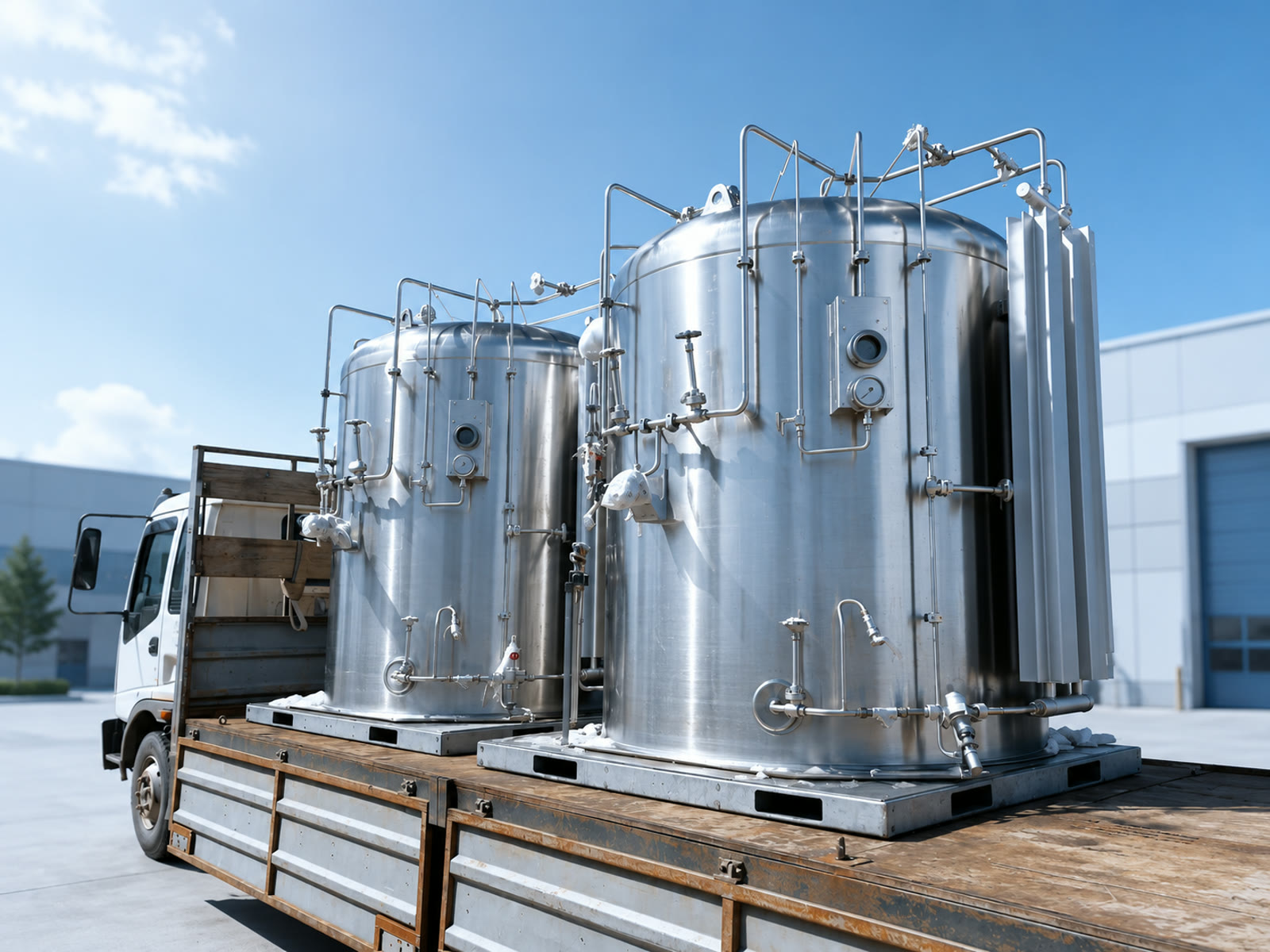
- vertical cryogenic storage tanks for bulk nitrogen, oxygen, argon and CO2 at gas distributors, food plants and breweries;
- microbulk-class vertical and horizontal cryogenic cylinders for laboratories, biotech facilities and fabrication shops;
- ambient vaporizers and cylinder filling pumps for fill-plant and station duty;
- 20 ft tank containers and cryogenic ISO tanks for merchant liquid logistics;
- liquid nitrogen dewars, high-pressure gas cylinders and dry ice pelletizers for smaller duties.
The ownership question has a compliance edge in the US — an owned vessel puts the paperwork on the importer, not the gas company. The trade-off itself is covered in our microbulk note.
One ASME code, fifty state pressure-vessel laws
The design standard is national; the law is not. For US code-state service, inner vessels are built to ASME Section VIII — typically Division 1 — under a Certificate of Authorization held by the manufacturer. A code-built vessel carries the ASME U Certification Mark on its nameplate. Foreign factories can hold U certificates on the same terms as domestic shops, working under a contracted Authorized Inspection Agency.
Registration is a separate step from marking. Most states also expect the vessel registered with the National Board: an NB number on the nameplate, and a Manufacturer’s Data Report filed centrally. The design standard, the mark, the registration and the in-service inspection are four different things, held by four different parties.
Adoption then varies by state. Most states legislate ASME construction for pressure vessels; a minority, often called non-code states, have no stamping law. Insurers and major gas users generally expect ASME and National Board construction there regardless. The installed state is therefore checked first, before capacity or price.
State inspectors, fire marshals and OSHA: who a US buyer answers to
Conformity in the United States is enforced by people, at the site. Three offices matter for a bulk installation:
- The state pressure-vessel program. Code states may require an installation permit or notification, then an operating certificate issued after inspection. The inspector can be a state deputy, an insurance-company inspection agency, or an approved owner-user program.
- The fire marshal or local AHJ. Siting follows NFPA 55 and the locally adopted fire code; operational permits can apply above modest thresholds, particularly for liquid oxygen. Separation distances are read from the code tables, not assumed.
- OSHA. OSHA writes almost no vessel-design rules of its own — bulk oxygen storage above 15 psig under 29 CFR 1910.104 is the notable exception, mandating ASME Section VIII construction directly. Elsewhere it holds the employer to recognized practice, with ASME construction and CGA pamphlets as the benchmark.
In seismic states, tank supports and anchorage may need design to the building code’s nonbuilding-structure provisions. Anchor calculations are a site-engineering task, planned with the foundation, not after delivery.
DOT cylinders under 49 CFR: the federal exception
Transport equipment is the one federally gated category. Cryogenic cylinders offered for transport must meet DOT specifications under 49 CFR, with their own filling and orientation rules. A foreign manufacturer of DOT-specification cylinders needs a PHMSA approval, and production is certified by an approved independent inspection agency.
The two tracks do not mix. A stationary tank answers to the state; a transport cylinder answers to federal rules before it reaches the port. The same federal logic applies to tank containers: cryogenic ISO tanks in US transport service run as UN T75 portable tanks under 49 CFR, with their own design approval and periodic inspection requirements — a position confirmed per order in the same way. Orders that combine tracks may be split across factories holding the respective approvals.
Customs clearance is not code acceptance
US customs verifies classification and duty; it does not verify code conformity for stationary vessels. There is no CE-style border gate. A non-code tank can clear the port and still be refused an operating certificate at installation. This is why the documentation file is assembled at the factory, not repaired at destination.
Duty and any additional tariff measures on Chinese-origin equipment depend on the HTS classification of the specific item. Landed cost is calculated line by line at quotation, against the classification actually applied — background on pricing structure is in the storage tank price guide and the ISO tank container guide.
Selecting an ASME-certified factory in China
One factory rarely holds every approval. Selection for a US order screens the network against:
- a current ASME Certificate of Authorization covering the vessel type and size range;
- a working Authorized Inspection Agency arrangement, so shop inspection is in place before steel is cut;
- National Board registration practice — data reports filed, NB numbers applied correctly;
- PHMSA approval and inspection-agency coverage, where DOT cylinders are in scope;
- oxygen-cleaning capability and an export record into North America.
The vetting method is described in our note on vetting Chinese suppliers. Certificates are verified against the issuing bodies, not taken from a brochure.
U-1A data reports and documents that travel with the vessel
Depending on the manufacturer and configuration, the shipment can carry:
- the Manufacturer’s Data Report (Form U-1 or U-1A), matching the nameplate serial and NB number;
- National Board registration confirmation;
- material certificates, weld and NDE records, and pressure-test reports;
- cleaning-for-oxygen-service certification, where the medium requires it;
- relief-device documentation, capacity tables and operating manuals in English.
Document scope is fixed per order. What the state program typically asks to see is established before production, not after arrival — the general export set is outlined in our export certification overview.
Permits and inspections on the buyer’s side
Some steps belong to the importer or site owner, and Cryofor does not perform statutory acts in the United States. Depending on the state and the site, the buyer’s list may include:
- installation permit or notification to the state pressure-vessel program;
- a fire-code operational permit for the stored fluid, where thresholds are met;
- the first in-service inspection and the operating certificate;
- seismic anchorage design and foundation sign-off, where the building code requires it;
- ongoing inspection and any repair work through appropriately certified shops.
We prepare the equipment and the file those steps rely on. The steps themselves stay with the buyer and the local authority.
Confirm before production
The availability and applicability of any standard, certificate, marking, or registration procedure are confirmed for the specific manufacturer, model, and order before production.
A US inquiry needs five data points before a factory is named: installation state, medium, capacity, working pressure and intended service. With those in hand, the configuration comes back with the code and documentation position stated per item. Pages for Australia and New Zealand show how the same network answers different regimes; the standards index collects the design codes; equipment bound for Canada follows CRN registration instead, evaluated per order.
Choosing a supplier for the USA: the ASME checklist
For the United States the baseline is ASME Section VIII with the U Stamp, plus National Board registration of the vessel — the combination most state jurisdictions require before a pressure vessel goes into service, with siting of bulk gas systems governed by NFPA 55 and state rules varying in detail. Sourcing outside the USA changes nothing about this: what matters is that the manufacturer holds a current ASME certificate, stamps the vessel, and registers it with the National Board. Before ordering, confirm the ASME certificate scope, NB registration, and the document pack: the manufacturer data report (U-1), material certificates, weld qualifications, NDE and pressure-test records.
Common questions
Is the ASME U Stamp mandatory for cryogenic tanks in the USA?
In most state jurisdictions, yes — pressure vessels put into service require ASME Section VIII construction with the U Stamp, and typically National Board registration as well.
Can a Chinese factory supply a U-Stamped vessel?
Yes. ASME certification is held by shops worldwide, including audited manufacturers in China. The certificate, the stamp and the National Board registration are what count, not the factory address.
What is National Board registration?
Registration of the manufacturer data report with the National Board of Boiler and Pressure Vessel Inspectors, giving the vessel an NB number that state inspectors use. Most jurisdictions expect it alongside the U Stamp.