Search “cryotherapy” and the picture is always the same: a person wrapped in a swirl of white fog, only their head showing above a sleek cabin, bathed in what looks like winter air. What the photo never shows is the part that matters most to whoever runs the room — the invisible, odourless gas settling silently across the floor. For a large share of these machines that fog is boiling liquid nitrogen, and the cold you can see matters far less than the nitrogen you cannot.
Cryofortune does not sell cryotherapy cabins, and we make no claims about what the therapy does or does not do. What we supply is the liquid-nitrogen side of the installation — the vessels that store, move and feed the LN2 a nitrogen-cooled cabin consumes. This article is for the operators and distributors who have to source that supply safely, not for patients.
Two kinds of “cold” — and only one needs nitrogen
Whole-body cold treatment splits into two very different families of hardware, and confusing them is the first and most expensive mistake an operator can make.
- Nitrogen-cooled single-person cabins, often called a “cryosauna” or cryo-cabin. Liquid nitrogen chills the air and vapour inside an open-topped cabin around the person, who stands with the head above the rim, breathing room air. The cabin is open to atmosphere; the nitrogen is the coolant. These need a reliable LN2 supply.
- Electric refrigerated chambers, walk-in rooms cooled by conventional refrigeration that use no nitrogen at all. If an operator runs one of these, there is no LN2 to source and the supply side of this article does not apply.
That distinction decides everything downstream — whether you need a gas supply, a refill contract, ventilation and an oxygen alarm, or none of it. Everything below concerns the nitrogen-cooled type.
How the nitrogen is actually used
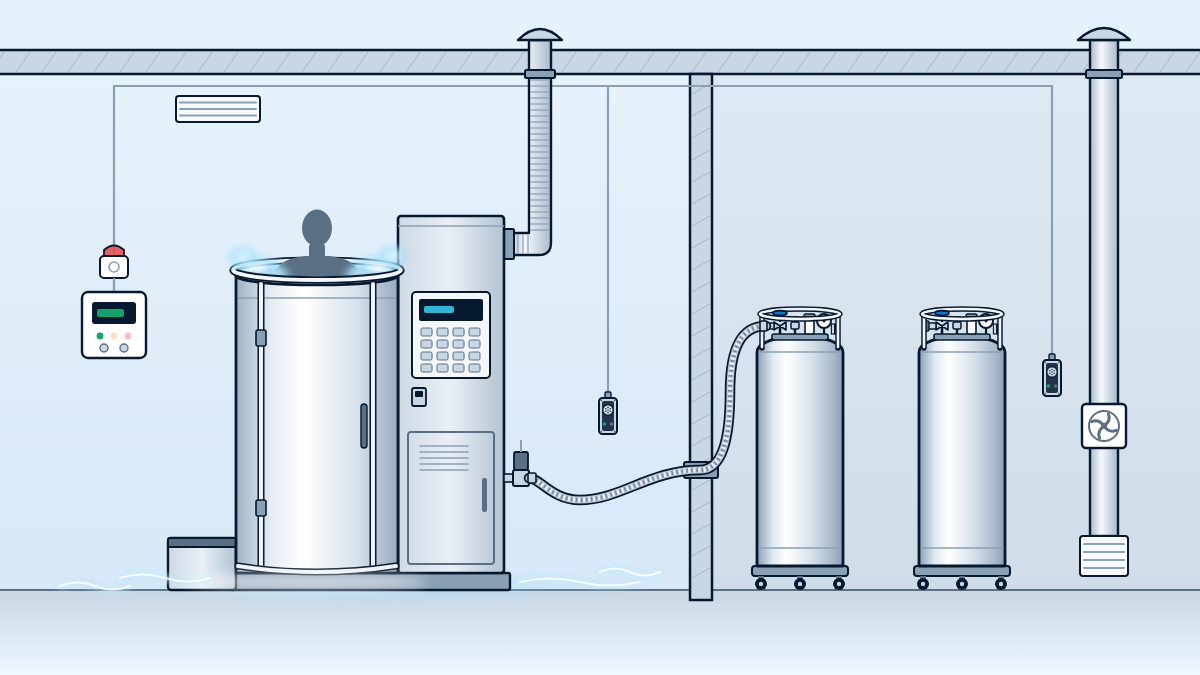
A nitrogen-cooled cabin draws liquid nitrogen from a pressurised supply vessel. Inside the unit the LN2 boils off, and that boil-off is what produces the cold nitrogen vapour that fills the cabin. The nitrogen is not recycled: it is vented to atmosphere after each session and consumed. Every session burns a measurable quantity of liquid, so a busy studio running back-to-back appointments goes through LN2 steadily, all day. Consumed, not recycled — that is why the supply chain, not the cabin, is the operator’s real ongoing commitment. Run out of nitrogen and the cabin is furniture.
The supply ladder: from one studio to a chain
The right LN2 setup scales with throughput. Cryofortune configures it as a ladder, from a single treatment room to a multi-site operator.
- Receive and move the liquid. A liquid nitrogen dewar is the open-neck vessel used to take delivery of LN2 and move it around the premises — the basic handling tool on site.
- Feed the cabin. A self-pressurizing vertical cryogenic cylinder is the working supply: a vacuum-insulated vessel that builds its own low pressure and feeds the cabin steadily. Where layout favours it, a horizontal cryogenic cylinder does the same job.
- Scale to a chain. Multi-site or high-volume operators step up to a small cryogenic storage tank refilled by tanker, cutting refill frequency and cost per litre. If gaseous nitrogen is also needed on site, a cryogenic vaporizer converts liquid to gas at the required flow.
All of these sit under our liquid nitrogen equipment hub, so the vessels can be matched as a set rather than bought piecemeal.
The part that has cost lives: nitrogen safety
This is the most important section here, because this industry has had real fatalities and every one of them traces back to the same physics. Nitrogen is colourless, odourless and non-toxic — it already makes up most of the air you breathe. That is exactly what makes it dangerous: it is an asphyxiant that gives no warning. It does not smell, it does not irritate, and it displaces the oxygen you need without you noticing.
Two properties make a cryotherapy room a specific hazard. First, liquid nitrogen expands roughly 1:700 as it boils, so a small spill or a normal session releases a large volume of gas. Second, that cold nitrogen gas is initially denser than room air, so it does not rise and disperse — it pools low, at floor level, in exactly the small treatment room where the cabin sits and exactly around the lower body the cabin surrounds. The oxygen-poor layer builds from the floor up.
The whole industry runs on two hard rules that follow directly from this:
- The head stays above the rim. In a nitrogen-cooled cabin the person’s head must remain above the cabin edge, breathing room air, never down inside the nitrogen atmosphere. This is non-negotiable — it is the single rule separating a cryosauna from a sealed trap.
- The room must be monitored. The space needs genuine ventilation and a fixed oxygen-deficiency monitor with an audible alarm — a permanent installation, not a handheld checked now and then. The rules: no unattended sessions, no small sealed rooms, and cold-burn PPE including cryogenic gloves for any staff handling LN2.
None of this is optional, and none of it is ours to certify for you. Local regulations for liquid-nitrogen handling, workplace oxygen monitoring and the therapy itself differ from country to country, and the operator is responsible for meeting them. We scope the gas supply; the medical and regulatory side sits with you and your local authorities.
Where Cryofortune fits
Cryofortune is an international sourcing and engineering supplier, not a factory. We configure the liquid-nitrogen supply chain behind a cryotherapy operation — handling dewar, self-pressurizing supply cylinder, and where volume justifies it a bulk tank with a vaporizer — sourced from a network of vetted Chinese manufacturers and matched to your destination country’s requirements. We do not sell the cabins and we make no therapeutic claims. Tell us how many sites you run and how many sessions a day each one does, and we will propose a supply configuration and a documentation route. Send those two figures through our contact page.
Availability and applicability of any standard, certificate, marking or registration procedure are confirmed for the specific manufacturer, model and order before production.