
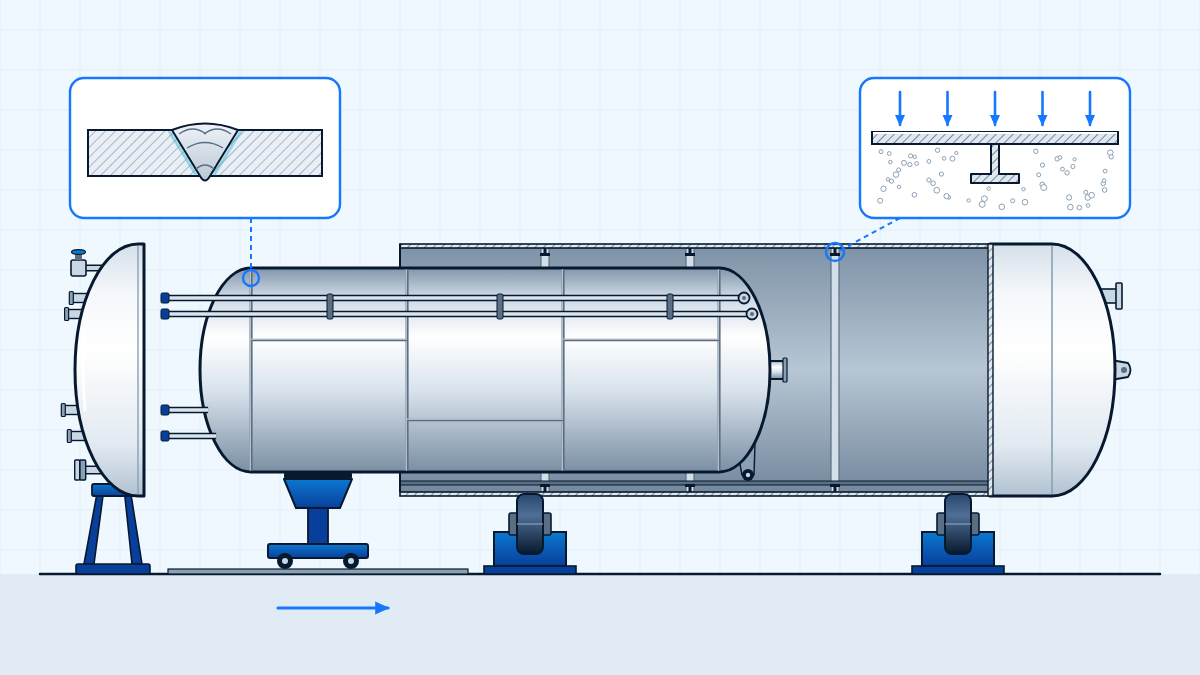
Every cryogenic storage tank is two vessels in one: an inner pressure vessel that lives at −196 °C, and an outer jacket that keeps the world away from it. Cryogenic pressure vessel design is the discipline of making that pair safe for decades — and for a buyer, knowing its outline is the difference between comparing offers on price and comparing them on substance. This is the buyer’s view of how these vessels are designed, and which documents prove it was done right.
The design problem: pressure plus deep cold
A cryogenic vessel carries the same membrane stresses as any pressure vessel, but at a temperature where ordinary carbon steel becomes brittle. The inner vessel must therefore be built from materials that keep their toughness at cryogenic temperature — austenitic stainless steels (304/316) for standard tanks, 9% nickel steel for large LNG service — and every material choice must be proven by impact testing at design temperature. The outer jacket, which stays near ambient, can be carbon steel; its job is to carry the vacuum, the wind and the piping loads.
The codes that govern the calculation
Wall thickness, nozzle reinforcement, weld factors and test pressures all come from the governing code, and the code comes from the destination market: ASME Section VIII for the USA and U-Stamp markets, EN 13458 with the PED for Europe, GB 150 / GB/T 18442 for Chinese domestic designs. The codes differ in margins and procedure but agree on the essentials: calculated thickness with corrosion and forming allowances, qualified welding, non-destructive examination, and a witnessed pressure test. A vessel is not “roughly to code” — it is designed, built and certified to one specific edition of one specific code.
Insulation and the vacuum as structure
Between the inner vessel and jacket sits the insulation space: vacuum with perlite powder for standard storage tanks, multilayer insulation (MLI) for smaller high-performance vessels. Design-wise the vacuum is not passive — the jacket must resist full external pressure, the inner vessel supports must carry the cold mass while conducting almost no heat (composite or stainless straps), and every penetration — fill, drain, gauge lines, safety devices — is a designed heat leak that the evaporation-rate figure ultimately pays for.
Relief devices are part of the design, not accessories
Cryogenic liquid trapped in a warming enclosed volume can generate dangerously high pressure, so the code requires a relief chain sized for the worst credible case, including loss of vacuum: safety valves plus bursting discs, with capacity calculations documented in the data book. When a vessel is refurbished or repurposed, the relief sizing must be revisited — a point covered in our guide to cryogenic tank repair and refurbishment.
What a buyer should ask to see
Five document sets separate a certified vessel from a welded shell. The design dossier: code edition, design pressure and temperature, MAWP. Material certificates (EN 10204 3.1) tracing every pressure-bearing plate and nozzle to a heat number. Welding qualifications: WPS/PQR procedures and welder certificates. NDE records: radiographic or dye-penetrant reports matching the code’s coverage. And the final data book: pressure-test certificate, nameplate details, relief-device sizing. If a factory cannot produce these for a specific vessel, the price difference is not a bargain — the full checklist logic is in our tank specification and selection guide.
What Cryofortune supplies
Cryofortune is a sourcing and engineering supplier, not a factory: for each order we match a vetted Chinese manufacturer to the destination market’s code — ASME, PED/TPED or GB — and confirm the design dossier, material traceability and certificate pack before production starts. The result is a vertical or horizontal vessel whose paperwork stands inspection in the country where it will operate.
Cryogenic vessel design: common questions
What materials are used for cryogenic pressure vessels?
The inner vessel uses materials that stay tough at cryogenic temperature — austenitic stainless steels such as 304/316, or 9% nickel steel in large LNG service — verified by impact tests. The outer vacuum jacket, staying near ambient, is normally carbon steel.
Which design codes apply?
ASME Section VIII in the USA and U-Stamp markets, EN 13458 under PED/TPED in Europe and the UK, and GB 150 / GB/T 18442 in China. The destination country decides the code, and the vessel is certified to one specific code and edition.
Why is the vacuum part of the structural design?
Because the outer jacket must resist full external atmospheric pressure when evacuated, and the inner-vessel supports must carry the full cold mass while conducting almost no heat. Loss of vacuum is also the sizing case for the relief devices.
What documents prove a vessel was designed correctly?
The design dossier with code and MAWP, 3.1 material certificates, WPS/PQR welding qualifications, NDE reports, and the final data book with the pressure-test certificate and relief-device sizing.