
A cryogenic loading skid is the piece of equipment that moves liquid nitrogen, oxygen, argon, LNG or CO2 between a road tanker or ISO container and a storage tank, and it is the part of a gas plant that most often gets specified last and regretted first. A skid that is undersized turns a forty-minute unloading into a three-hour one; a skid without proper metering starts arguments with every delivery; a skid without cooldown and purge logic eats pump seals. This guide explains what sits on a loading skid, how pump transfer differs from pressure transfer, how to size the flow for a real tanker turnaround, and which safety and metering requirements a buyer has to state before asking for offers.
What a cryogenic loading skid does
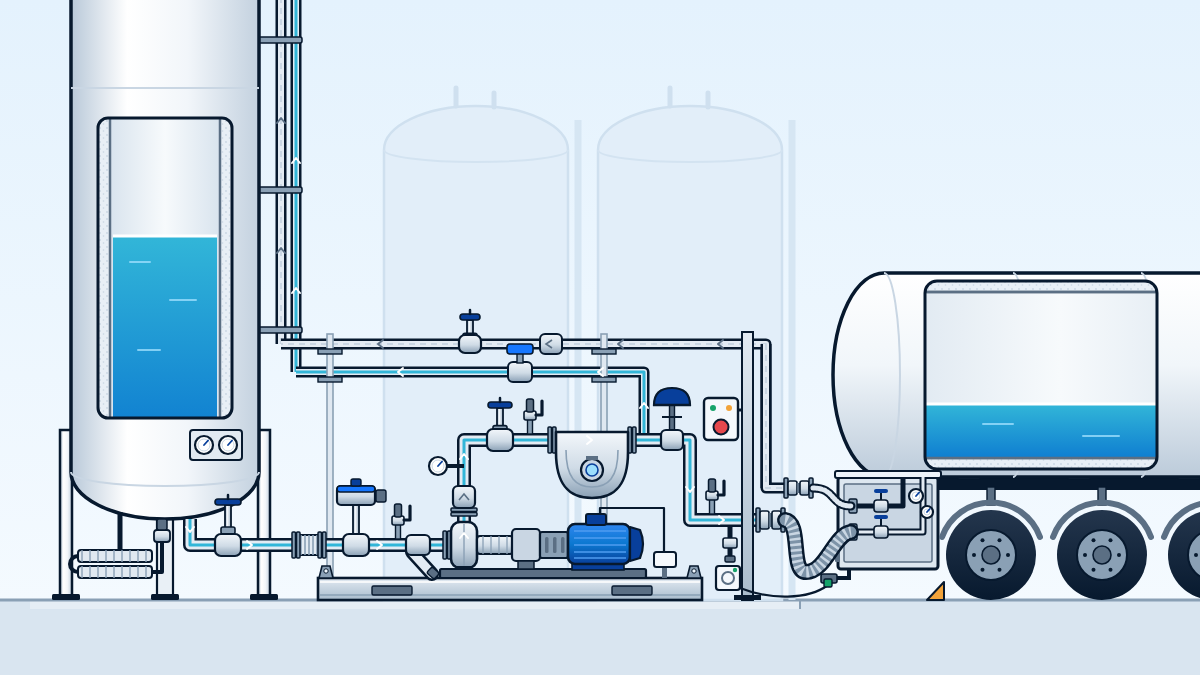
The skid is a pre-piped, pre-wired frame that connects two vessels through a controlled transfer path. In an unloading duty the liquid moves from a tanker or T75 ISO container into a fixed storage tank; in a loading duty the direction reverses and the plant fills tankers, ISO containers or large liquid cylinders from its own bulk storage. The same frame usually handles both, with the pump suction and discharge manifolds valved so the operator selects direction without breaking connections. Because everything is mounted, tested and documented as one unit at the factory, the site work reduces to setting the frame on a pad, connecting the storage tank, the utilities and the hose station, and commissioning.
Pump transfer or pressure transfer
Two common methods of transferring cryogenic liquid are pressure transfer and pump transfer. Pressure transfer raises the pressure in the source vessel, using its pressure-build vaporizer, until the differential pushes liquid into the receiving tank. It is simple and has no rotating equipment, but it is slow, it warms the product, and it vents gas at the receiving end. Pump transfer uses a cryogenic centrifugal pump to lift the liquid, keeps both tanks near their normal operating pressure and reaches flows of 10 to 100 m3/h with almost no product loss. A skid is the pump-transfer solution: the pump, its cooldown and recirculation lines, the vapor return and the instrumentation are what justify building a skid at all. Sites that only receive one small delivery a week sometimes stay with pressure transfer; sites that turn tankers daily, fill ISO containers or sell by the tonne almost always need the pump.
The components on the frame
A complete loading skid carries a fixed set of items, and a quotation that omits any of them should be read carefully:
- Cryogenic transfer pump: a submerged-motor or externally driven centrifugal pump in stainless steel or bronze, with the impeller and seal design matched to the product; centrifugal transfer pumps for loading skids are sourced per project to the required flow and head (for high-pressure reciprocating pumps, see our cryogenic pump page).
- Suction strainer and filters: to protect the impeller from weld spatter and tanker debris on the first deliveries.
- Cooldown and recirculation line: returning cold vapor and liquid to the source tank so the pump is cold and primed before the discharge valve opens.
- Vapor return line: equalizing pressure between the vessels so the receiving tank does not vent product to atmosphere while it fills.
- Flowmeter: a Coriolis mass meter for custody transfer, a temperature-compensated turbine meter (also MID and OIML approved, and the traditional choice on delivery tankers), or an uncertified turbine meter for internal accounting.
- Hose station or loading arm: vacuum-insulated hoses for smaller flows, articulated loading arms for LNG and high-throughput terminals.
- Valves, relief and instrumentation: cryogenic globe and check valves, thermal relief on every section that can trap liquid, pressure and temperature transmitters, and a local control panel.
- Drive and control: a motor with soft start or variable frequency drive, and interlocks that will not let the pump run dry or start warm.
Sizing the skid for a real turnaround
The single number that defines a loading skid is the flow rate, and it is derived from turnaround time rather than from the pump catalogue. A 20 m3 tanker unloaded at 25 m3/h pumps out in about 50 minutes and occupies the bay for roughly an hour and a quarter including connection, cooldown and purge; the same tanker on a 10 m3/h skid occupies the bay for two and a half hours, and on a busy site that means a second bay. The pump curve then has to deliver that flow at the head the installation demands: the pressure difference between the vessels, the elevation from the tanker outlet up to the tank inlet, and the friction loss through the meter, valves and hose. Cryogenic pumps are sensitive to net positive suction head, so the source vessel pressure, the liquid level and the subcooling at the pump inlet all belong in the datasheet; a pump that cavitates on the last cubic meters of every tanker will not last its first year. Product matters too: LNG duty adds hazardous-area equipment and static control, oxygen duty imposes cleanliness and material limits, and CO2 at 15 to 20 bar sits in a different pressure class from nitrogen at 2 to 4 bar.
Metering and custody transfer
If the liquid crossing the skid is bought or sold on the meter reading, the meter normally comes under legal metrology control. Coriolis mass flowmeters are the usual choice for cryogenic custody transfer because they measure mass directly, unaffected by the density change as the liquid warms in the line; reference accuracies of 0.1 to 0.2 percent of reading are quoted on the calibration liquid, while the legal accuracy class for cryogenic measuring systems under MID and OIML R 117 is a much looser class 2.5. In the EU the measuring system is approved under the Measuring Instruments Directive (MI-005) and the international recommendation OIML R 117. Other markets have their own legal-metrology regimes, and the buyer must state which one applies before the skid is designed, because it decides the meter, the flow computer, the sealing points and the calibration documents. For internal plant accounting an uncertified turbine meter or even a tank-level difference is acceptable and far cheaper.
Safety functions that belong on every skid
A loading operation means a person standing next to a hose full of liquid at minus 196 degrees Celsius, so the skid carries its own protection. An emergency shutdown circuit stops the pump and closes the isolation valves from a button at the bay and from the control room. Breakaway couplings on the hose or arm part cleanly if a tanker drives off connected. Every pipe section between two valves has a thermal relief valve, because trapped cryogenic liquid warming to ambient generates pressures no pipe survives. Grounding and bonding are mandatory for LNG and good practice for everything else. Oxygen skids are degreased, oxygen-clean and built from compatible materials throughout. A nitrogen purge connection lets the operator dry the line before the first cooldown and after maintenance. None of these are options; a buyer comparing quotations should confirm each one is present rather than assume it.
Codes and the document set
The pressure-bearing parts of a loading skid follow the pressure-equipment code of the destination country: ASME B31.3 piping and Section VIII vessels for North America, PED with EN 13480 piping in the EU, GB codes in China, with the transportable side of the interface governed by ADR, TPED or DOT rules. LNG skids add hazardous-area certification for the electrical equipment as the destination requires: ATEX in the EU, IECEx internationally, or NEC and CEC listings in North America. The document pack at delivery should include the piping and instrumentation diagram, the pump curve and datasheet, material certificates for pressure parts, weld records and non-destructive examination reports, the pressure and leak test certificates, the meter calibration certificate, and the electrical and control drawings. The same discipline applies to the storage tank on the other end, described in our tank installation guide.
What Cryofortune supplies
Cryofortune sources cryogenic loading and unloading skids from Chinese manufacturers whose pumps, piping and controls we have verified on delivered projects, and configures each skid to the product, the flow, the metering regime and the destination code. We supply the skid alone or together with the storage tank, the ISO container fleet and the vaporizers that make up a complete liquid-handling installation, and we check the datasheet against the site’s actual tanker sizes and turnaround targets before the manufacturer releases the order to production. The wider picture of how these packages fit into a gas plant is on our gas filling systems page. Availability and applicability of any standard, certificate, marking or registration procedure are confirmed for the specific manufacturer, model and order before production.
Cryogenic loading skids: common questions
What is a cryogenic loading skid?
A pre-assembled, skid-mounted unit that transfers cryogenic liquid between a tanker or ISO container and a storage tank. It carries the transfer pump, cooldown and vapor-return piping, a flowmeter, hose or arm connection, relief valves and controls on one frame, tested and documented before it leaves the factory.
How fast can a tanker be unloaded with a pump skid?
Typical cryogenic loading skids run at 10 to 100 m3/h. At 25 m3/h a 20 m3 tanker pumps out in roughly 50 minutes, about an hour and a quarter of bay time including connection, cooldown and purge, compared with two to three hours by pressure transfer.
Which flowmeter is used for cryogenic custody transfer?
Coriolis mass flowmeters, because they measure mass directly and are unaffected by density change as the liquid warms. For legal trade the whole measuring system is approved under the local metrology regime, such as MID MI-005 and OIML R 117 in the EU.
Can one skid serve nitrogen, oxygen and argon?
Nitrogen and argon can share a skid with a purge between products. Oxygen requires oxygen-clean, compatible materials and is normally kept on its own skid; LNG and CO2 need their own designs because of hazardous-area rules and a different pressure class.