The Philippines belongs to the regional pattern described in our guide to cryogenic equipment for Southeast Asia: an internationally accepted design code answers how the vessel is built, and a national gate answers whether it may operate. What sets the Philippine market apart is where that gate sits — inside workplace-safety law administered by the Department of Labor and Employment rather than a stand-alone pressure-equipment act — and the language the whole process runs in, which is English from the first specification to the final permit filing.
Cryofortune Engineer & Supply Co., Ltd. is an international sourcing and engineering supplier working from a network of vetted Chinese manufacturers. We are not a factory. For each Philippine order we select the manufacturer to fit the vessel class and the code requirement, engineer the specification around the site, and assemble the manufacturer’s documentation file around the buyer’s registration route. This page covers the equipment, the DOLE layer, the design-code question and the practicalities of moving pressure equipment across an archipelago. Other markets are covered in our country directory.
Cryogenic equipment supplied to Philippine buyers
Philippine orders draw on the same core equipment classes as the rest of the region:
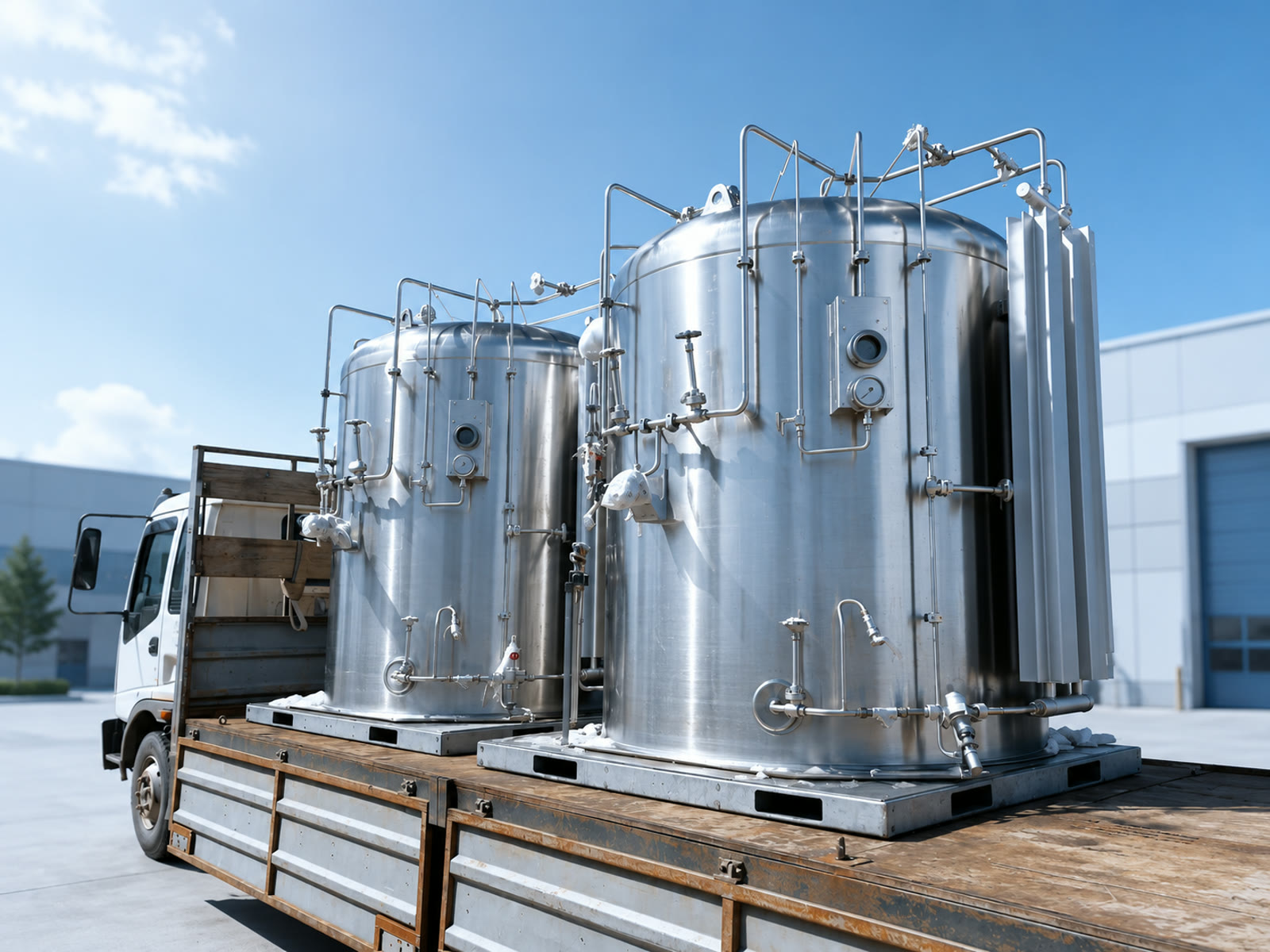
- Cryogenic storage tanks — vacuum-insulated vessels for liquid oxygen, nitrogen, argon and carbon dioxide, vertical or horizontal, sized to the site’s consumption profile rather than to a catalogue default.
- Cryogenic vaporizers — ambient-air and heated units that turn stored liquid into process gas. The warm, humid climate favors ambient vaporization year-round, though sustained draws still need sizing that respects humidity-driven frost build-up.
- Cryogenic liquid cylinders — portable vessels for hospitals, laboratories, food plants and workshops where a fixed tank is not yet justified, and a practical format for distribution beyond the main industrial islands.
- Industrial pressure vessels — air receivers, buffer vessels and other unfired equipment that accompanies a gas installation.
Every item is built by a specific, named manufacturer selected for that order. Capacities, working pressures and materials are fixed in the technical annex of the contract. We do not quote generic figures here, because the certificate that ships with a vessel names a specific factory, model and serial number — and the specification has to match that certificate, not a brochure.
Pressure vessels under DOLE and the OSHS
In the Philippines, pressure equipment in workplaces is governed through the Occupational Safety and Health Standards (OSHS), administered by the Department of Labor and Employment (DOLE). The OSHS contains the chapters that deal with boilers and unfired pressure vessels: permits or registration for the equipment, inspection before it is placed in service, and periodic inspection during its working life.
Two features of this arrangement matter to an importer. First, the obligations attach to the employer operating the equipment: the permit, the inspections and the registration run through the operator’s side, using DOLE’s technical safety machinery — they are not something a foreign supplier can file for. Second, the fine detail — how inspections are conducted and what is delegated to accredited local practitioners — has evolved over the years and continues to evolve. We treat the Philippine gate the way we treat every national gate: current requirements are confirmed for each order with the buyer’s Philippine consultant or safety officer before production starts, not assumed from a summary, including this one.
The division of labor is consistent with every market we serve. Cryofortune arranges the manufacturer’s side of the file — design calculations, material certificates, weld and test records, the manufacturer’s certification for the specific vessel. The statutory steps inside the Philippines — filings, inspection appointments, the permit to operate — belong to the buyer, the importer of record or their local representative. We support those steps with documentation; we do not perform them.
ASME Section VIII: the natural import language
Philippine mechanical-engineering practice is historically American in orientation, and ASME Section VIII is the pressure-vessel code that Philippine engineers, consultants and inspectors read most fluently. For an imported cryogenic vessel this makes ASME the natural language of the order: the calculation set, the nameplate logic and the test records arrive in a format the reviewing engineer already knows how to check.
Factories in our network differ in what they hold. Some carry ASME certification; others build to ASME methodology, or to GB or EN codes, with full supporting documentation. Which route a Philippine order takes depends on what the buyer’s registration path actually requires — a question we put to the buyer’s Philippine side in writing before the manufacturer is fixed, because code certification belongs to a specific factory and a specific vessel, never to a brand and never to a supplier’s letterhead.
An English-language market
The Philippines conducts business and regulation in English. Contracts, technical submissions, DOLE paperwork and correspondence with inspectors run in English as a matter of course. For an equipment import this removes a layer of friction that exists almost everywhere else in the region: manuals do not wait for translation, certificates are read as issued, and questions between the buyer’s engineer and the manufacturer’s engineer pass through our project team without a translation step in either direction. Among the markets covered in our regional guide, the Philippines offers the smoothest documentation path for precisely this reason.
Archipelago logistics: plan for the last island
The second Philippine particularity is geography. The country is an archipelago of more than seven thousand islands, and a delivery rarely ends at the port of discharge. A tank landed at Manila or Batangas may be destined for Cebu, Iloilo, Davao or a provincial estate reached by inter-island vessel and regional road — and every additional lift and sea leg is a handling event for a vacuum-insulated vessel.
This is why containerised and ISO-frame formats carry particular weight in Philippine orders. Equipment engineered to move inside or as a standard container passes through the main ports with ordinary container handling, transfers to inter-island shipping without special rigging, and arrives with its insulation system undisturbed. Our 20ft cryogenic ISO tank container guide covers the format in detail, and the same logic — frame protection, standard corner castings, no out-of-gauge handling — extends to smaller vessels shipped containerised. We plan packing, lifting points and delivery terms around the final island, not the first port.
Where Philippine demand comes from
Enquiries from the Philippines concentrate in four sectors:
- Food processing and cold chain — carbon dioxide and nitrogen for chilling, freezing and packaging, plus the storage tanks behind them, in an island geography where cold-chain capacity is being extended port by port.
- Electronics and semiconductor assembly — the Philippines hosts a substantial semiconductor assembly-and-test and electronics export industry, a steady consumer of nitrogen for soldering, ovens and inerting, typically fed from liquid-nitrogen storage with vaporizers.
- Shipbuilding and metal fabrication — shipyards, ship repair and steel fabrication consume oxygen, fuel gases, argon and welding mixtures, supplied from cylinders or bulk storage depending on scale.
- Healthcare — hospital liquid-oxygen storage and backup capacity remains an investment priority after the pandemic exposed gaps in provincial oxygen supply. Where the gas itself is medical, the medicines-regulatory layer is separate from the pressure-vessel question and is confirmed on the buyer’s side.
How the manufacturer is selected
Because Cryofortune supplies from a network rather than a single plant, the first engineering decision on a Philippine order is which factory builds it. The selection weighs the code requirement, the vessel class, the factory’s export record and its current audit standing; the process is described step by step in how Cryofortune selects a manufacturer. The commercial mechanics — contract, production inspection, pre-shipment testing and shipment — are set out in our guide to importing cryogenic equipment from China.
The documentation file
A Philippine order ships with a manufacturer’s documentation file assembled for the buyer’s registration route. Depending on the vessel and the agreed code, it typically includes:
- Design calculations and drawings to the agreed design code.
- Material certificates for pressure-bearing components.
- Welding and non-destructive-examination records.
- Pressure-test and leak-test reports from the factory.
- The manufacturer’s certificate of conformity for the specific vessel and serial number.
- Operating and maintenance manuals in English.
- Commercial and shipping documents for Philippine customs entry.
All certificates are issued in the manufacturer’s name for the specific vessels in the order. That is not a limitation of our model; it is how pressure-equipment certification works, and treating it honestly from the first offer is what keeps the DOLE-side registration unsurprising later.
Starting a Philippine enquiry
To begin, send the medium (oxygen, nitrogen, argon, carbon dioxide or LNG), the required capacity, the working pressure, and the island and site where the equipment will operate — in the Philippines the site determines the delivery chain, so it belongs in the first message rather than the last. Reach us through the contact page. We respond with candidate manufacturers, a draft specification and a documentation plan matched to your registration route.
Availability and applicability of any standard, certificate, marking or registration procedure are confirmed for the specific manufacturer, model and order before production.