
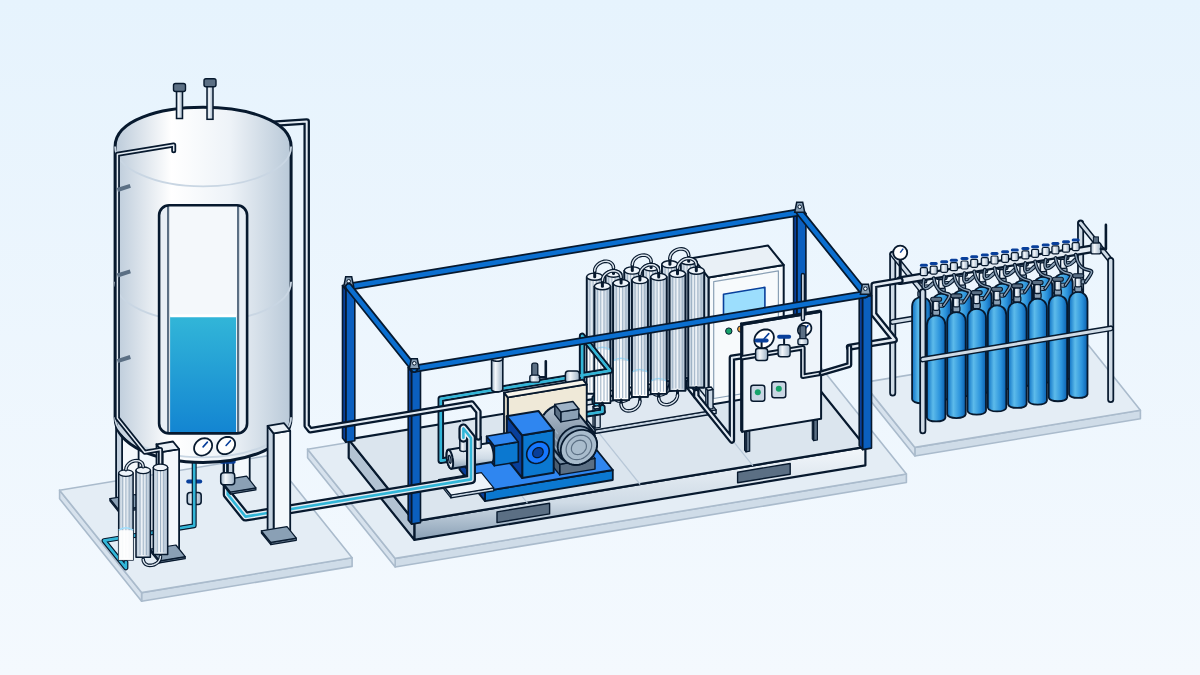
A cylinder filling module is a packaged, factory-assembled unit that takes cryogenic liquid from a storage tank and fills high-pressure gas cylinders with it: a piston pump, a high-pressure vaporizer, a filling manifold and the controls, mounted on one frame and tested as a system. It is how many new oxygen, nitrogen, argon and CO2 filling stations are built today, because it replaces weeks of site piping with a unit that arrives working. This guide explains what the module contains, how the liquid-to-gas route differs from liquid-to-liquid filling, how to size it in cylinders per hour rather than in pump litres, and what changes when the product is oxygen or CO2.
Why a module instead of a stick-built station
A filling station built piece by piece on site requires a pump foundation, a separately purchased vaporizer, field-welded high-pressure piping, individual valves, gauges and relief devices, and a commissioning engineer who reconciles all of it. A module moves that work into a factory: the pump is aligned on the frame, the high-pressure piping is welded, tested and certified once, the manifold and instrumentation are wired to one panel, and the whole assembly is pressure-tested before shipment. On site the module needs a pad, a liquid supply line from the tank, power, and the cylinder ramps. For a buyer sourcing internationally, the module also simplifies compliance, because one manufacturer owns the design, the test certificates and the document pack for the complete pressure system rather than four suppliers owning a quarter each.
Two filling routes: liquid-to-gas and liquid-to-liquid
High-pressure cylinders at 150 to 200 bar are filled by the liquid-to-gas route. A reciprocating cryogenic piston pump draws liquid from the storage tank and raises it to the filling pressure while it is still liquid, which takes a fraction of the energy that a gas compressor would need; a high-pressure vaporizer then turns the pressurized liquid into ambient-temperature gas, and the manifold distributes that gas to the cylinders. Liquid cylinders and dewars, by contrast, are filled with liquid directly from the tank by pressure transfer or a small centrifugal pump, with no vaporizer at all. A complete filling plant usually has both routes, and the module is the high-pressure one; the liquid route is covered on our liquid cylinder pages.
What the module carries
- Cryogenic piston pump: the reciprocating pump that sets the filling pressure and the throughput; our cryogenic cylinder filling pump page lists the 800 and 1,000 L/h DYB200 classes, and our cryogenic reciprocating pump page covers smaller classes from about 50 L/h, and our guide on how to choose a cylinder filling pump covers the selection in detail.
- High-pressure ambient vaporizer: finned aluminum tubes rated for the full filling pressure, sized so the gas leaves warm even at the end of a long shift; a steam or electric trim heater is added where the climate or the duty demands it.
- Filling manifold: the header with individual cylinder connections, isolation valves, a master pressure gauge and a relief device, arranged in ramps of typically 10 to 20 cylinders.
- Pressure control and interlocks: a pressure switch that stops the pump at set pressure, a low-suction-pressure or cavitation interlock, and a low-temperature trip on the vaporizer outlet that stops the pump if the gas leaves too cold for the downstream piping and cylinders, plus a high-temperature cut-out on any electric or steam trim heater.
- Purge and vent: connections to evacuate or purge the manifold between batches and to vent residual gas safely.
- Frame, drip tray and panel: a stainless or painted-steel frame with lifting points, a local control panel, and drip protection under the cold parts.
Sizing in cylinders per hour
Buyers who specify a filling module by pump flow alone usually end up either paying for capacity they never use or queuing cylinders on the ramp. The right sequence starts from the required output. One litre of liquid nitrogen yields roughly 0.69 standard cubic metres of gas, liquid oxygen about 0.85 and liquid argon about 0.84. A 40-litre cylinder at 150 bar holds about 6 standard cubic metres, and at 200 bar around 8 once real-gas behaviour is included. A pump delivering 200 litres of liquid nitrogen per hour therefore produces around 140 standard cubic metres of gas, or roughly 23 cylinders per hour at 150 bar, before any allowance for cooldown, ramp changeover and the last-bar slowdown that every filler experiences. Working backwards from a shift target of, say, 300 cylinders in eight hours gives about 40 cylinders per hour, which points to a pump in the 350 to 400 litres per hour class and a vaporizer rated for the matching gas flow with margin for winter. The storage tank behind the module has to sustain that draw, which is where the tank sizing in our guide to liquid nitrogen tank sizes comes in.
CO2 filling is different
CO2 cylinders are filled with liquid, not gas, and by weight, not pressure. The liquid CO2 comes from a refrigerated storage tank at around 15 to 20 bar, and a CO2 filling module uses a pump to push subcooled liquid into cylinders sitting on scales, stopping each fill at the permitted weight so that the cylinder is never liquid-full at ambient temperature. Instead of a high-pressure vaporizer the module needs a subcooler or vapour-return line at the pump suction, keeping the liquid below its saturation temperature so the piston pump does not cavitate; a CO2 heater belongs on the vapour side for tank pressure-building or gas draw-off, not on the liquid feeding the pump. The manifold is built around the scales. A buyer asking for a cylinder filling module has to say whether CO2 is in scope, because the pump, the piping class and the control philosophy all change.
Oxygen service and mixed-gas stations
An oxygen filling module is oxygen-clean from the pump to the manifold, uses copper alloys and other compatible materials in the high-pressure section, avoids adiabatic compression hazards through slow-opening valves and correct velocity limits, and is kept physically separate from fuel-gas filling. Nitrogen and argon can share a module with a documented purge between products; oxygen generally gets its own. Where the station also fills shielding-gas mixtures, a gas mixer with a buffer tank sits upstream of the manifold, as explained in our article on welding shielding gas mixing. The cylinders themselves, their valves and their periodic inspection follow the destination country’s cylinder rules; our high-pressure gas cylinder page lists the common standards.
LPG is a separate duty with its own equipment: LPG cylinders are filled by weight at dedicated filling posts, where an electronic filling scale stops each fill at a preset mass. That filling-post equipment is covered on the LPG cylinder filling page.
Standards and documentation
The high-pressure piping and the vaporizer follow the pressure code of the destination: ASME B31.3 and Section VIII in North America, PED with EN 13480 in the EU, GB codes in China. Filling practice itself follows the industrial-gas association guidance that applies in the market, published by EIGA in Europe and CGA in North America, and the local occupational-safety rules for filling rooms and cylinder handling. The document set should include the piping and instrumentation diagram, the pump and vaporizer datasheets, material certificates for pressure parts, weld and non-destructive examination records, the system pressure-test certificate, the oxygen-cleaning certificate where applicable, and electrical drawings. A module that arrives without that pack cannot be signed off by an inspector, however well it is built.
What Cryofortune supplies
Cryofortune sources cylinder filling modules from Chinese manufacturers whose piston pumps and high-pressure vaporizers we have verified on delivered stations, and configures each module to the product, the cylinders-per-hour target, the filling pressure and the destination code. We supply the module alone or as part of a complete filling plant with the storage tank, the liquid cylinder filling point, the gas mixer and the dry-ice line where required, and we check the pump class against the shift target before the manufacturer releases the order to production. The layout of a full station is described on our gas filling systems page.
Cylinder filling modules: common questions
What is a cylinder filling module?
A factory-assembled unit that fills high-pressure gas cylinders from cryogenic liquid: a piston pump raises the liquid to filling pressure, a high-pressure vaporizer turns it into gas, and a manifold distributes it to the cylinders, all mounted, wired and tested on one frame.
How many cylinders per hour can a filling module fill?
It depends on the pump class. A 200-litre-per-hour liquid nitrogen pump yields about 140 standard cubic metres of gas, roughly twenty-three 40-litre cylinders per hour at 150 bar; a 400-litre-per-hour pump roughly doubles that. Allow margin for cooldown, ramp changeover and the slow final bars.
Can the same module fill oxygen and nitrogen?
Nitrogen and argon can share a module with a purge between products. Oxygen normally gets its own oxygen-clean module built from compatible materials and kept separate from fuel gases, in line with EIGA and CGA practice.
Does a CO2 filling module need a vaporizer?
No. CO2 cylinders are filled with liquid by weight from a refrigerated tank at 15 to 20 bar, so the module uses a pump, a subcooler at the pump suction to prevent cavitation, and scales under the cylinders instead of a high-pressure vaporizer; a CO2 heater is used only on the vapour side for tank pressure-building.